By L K Monu Borkala · Tracking Karnataka admissions since 2006 · Checked against primary records on 13 November 2026
At a glance
Three admission routes named on the earlier version of this page do not exist. There is no PGCET Law, no KCET law quota, and no Symbiosis Law School in Bangalore. A graduate following that advice would have sat two examinations that do not admit to law and applied to a law school that is not in this state.
What does exist is simpler. CLAT for the National Law Universities, the institution's own test at private and deemed universities, and plain merit on your qualifying degree marks for the three-year LLB at colleges affiliated to Karnataka State Law University.
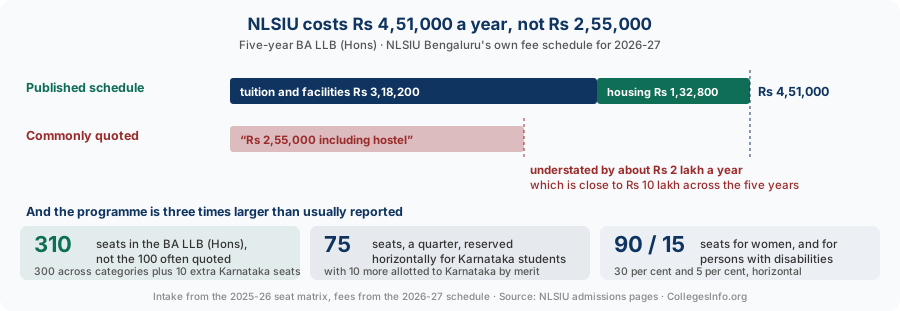
NLSIU costs Rs 4,51,000 a year including housing and admits 310, with 75 of those seats, a quarter, reserved horizontally for Karnataka students. The earlier version said Rs 2.25 lakh and 100 seats, understating the cost by about Rs 11 lakh across the five years.
Bar Council of India approval is the check that decides whether the degree works. Enrolment as an advocate depends on it, the Karnataka State Bar Council has refused enrolment where a course lacked it, and the approved list is not always current.
This page was rebuilt on 13 November 2026 after an audit found that its central advice pointed readers at examinations that do not cover law. Everything below is written from primary records: NLSIU's own admissions and fee pages, the Karnataka Examinations Authority's notification of what PGCET actually covers, CHRIST's and Alliance University's own disclosures, the Consortium of NLUs on CLAT, and the Bar Council of India approval position as reported in September 2026. Figures that could not be traced to a record of that kind have been removed rather than rounded.
The three routes that do not exist
This is the most consequential part of the audit, because the errors were not small and they were repeated with confidence.
There is no PGCET Law. The earlier version mentioned "Karnataka PGCET" nine times and devoted a question to it: "PGCET Law is for 3-year LLB admission in Karnataka for graduates. Conducted by KEA. Government and government-aided law colleges admit through PGCET." The Karnataka Examinations Authority's PGCET notification covers MBA, MCA, M.E. and M.Tech, and M.Arch. Law is not among them, and never has been. A graduate who registered for PGCET on this advice would have sat a management or engineering aptitude paper.
There is no KCET law quota. The earlier version stated that "KEA conducts counselling for KSLU-affiliated law colleges using KCET scores", and listed "KCET Law" as the admission route for four named colleges. KCET is the Karnataka Common Entrance Test for engineering, architecture, pharmacy and the medical stream. It does not admit to the LLB.
There is no Symbiosis Law School in Bangalore. It appeared in the earlier version's ranked table of Karnataka law colleges, as "Symbiosis Law School Bangalore, Bengaluru, Symbiosis International University, SLAT entrance". Symbiosis Law School has campuses at Pune, Noida, Hyderabad and Nagpur. Symbiosis does have a Bengaluru presence, but it is a management school, not a law school. The same page separately carried a section placing Symbiosis Law School correctly in Pune, so one institution was listed in two cities, one of which has no law campus.
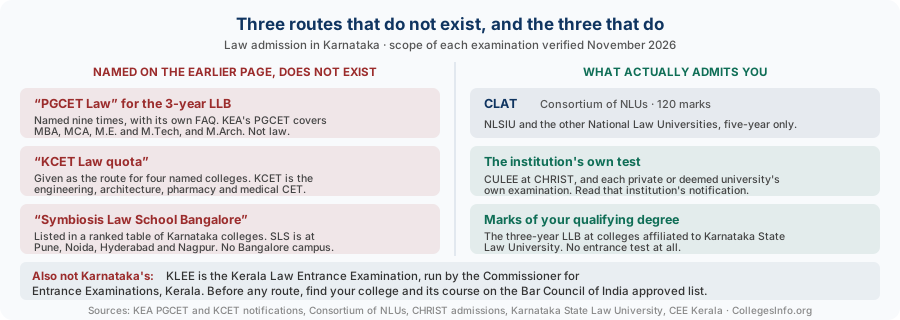
One more, inherited from the same family of pages: KLEE is the Kerala Law Entrance Examination, conducted by the Commissioner for Entrance Examinations, Kerala. It is not a Karnataka examination, and our Mangalore law colleges guide is next in line for the same correction.
How law admission in Karnataka actually works
There are three routes, and which one applies depends on the kind of institution rather than on the district.
| Institution | Route | Programme | Who runs it |
|---|---|---|---|
| NLSIU and other National Law Universities | CLAT | Five-year integrated only | Consortium of NLUs |
| CHRIST (Deemed to be University) | CULEE, its own law entrance examination | Five-year integrated and three-year LLB | The university |
| Alliance University and other private universities | The institution's own test | Varies by institution | The university |
| Colleges affiliated to Karnataka State Law University | Merit on your qualifying degree marks | Three-year LLB | The college, under KSLU rules |
| Anywhere in Karnataka | Not PGCET, not KCET, not KLEE | – | – |
For the three-year LLB the usual minimum is a bachelor's degree in any discipline with 45 per cent, relaxed for reserved categories, and notifications generally open around the middle of the year. CHRIST's route is worth naming precisely because the abbreviation misleads: it is CULEE, the Christ University Law Entrance Examination, not the national Common University Entrance Test and not CLAT.
NLSIU, with the published numbers
NLSIU Bengaluru is the first National Law University in India, established in 1987, and sits first in the NIRF law ranking. The figures below come from its own admissions and fee pages.
| Item | Earlier version said | Published record |
|---|---|---|
| Annual fee | Rs 2.25 lakh including hostel | Rs 4,51,000, being Rs 3,18,200 tuition and facilities plus Rs 1,32,800 housing |
| Cost across five years | Rs 11.25 lakh | About Rs 22.5 lakh at current rates |
| Intake | 80 all-India plus 20 Karnataka domicile | 310, being 300 across categories plus 10 additional Karnataka seats |
| Karnataka students | 20 seats | 75 seats, 25 per cent, horizontal and compartmentalised, plus 10 more by merit |
| Other horizontal reservation | Not mentioned | 90 seats for women, 15 for persons with disabilities |
| One-time charges | Not mentioned | Admission fee Rs 13,900; refundable deposit Rs 18,800 for SC and ST, Rs 23,700 for others |
The cost error is the one that changes decisions. Understating an annual fee by about Rs 2.26 lakh understates the five-year commitment by roughly Rs 11 lakh, which is the difference between a manageable education loan and an unmanageable one. The seat error cuts the other way and is worth knowing: at 310 seats with a quarter held for Karnataka students, NLSIU is more reachable for a candidate schooled in the state than a national rank table implies.
The earlier version also carried three different cutoff claims in the same article: that the all-India range was rank 1 to 70 with Karnataka domicile 70 to 200, that "only the top 100 CLAT scorers nationally access NLSIU", and that "you need a CLAT rank under 100". None was sourced and none is reconcilable with a 310-seat programme, so no cutoff figure appears here. For a rank-based view, read the official CLAT result and counselling data for the year you are applying in.
Bar Council of India approval, and why it comes first
A law degree takes you to the Bar only if the course was approved by the Bar Council of India. Approval goes to a Centre of Legal Education for particular courses and has to be extended periodically. Where it is missing the cost falls on the student: the Karnataka State Bar Council has refused to enrol graduates as advocates because their college's course lacked BCI approval.
The renewal cycle does slip. Centres of Legal Education had to apply to extend approval for the 2026-27 session, upload their university's affiliation order and pay the fee. The original deadline of 31 December 2025 was extended five times, to 16 January, 5 March, 31 July, 31 August and finally 15 September 2026. As reported on 18 September 2026, that fifth deadline passed with NLSIU Bengaluru and Tamil Nadu National Law University still not on the approved list, while Gujarat NLU had secured approval.
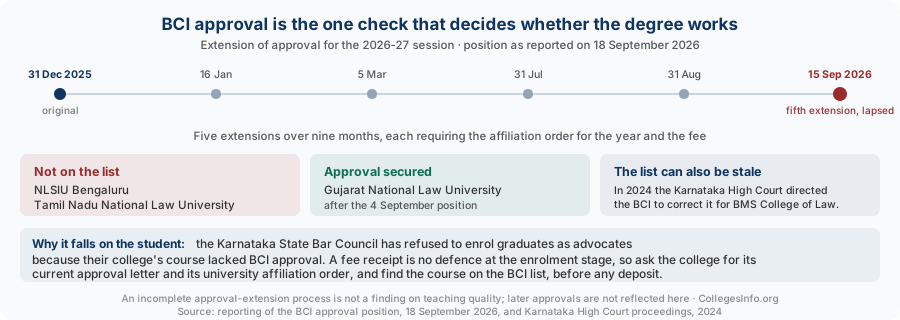
That describes an approval-extension process that had not completed by that date. It is not a finding that teaching is deficient or that existing degrees are void, and this page cannot confirm what was recorded afterwards, which is the reason to look rather than assume. The list can also be stale in the other direction: in 2024 the Karnataka High Court directed the BCI to review and correct it in a case brought by BMS College of Law, whose entry showed affiliation only up to an earlier year.
The useful habit is to ask the institution to show you its approval. Alliance University, for example, states on its own law pages that Alliance School of Law is approved by the Bar Council of India. A college that cannot point to the equivalent for your course and your year has not answered the question.
Karnataka State Law University, the affiliating body
Most law colleges in Karnataka that are not themselves universities sit under Karnataka State Law University, established in January 2009 by the Government of Karnataka with jurisdiction over the whole state. More than 100 colleges were affiliated to it as of the most recent published count.
That number corrects something on the earlier version, which told readers the state has "60-plus law colleges". It also matters for a practical reason. On a page listing colleges, the affiliating university is often given from memory, and the earlier version contradicted itself: SDM Law College appeared under KSLU in the prose and under Mangalore University in the table, and Government Law College Bangalore was given as Bangalore University in the table while a sibling page called the same institution University College of Law with a different fee again.
Rather than guess, treat the affiliating university as something to read off the college's own current affiliation order, which it needs for BCI approval in any case. Ask for that document and the question answers itself for the year you would join.
The colleges, and what can be checked about each
The institutions below are the ones the earlier version named, minus the two that are not in Karnataka. This is deliberately not a ranking: no published measure exists that would support ordering them.
| Institution | City | Checkable | Not checkable |
|---|---|---|---|
| NLSIU | Bengaluru | First NLU, 1987; NIRF first in law; 310 seats; Rs 4,51,000 a year | Its CLAT cutoff, which is not published as a range |
| CHRIST School of Law | Bengaluru | CHRIST holds NAAC A+, CGPA 3.42, valid to 25 October 2027; admission through CULEE | Its law fee, which is not published in a schedule this page could read |
| Alliance School of Law | Bengaluru | Alliance is a private state university under Karnataka Act 34 of 2010; the School of Law states BCI approval | Its fee |
| Ramaiah College of Law | Bengaluru | A KSLU-affiliated college | The "KCET Law" route the earlier version gave it, which does not exist |
| Government law college, Bengaluru | Bengaluru | Government fee scale, far below private | Its exact name, affiliating university and fee, all given inconsistently across these pages |
| KLE Society's Law College | Belagavi | Long-established; KSLU-affiliated | Fee; the "KCET Law" route |
| SDM Law College | Mangaluru | Established coastal college | Whether KSLU or Mangalore University affiliates it; the earlier page said both |
| JSS Law College | Mysuru | Established 1958 per the earlier version | Fee; the "KCET Law" route |
| Dayananda Sagar University School of Law | Bengaluru | Part of a private university | Fee |
| Presidency College of Law | Bengaluru | Offers the three-year LLB and the integrated programme | Fee |
Two entries were dropped rather than carried forward. Symbiosis Law School is not in Karnataka. School of Excellence in Law is in Chennai, and appeared as item two in a list headed "Top Private Law Colleges in Karnataka".
Fees: what is quotable and what is not
Only NLSIU's fee appears on this page with a figure, because NLSIU publishes a schedule. The earlier version carried a seven-row fee table covering every institution above, with five-year totals, and none of it could be traced to a published source. It also contradicted its own meta description twice: the description advertised Christ at Rs 1.5 to 2.5 lakh a year against a body figure of Rs 1.2 to 1.8 lakh, and government law colleges at Rs 20,000 to 50,000 against a body figure of Rs 8,000 to 15,000.
The structural reason is the same one that applies to private engineering: there is no state fee notification for private law programmes, so a range quoted as fact is describing something no authority publishes. Ask each institution for the fee schedule for every year of the course, in writing, with the refund terms if the student leaves after the first year. Government law colleges are the cheapest route into litigation in the state by a wide margin, but read the figure from the college rather than from any comparison table, including ours.
Judiciary and careers
Recruitment to the Karnataka judicial service is conducted by the High Court of Karnataka, which advertised 90 Civil Judge posts in 2026. It is not the Karnataka Public Service Commission, and pages that send you there are sending you to the wrong body.
Eligibility has moved twice in eighteen months. In May 2025 the Supreme Court restored a requirement of three years of practice at the Bar for direct recruitment as Civil Judge (Junior Division). Then in Bhumika Trust v. Union of India [2026 INSC 904], decided 21 August 2026, the Court revisited it, holding that three years of conventional practice does not by itself guarantee meaningful experience. As reported, the effect is that for recruitment advertisements issued up to 31 March 2027 all law graduates may apply and are deemed to have completed a year of practice, with one year of practice required from April 2027. Read the notification you are applying under, since the operative conditions are in the order.
No placement average or salary figure appears here. The earlier version gave NLSIU "100 per cent placement" with an average of Rs 18 to 22 lakh a year, unsourced. Legal pay is not published in any form that can be sourced across institutions, and figures that circulate are drawn from a handful of national law school graduates. If an institution quotes you an average, ask for the size of the graduating batch, how many were placed, the median rather than the mean, and the recruiter list for the last completed year.
What the earlier version got wrong
| Claim | What the record shows |
|---|---|
| Karnataka PGCET admits graduates to the three-year LLB | KEA's PGCET covers MBA, MCA, M.E. and M.Tech, and M.Arch. There is no PGCET Law. |
| A "KCET Law quota" fills KSLU-affiliated law colleges | KCET is the engineering, architecture, pharmacy and medical CET. It does not admit to the LLB. |
| Symbiosis Law School Bangalore | Symbiosis Law School is at Pune, Noida, Hyderabad and Nagpur. There is no Bangalore law campus. |
| NLSIU costs Rs 2.25 lakh a year including hostel | Rs 4,51,000 a year including housing, from the university's own schedule. |
| NLSIU has 80 all-India plus 20 Karnataka seats | 310 seats, with 75 reserved horizontally for Karnataka students. |
| CHRIST admits through its entrance test "CUET" | CULEE, the Christ University Law Entrance Examination. |
| Alliance is a deemed university | A private state university under Karnataka Act 34 of 2010. |
| Karnataka has 60-plus law colleges | More than 100 are affiliated to Karnataka State Law University alone. |
| "Bangalore High Court" | The High Court of Karnataka. |
| Fee table for seven institutions with five-year totals | Not traceable to any published source, and contradicted twice by the page's own meta description. |
| School of Excellence in Law among Karnataka's top private colleges | It is in Chennai. |
For the city-level view see our Bangalore law colleges guide, which carries NLSIU's seat matrix in full, and browse the law colleges directory for course and admission detail. The full college directory covers everything else.
Frequently Asked Questions
Is there a PGCET for law in Karnataka?
No. The Karnataka Examinations Authority's PGCET covers MBA, MCA, M.E. and M.Tech, and M.Arch. Law is not among them. For the three-year LLB at colleges affiliated to Karnataka State Law University, admission runs on the marks of your qualifying degree.
Does KCET have a law quota?
No. KCET is the Karnataka Common Entrance Test for engineering, architecture, pharmacy and the medical stream. It does not admit candidates to the LLB, and no KEA counselling fills law seats on a KCET score.
Is there a Symbiosis Law School in Bangalore?
No. Symbiosis Law School has campuses at Pune, Noida, Hyderabad and Nagpur. Symbiosis has a Bengaluru presence, but it is a management school rather than a law school.
What does NLSIU cost?
Rs 4,51,000 a year including housing, from the university's 2026-27 schedule: Rs 3,18,200 for tuition and facilities and Rs 1,32,800 for housing with a meal plan, plus a one-time admission fee of Rs 13,900 and a refundable deposit.
How many seats does NLSIU have, and how many are for Karnataka students?
310 in the five-year BA LLB (Hons): 300 across categories plus 10 additional Karnataka seats. Within the 300, 75 seats, a quarter, are reserved horizontally for Karnataka students, with 90 for women and 15 for persons with disabilities.
How many law colleges does Karnataka have?
More than 100 are affiliated to Karnataka State Law University alone, which was established in January 2009 with jurisdiction over the whole state. Institutions that are themselves universities, such as NLSIU, CHRIST and Alliance, sit outside that count.
Why does Bar Council of India approval matter more than rankings?
Because enrolment as an advocate depends on it. The Karnataka State Bar Council has refused to enrol graduates whose college's course lacked BCI approval, and in 2024 the Karnataka High Court had to direct the BCI to correct its own list in a case brought by BMS College of Law.
Which entrance test does CHRIST use for law?
CULEE, the Christ University Law Entrance Examination. It is not the national Common University Entrance Test, whose abbreviation it resembles, and it is not CLAT.
Who conducts judicial service recruitment in Karnataka?
The High Court of Karnataka, which advertised 90 Civil Judge posts in 2026. For advertisements issued up to 31 March 2027 all law graduates may apply following Bhumika Trust v. Union of India, decided 21 August 2026, with one year of practice required from April 2027.
Can I do a three-year LLB after any degree in Karnataka?
Yes. The three-year LLB takes graduates of any discipline, usually with a minimum of 45 per cent relaxed for reserved categories, and admission at KSLU-affiliated colleges runs on those degree marks. National Law Universities offer only the five-year integrated programme, so the three-year route cannot take you to NLSIU.
For the Bangalore-specific comparison, see the best law colleges in Bangalore guide.