By L K Monu Borkala · Tracking Karnataka admissions since 2006 · Checked against primary records on 13 November 2026
At a glance
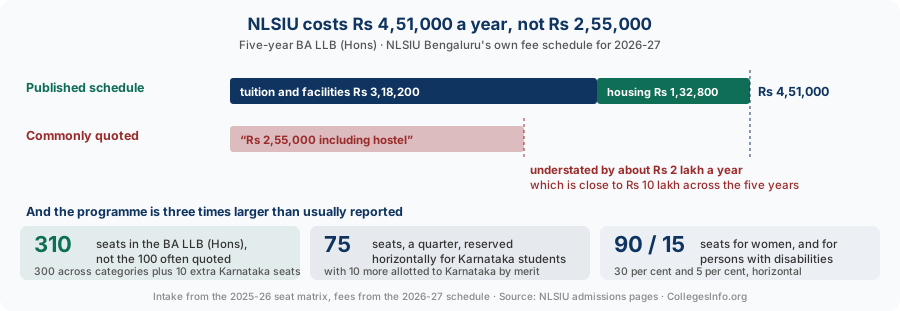
NLSIU costs Rs 4,51,000 a year including housing, made up of Rs 3,18,200 in tuition and facilities and Rs 1,32,800 for housing with a meal plan, from the university's own 2026-27 schedule. It admits 310, not the hundred often quoted, and 75 of those seats, a quarter, are reserved horizontally for Karnataka students, with 10 more allotted to Karnataka candidates by merit.
Check the Bar Council of India approved list before you pay anyone. A law degree only takes you to the Bar if the course was BCI-approved, and the list is not a formality: as of 18 September 2026, after a fifth extension deadline lapsed, NLSIU Bengaluru and Tamil Nadu NLU were reported as still not on it, while GNLU had secured approval.
KLEE is Kerala's law entrance exam, not Karnataka's. Karnataka has no state-wide CLAT equivalent for its three-year LLB seats. Admission at KSLU-affiliated colleges runs on the marks of your qualifying degree.
CLAT is a 120-question, 120-mark paper of two hours with 0.25 deducted for a wrong answer. Guides still quoting 150 marks are describing the older pattern.
This page was rebuilt on 13 November 2026. The version before it ran to a single sentence while its description promised NLSIU cutoffs and fees, so anyone arriving from a search for law colleges in Bangalore found a link and nothing else. What follows is written from primary records: NLSIU's own admissions and fee pages, the Consortium of NLUs' CLAT pattern, the Bar Council of India approval position as reported in September 2026, and the Supreme Court's August 2026 ruling on judicial service eligibility. Where a figure could not be traced to a source of that kind, it is not here.
What NLSIU actually costs, and how many it takes
NLSIU Bengaluru is the first National Law University in India, set up in 1987, and sits first in the NIRF law ranking. It is also the most misreported institution on this subject, so the numbers below come from its own admissions pages rather than from any aggregator.
The five-year BA LLB (Hons) programme has a sanctioned intake of 310: 300 seats across categories, plus 10 additional seats for Karnataka students. Within the 300, reservation runs SC 45, ST 23, OBC non-creamy-layer 81, EWS 30 and General 121. Three horizontal reservations cut across those: 75 seats, a quarter of the intake, compartmentalised for Karnataka students, 90 seats for women, and 15 for persons with disabilities. Admission is on CLAT merit.
| Item | Figure |
|---|---|
| Total intake | 310, being 300 plus 10 additional Karnataka seats |
| Karnataka students, horizontal reservation | 75 seats, 25 per cent, compartmentalised |
| Women, horizontal reservation | 90 seats, 30 per cent |
| Persons with disabilities | 15 seats, 5 per cent |
| Tuition and facilities | Rs 3,18,200 a year |
| Housing, including a meal plan | Rs 1,32,800 a year |
| Total a year, with housing | Rs 4,51,000 |
| One-time admission fee | Rs 13,900 |
| Refundable security deposit | Rs 18,800 for SC and ST, Rs 23,700 for others |
The figure that circulates most widely for NLSIU is about Rs 2,55,000 a year including hostel. Against the published schedule that understates the annual cost by roughly Rs 2 lakh, which over five years is close to Rs 10 lakh of planning error in a family's budget. If you are weighing an education loan, work from Rs 4,51,000 a year plus the one-time charges, and note that the intake and fee figures on the university's pages are labelled for different academic years, so confirm both for the year you would join.
Two readings follow from the seat matrix. A quarter of NLSIU's seats being compartmentalised for Karnataka students makes it materially more reachable for a candidate who has studied in the state than a national rank table suggests. And 310 seats is a far larger programme than the hundred usually quoted, which changes what a given CLAT rank is likely to reach.
Check the BCI approved list before you pay anyone
This is the part of a law admission that has no equivalent in engineering or medicine, and it is the one families skip. A law degree earns you a place at the Bar only if the course you took was approved by the Bar Council of India. Approval is granted to a Centre of Legal Education for particular courses, and it has to be extended periodically. Where it is missing, the consequence falls on the student: the Karnataka State Bar Council has in the past refused to enrol graduates as advocates because their college's course lacked BCI approval.
Treating the list as a formality would be a mistake, because the renewal process does slip. Existing Centres of Legal Education had to apply to extend approval for the 2026-27 session, upload their university's affiliation order for the year and pay the fee. The original deadline of 31 December 2025 was extended five times, to 16 January, 5 March, 31 July, 31 August and finally 15 September 2026. As reported on 18 September 2026, that fifth deadline passed with NLSIU Bengaluru and Tamil Nadu National Law University still not on the approved list, while Gujarat NLU had secured approval.
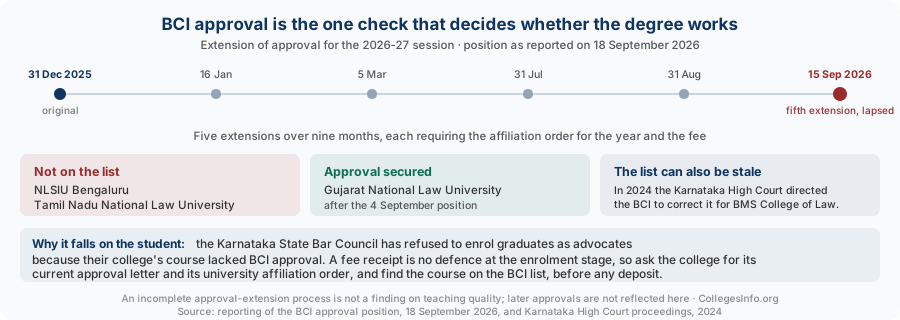
Read that for what it is. It describes an approval-extension process that had not completed for those institutions by that date, not a finding that their teaching is deficient or that existing degrees are void. Whether NLSIU's approval was recorded afterwards is not something this page can confirm, which is exactly why the instruction is to look rather than to assume. In 2024 the Karnataka High Court had to direct the BCI to review and correct the list in a case brought by BMS College of Law, whose entry showed affiliation only up to an earlier academic year, so an absent or stale entry does not by itself tell you a college is unapproved either.
What to do, in order: find the college and the specific course on the BCI's own approved list for the year you would join; ask the college for its current BCI approval letter and its university affiliation order, both of which it must hold; and if either is missing, ask when it expires and what has been applied for. Do this before any deposit, because a fee receipt is not a defence at the enrolment stage.
Karnataka has no CLAT of its own, and KLEE is Kerala's
Guides to law admission in Karnataka routinely refer to "KLEE, the Karnataka Law Entrance Exam". KLEE is the Kerala Law Entrance Examination, conducted by the Commissioner for Entrance Examinations, Kerala, for three-year and five-year LLB seats in that state. It has nothing to do with admission in Karnataka, and a candidate who prepares for it on that advice has prepared for the wrong examination in the wrong state.
Karnataka works differently. For the three-year LLB at colleges affiliated to Karnataka State Law University, which affiliates law colleges across the state, admission runs on the marks of your qualifying bachelor's degree rather than on an entrance test, with the usual minimum of 45 per cent, relaxed for reserved categories. Notifications typically open around the middle of the year and colleges register admitted students with the university afterwards. For the five-year integrated programmes the entrance test depends on the institution, not the state.
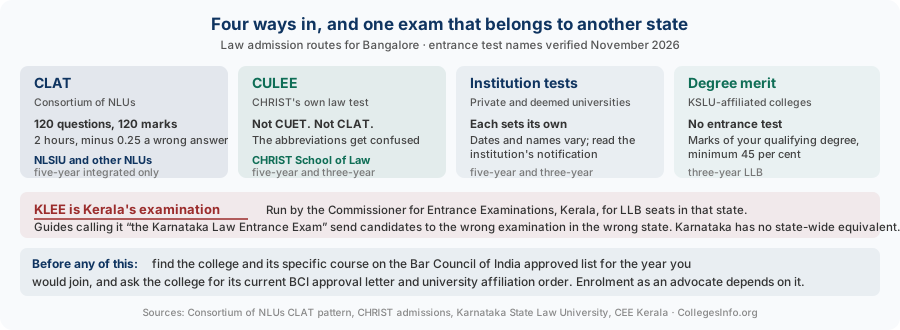
| Where you are applying | Route | Programme |
|---|---|---|
| NLSIU and other National Law Universities | CLAT, conducted by the Consortium of NLUs | Five-year integrated only |
| CHRIST (Deemed to be University) | CULEE, the Christ University Law Entrance Examination | Five-year integrated and three-year LLB |
| Other private and deemed universities | The institution's own entrance test | Varies by institution |
| KSLU-affiliated colleges, three-year LLB | Merit on your qualifying degree marks | Three-year LLB |
| Anywhere in Karnataka | Not KLEE. That is Kerala's examination. | – |
One correction worth making explicitly, because it is on many pages: CHRIST admits to its law programmes through CULEE, its own law entrance examination. It is not the national Common University Entrance Test, whose abbreviation it unfortunately resembles, and it is not CLAT.
What CLAT is now
CLAT's undergraduate paper is 120 multiple-choice questions carrying 120 marks, written in two hours in pen-and-paper mode, with one mark for a correct answer and 0.25 deducted for a wrong one. Unattempted questions cost nothing.
The five sections are English Language, Current Affairs and General Knowledge, Legal Reasoning, Logical Reasoning, and Quantitative Techniques. Published per-section question counts differ between coaching sources, so take the section weighting from the Consortium's own notification for your year rather than from a guide. What matters more than the exact split is that any page quoting a 150-mark CLAT, or section counts in the mid-thirties, is describing the older pattern and is out of date on everything else too.
There is no overlap between CLAT and KCET or NEET. A candidate preparing for law alongside engineering or medicine is preparing for two separate examinations with different syllabi, which is the practical argument for deciding the stream early. Our Karnataka law colleges guide covers the state-wide picture, and the Mangalore law colleges guide the coastal options.
Three-year LLB or five-year integrated
Both end in an LLB. The difference is when you start and which doors are open.
| Factor | Three-year LLB | Five-year integrated |
|---|---|---|
| You enter after | Any bachelor's degree | Class 12 or PUC |
| Minimum marks | 45 per cent, relaxed for reserved categories | 45 per cent, relaxed for reserved categories |
| Admission basis | Degree merit at KSLU-affiliated colleges | CLAT for NLUs, the institution's test elsewhere |
| National Law Universities | Not offered; NLUs run the integrated course only | Open, through CLAT |
| Suits | Graduates changing direction, including working ones | Candidates who have decided at school |
| Degree awarded | LLB | BA LLB, BBA LLB or BSc LLB |
The three-year route is the one most often overlooked, and it is the cheaper entry to litigation in Bangalore by a wide margin. It carries no upper age bar in the way the integrated programmes effectively do, which is why engineering and commerce graduates who find law later take it. At the hiring stage most Bangalore firms do not sort candidates by the length of the degree; they sort by the institution, academic record and internships.
The judicial service rules changed in August 2026
If the reason you are reading this is the judiciary, the eligibility position has moved twice in eighteen months and most pages have not caught up.
In May 2025 the Supreme Court restored a requirement of three years of practice at the Bar for direct recruitment as Civil Judge (Junior Division), displacing the earlier position under which fresh graduates could sit the examination. Then in Bhumika Trust v. Union of India [2026 INSC 904], decided 21 August 2026, the Court revisited that, reasoning that three years of conventional practice does not by itself guarantee meaningful experience, since quality depends on the chamber, the mentoring and the candidate's finances. As reported, the effect is that for recruitment advertisements issued up to 31 March 2027 all law graduates may apply regardless of the three-year rule and are deemed to have completed a year of practice, with one year of practice required from April 2027.
Read the judgment or the notification you are applying under before relying on this; the operative conditions are in the order, and this is a summary of reporting on it. The point for a candidate choosing a college now is that the window to apply as a fresh graduate is narrow and dated, and it closes well before a student starting a five-year programme in 2027 would graduate.
One correction on the agency. Recruitment to the Karnataka judicial service is conducted by the High Court of Karnataka, which advertised 90 Civil Judge posts in 2026, not by the Karnataka Public Service Commission. Pages that route you to KPSC for a judgeship are sending you to the wrong body.
Careers, without the invented salary figures
No placement average or starting salary appears on this page. Law firm and in-house pay in Bangalore is not published in any form that can be sourced, the spread between institutions is wide, and the figures that circulate are drawn from a small number of national law school graduates rather than from the field as a whole.
What can be said structurally is that Bangalore offers an unusual range of legal work for one city: the Karnataka High Court and the district courts for litigation; corporate and transactional practice driven by the technology economy, which concentrates intellectual property, contract, privacy and employment work; in-house legal teams at technology companies, which is the fastest-growing route; government and public prosecution; and academia, which requires a master's degree. The Digital Personal Data Protection Act, 2023 has created a privacy specialisation that barely existed a few years ago.
If a college quotes you a placement average, ask for the number of students in the graduating batch, how many were placed, the median rather than the average, and the recruiter list for the most recent completed year. An average is easy to lift with two outliers in a batch of sixty.
How to choose, in the order that matters
| Step | What to check | Where |
|---|---|---|
| 1 | BCI approval for this course, for the year you would join | The BCI approved list, plus the college's own approval letter |
| 2 | University affiliation order for the current year | The college, and KSLU for its affiliates |
| 3 | The entrance route and its real deadline | CLAT for NLUs, CULEE for CHRIST, the institution otherwise |
| 4 | The full fee schedule for every year of the course, in writing | The college's published fee page, not a comparison table |
| 5 | Whether the Karnataka horizontal quota helps you | NLSIU reserves 75 of 310 seats for Karnataka students |
| 6 | Moot court, legal aid clinic and internship arrangements | Ask to see the last two years' records, not a brochure |
The order is deliberate. Steps one and two decide whether the degree works at all; everything after that decides how good it is. Browse the law colleges in Karnataka directory for fees, courses and admission details, and the full college directory for the rest.
Frequently Asked Questions
What is the fee at NLSIU Bangalore?
Rs 4,51,000 a year including housing, from the university's 2026-27 schedule: Rs 3,18,200 for tuition and facilities and Rs 1,32,800 for housing with a meal plan. There is also a one-time admission fee of Rs 13,900 and a refundable deposit of Rs 18,800 for SC and ST candidates or Rs 23,700 for others.
How many seats does NLSIU have?
310 in the five-year BA LLB (Hons): 300 across categories plus 10 additional Karnataka seats. Within the 300, 75 seats are reserved horizontally for Karnataka students, 90 for women and 15 for persons with disabilities.
Is KLEE the entrance exam for law colleges in Karnataka?
No. KLEE is the Kerala Law Entrance Examination, run by the Commissioner for Entrance Examinations, Kerala. Karnataka has no equivalent state law entrance test for its three-year LLB seats, where admission runs on your qualifying degree marks at KSLU-affiliated colleges.
How many marks is the CLAT paper?
120. The undergraduate paper has 120 multiple-choice questions carrying one mark each, written in two hours, with 0.25 deducted for a wrong answer. Guides quoting 150 marks are describing the older pattern.
Why should I check Bar Council of India approval?
Because enrolment as an advocate depends on it, and the Karnataka State Bar Council has refused to enrol graduates whose college's course lacked BCI approval. The list is also not always current: in 2024 the Karnataka High Court directed the BCI to correct it in a case brought by BMS College of Law.
Was NLSIU on the BCI approved list?
As reported on 18 September 2026, NLSIU Bengaluru and Tamil Nadu National Law University were still not on it after a fifth extension deadline lapsed on 15 September 2026, while Gujarat NLU had secured approval. That describes an incomplete approval-extension process rather than a finding about teaching quality, and this page cannot confirm what was recorded later, so check the list yourself.
Which entrance test does CHRIST use for law?
CULEE, the Christ University Law Entrance Examination. It is not the national Common University Entrance Test and it is not CLAT, though pages often confuse all three.
Can a fresh law graduate become a Civil Judge in Karnataka?
For recruitment advertisements issued up to 31 March 2027, yes, following Bhumika Trust v. Union of India, decided 21 August 2026, under which all law graduates may apply and are deemed to have a year of practice. One year of practice is required from April 2027. Read the notification you are applying under, since the conditions are in the order.
Who conducts judicial service recruitment in Karnataka?
The High Court of Karnataka, which advertised 90 Civil Judge posts in 2026. It is not the Karnataka Public Service Commission.
Is a three-year LLB treated as less than a five-year integrated degree?
Not by most Bangalore employers, who sort on the institution, academic record and internships rather than the length of the course. The real difference is access: National Law Universities offer only the integrated programme, so the three-year route cannot take you to NLSIU.
For the state-wide comparison by CLAT cutoff, see the best law colleges in Karnataka guide.