By L K Monu Borkala · Tracking Karnataka admissions since 2006 · Checked against primary records on 13 November 2026
At a glance
KLEE is Kerala's law entrance examination, not Karnataka's. An earlier version of this page named it seven times. That matters more here than anywhere else in the state, because Mangalore draws students from the Kerala border districts, and the one thing a Kerala candidate must not do is use KLEE to apply for a Karnataka seat.
Mangaluru has no High Court bench. The Karnataka High Court sits at Bengaluru, with permanent benches at Dharwad and Kalaburagi since August 2013. A judicial committee has been examining the feasibility of a bench at Mangaluru, with no outcome this page can confirm. If litigation is the plan, local practice means the Dakshina Kannada district courts.
Law colleges here moved to Karnataka State Law University in 2009. SDM Law College was under Mangalore University until KSLU was established in January 2009. Several directories still print the old affiliation, which is exactly why you read the current affiliation order rather than a listing.
No fee figure appears on this page. The earlier version advertised Rs 40,000 to Rs 1.2 lakh a year in its description and then gave no fee anywhere in the body. There is no state fee notification for private law programmes, so the college's own circular is the only binding figure.
This page was rebuilt on 13 November 2026. The version before it described the city's campus culture at length and contained almost nothing a candidate could check: no fees, no seat counts, no affiliating university per college, and an entrance examination belonging to another state. What follows keeps the practical local detail and replaces the rest with what can be traced to a record, or says plainly that it cannot be.
The exam you must not use
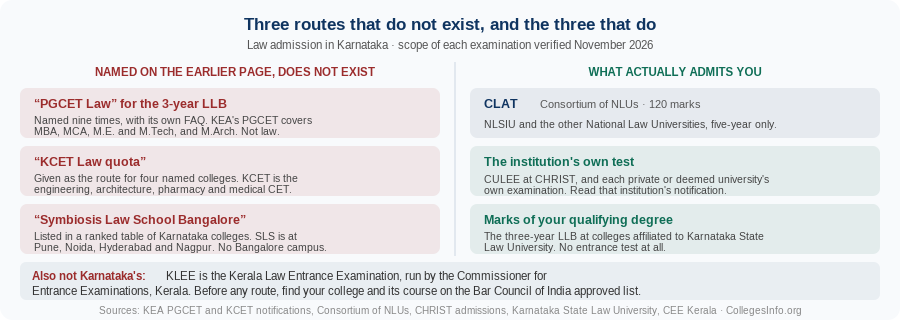
KLEE is the Kerala Law Entrance Examination, conducted by the Commissioner for Entrance Examinations, Kerala, for three-year and five-year LLB seats in that state. It has no part in Karnataka admission.
On a Mangalore page this is not a trivia correction. The city sits close to the Kerala border and takes students from Kasaragod and beyond, so a family that has heard of KLEE from relatives across the border can reasonably assume it is the route here. It is not. A Kerala candidate applying to a Mangalore college applies the Karnataka way, and a Karnataka candidate applying to a Kerala college applies through KLEE. The two systems do not overlap, and sitting the wrong one costs a year.
| Where you apply | Route | Programme |
|---|---|---|
| A KSLU-affiliated college in Dakshina Kannada | Merit on your qualifying degree marks | Three-year LLB |
| The same colleges, integrated programme | Class 12 marks, or the college's own test where it runs one | BA LLB, BBA LLB |
| A National Law University | CLAT, conducted by the Consortium of NLUs | Five-year integrated only; there is no NLU in Mangalore |
| A private or deemed university elsewhere in Karnataka | That institution's own test, such as CULEE at CHRIST | Varies |
| Anywhere in Karnataka | Not KLEE, not PGCET, not a KCET law quota | – |
Two of those non-routes were on a sibling page until yesterday: there is no PGCET Law, because the Karnataka Examinations Authority's PGCET covers MBA, MCA, M.E. and M.Tech, and M.Arch; and there is no KCET law quota, because KCET admits to engineering, architecture, pharmacy and the medical stream. Our Karnataka law colleges guide sets both out in full.
Where the courts actually are
This is the part of a Mangalore law decision that no brochure covers, and it shapes a litigation career more than any campus feature.
The High Court of Karnataka sits at Bengaluru, with permanent benches at Dharwad and Kalaburagi, both operational since August 2013. There is no bench at Mangaluru. A three-member committee of the High Court, comprising Justices Anu Sivaraman, S.G. Pandit and Mohammad Nawaz, has been examining the feasibility of circuit or permanent benches at Mangaluru and other districts, and local advocates' bodies have pressed for one. This page cannot confirm any outcome, so treat a Mangaluru bench as proposed rather than coming.
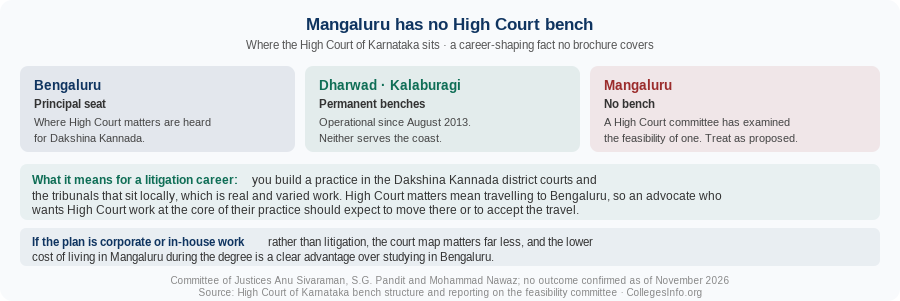
What that means in practice. A junior who wants to build a litigation practice in Mangalore builds it in the Dakshina Kannada district courts and the tribunals and forums that sit locally, which is real, varied work and the usual way a practice starts anywhere. But High Court matters mean travelling to Bengaluru, and an advocate who wants High Court work as the core of their practice eventually moves there or accepts the travel. That is a career-shaping fact, and it is worth knowing before you choose the city rather than after.
It cuts the other way too. If your plan is corporate or in-house work rather than litigation, the court map matters far less, and Mangalore's lower cost of living during the degree is a clear advantage over Bengaluru.
The affiliation changed in 2009, and listings still have not caught up
Law colleges in Karnataka that are not themselves universities sit under Karnataka State Law University, established in January 2009 with jurisdiction over the whole state. Before that, Mangalore's law colleges were affiliated to Mangalore University: SDM Law College's own recorded history runs Mangalore University from the mid-1980s to 2009, then KSLU from 2009 onward.
The practical problem is that aggregator listings were written at different times and never corrected, so the same college appears under Mangalore University on one site and KSLU on another. A sibling page on this site carried both versions at once. None of that tells you anything about the college; it tells you the listings are stale.
So read the affiliating university off the college's current affiliation order, which it has to hold anyway for Bar Council of India approval. One document answers the question for the year you would join, and no amount of cross-checking directories will.
Bar Council of India approval comes before everything else
A law degree takes you to the Bar only if the course was approved by the Bar Council of India. Approval goes to a Centre of Legal Education for particular courses and has to be extended periodically. Where it is missing the cost falls on the student: the Karnataka State Bar Council has refused to enrol graduates as advocates because their college's course lacked BCI approval.
The renewal cycle slips badly. The 2026-27 extension deadline of 31 December 2025 was pushed five times, to 16 January, 5 March, 31 July, 31 August and finally 15 September 2026, and as reported on 18 September 2026 that last deadline passed with NLSIU Bengaluru and Tamil Nadu National Law University still not on the approved list while Gujarat NLU had secured approval. That describes an incomplete approval-extension process rather than a judgement on teaching, and later approvals are not reflected here, which is the reason to check rather than assume.
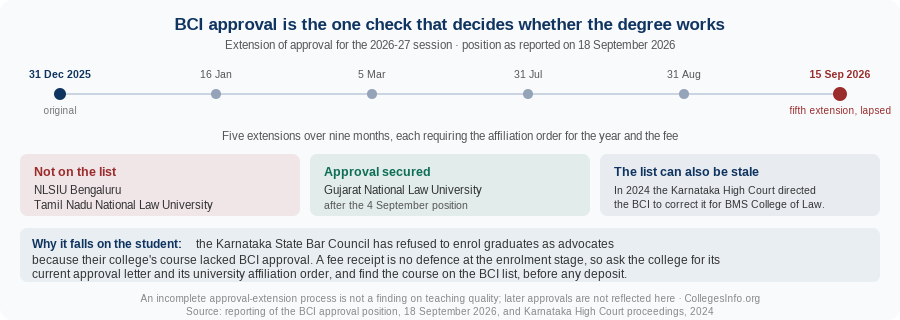
For a newer Dakshina Kannada college this is the single most important question, because a recently established programme is exactly where approval is most likely to be pending. No current approval letter for a 2026-27 law programme at any Mangalore-region college could be located from outside the institutions while writing this page. That is a limit of what can be read from the public record, not a finding about any college, and it is why the instruction below is to ask for the document rather than to trust a listing.
The colleges, and what can be checked about each
The institutions below are the ones the earlier version of this page named. The table says what can be verified from a record outside the college and what cannot. It is deliberately not a ranking.
| College | Where | Checkable | Not checkable |
|---|---|---|---|
| SDM Law College | Mangaluru | Private, run by the Shri Dharmasthala Manjunatheshwara Educational Society; under Mangalore University to 2009, KSLU since; runs LLB and BBA LLB | Fee; its accreditation grade, which sources give variously; current BCI approval, which only the college can show you |
| Alva's Law College | Moodbidri, Dakshina Kannada | Established by Alva's Education Foundation; listed as KSLU-affiliated; runs BA LLB and LLB | Fee; sanctioned intake; a 2026-27 BCI approval letter, which could not be located from outside |
| University College of Law | Mangaluru, as named on the earlier page | – | Could not be confirmed from any outside record under this name, including whether it is a government institution as the earlier version implied. Verify it exists and is approved before applying |
| Other private colleges in the region | Dakshina Kannada | Several exist under KSLU affiliation | The earlier page referred to them without naming any, so nothing about them was checkable at all |
One name to be careful with. Alva's Law College at Moodbidri is the law institution. Alva's College, also at Moodbidri, is a separate and older arts, science and commerce institution affiliated to Mangalore University. They share a founder and a town, and listings conflate them, so when you check approval or affiliation make sure the document names the law college.
Why no fees are quoted
The earlier version advertised "BA LLB and BBA LLB fees Rs 40K-1.2L per year" in its description and then gave no fee anywhere in the body, so a reader arriving from a search for Mangalore law college fees found none.
Karnataka publishes a fee notification for engineering and other professional courses through its annual consensual agreement. It publishes nothing equivalent for private law programmes. A range quoted as fact for a law college is therefore describing something no authority publishes, and it changes by college, by programme and by year.
Ask each college for the fee schedule covering every year of the course, in writing, with the examination and university fees separated from tuition and the refund terms stated if the student leaves after the first year. For the three-year LLB, government and aided colleges remain far cheaper than private ones across Karnataka, but read the figure from the college.
What to settle before you pay a deposit
| Step | What to ask for | Why it comes here |
|---|---|---|
| 1 | The BCI approval letter for this course, valid for the year you would join | Enrolment as an advocate depends on it |
| 2 | The current KSLU affiliation order | Listings carry affiliations that changed in 2009 |
| 3 | The fee schedule for every year, with refund terms | No authority publishes a law fee for you to compare against |
| 4 | Sanctioned intake for your programme | Tells you how many seats actually exist |
| 5 | Moot court, legal aid clinic and internship records for the last two years | Practical exposure is what a Mangalore degree can really offer |
| 6 | Which courts students are placed in for internships | With no High Court bench locally, this shows what access the college really has |
Steps one and two decide whether the degree works at all. Everything after that decides how good it is.
Living and studying in Mangaluru
The practical advantages of the city are real and were the one part of the earlier version worth keeping. Living costs are materially lower than Bengaluru, hostels and paying-guest accommodation near the main academic areas are plentiful, and the city is well connected by rail through Mangaluru Central and Mangaluru Junction, by bus, and by air through Mangaluru International Airport for students from elsewhere in Karnataka or from the Gulf.
For a law student specifically, the thing to look for on a campus visit is not the building. It is whether the college has a working legal aid clinic, whether students appear in moots beyond the college's own, and whether the faculty includes practising advocates from the Dakshina Kannada bar. Those three determine how much practical exposure the two or five years actually produce, and all three are visible in an afternoon if you ask.
For the wider picture see our Karnataka law colleges guide and the Bangalore law colleges guide, which carries NLSIU's seat matrix and fee schedule in full. Browse the law colleges directory for course detail and the full college directory for everything else.
Frequently Asked Questions
Is KLEE the entrance exam for law colleges in Mangalore?
No. KLEE is the Kerala Law Entrance Examination, run by the Commissioner for Entrance Examinations, Kerala. Karnataka has no equivalent state law entrance test for its three-year LLB seats, where admission runs on the marks of your qualifying degree at KSLU-affiliated colleges.
Can a Kerala student join a Mangalore law college?
Yes, and the application follows the Karnataka route, not KLEE. For the three-year LLB that means degree merit at a KSLU-affiliated college; for the integrated programme it means Class 12 marks or the college's own test where it runs one.
Is there a High Court bench in Mangaluru?
No. The Karnataka High Court sits at Bengaluru with permanent benches at Dharwad and Kalaburagi, operational since August 2013. A High Court committee has been examining the feasibility of a bench at Mangaluru, but no outcome can be confirmed here.
Which university affiliates Mangalore law colleges?
Karnataka State Law University, established in January 2009 with jurisdiction over the whole state. Before 2009 these colleges were under Mangalore University, and several directories still print that older affiliation, so read the current affiliation order from the college.
What do law colleges in Mangalore charge?
No figure is quoted here. Karnataka publishes no fee notification for private law programmes, so a range cannot be sourced to any authority. Ask for the fee schedule for every year of the course in writing, with refund terms.
Is there a National Law University in Mangalore?
No. The nearest is NLSIU in Bengaluru, which admits only through CLAT and only to the five-year integrated programme. CLAT is a 120-question, 120-mark paper.
Why check Bar Council of India approval first?
Because enrolment as an advocate depends on it, and the Karnataka State Bar Council has refused to enrol graduates whose college's course lacked approval. The approved list also runs behind: the 2026-27 extension deadline was pushed five times to 15 September 2026.
Is Alva's Law College the same as Alva's College?
No. Alva's Law College at Moodbidri is the law institution, listed as KSLU-affiliated. Alva's College, also at Moodbidri, is a separate and older arts, science and commerce institution under Mangalore University. Listings confuse the two, so check that any document names the law college.
Can I do a three-year LLB in Mangalore after any degree?
Yes. The three-year LLB takes graduates of any discipline, usually with a minimum of 45 per cent relaxed for reserved categories, and admission at KSLU-affiliated colleges runs on those degree marks with no entrance test.
Is Mangalore a good place to study law if I want to litigate?
It is a reasonable place to start, in the Dakshina Kannada district courts, at a lower cost of living than Bengaluru. But with no High Court bench in the city, an advocate who wants High Court work as the core of their practice should expect to move or to travel.
For the state-wide comparison, see the best law colleges in Karnataka guide.