Quick Facts: Fashion Technology Colleges in Karnataka
| What it actually is | The production and manufacturing-engineering side of the fashion industry – apparel manufacturing technology, quality management, and garment production – distinct from Fashion Design's creative focus |
|---|---|
| Duration | 4 years (NIFT's B.F.Tech); 3 years (BSc Fashion Technology at most private colleges) |
| Flagship government option | NIFT Bangalore's B.F.Tech (Apparel Production) |
| Entrance routes | NIFT Entrance Exam (GAT, no Creative Ability Test needed) for NIFT; merit-based or college-specific tests for private colleges |
| Eligibility difference from Fashion Design | NIFT's B.F.Tech requires Physics, Chemistry, Mathematics at 10+2 (or a diploma in engineering/technology) – Fashion Design's B.Des does not |
If you're comparing Fashion Technology to Fashion Design, the honest starting point is this: Fashion Technology is the technical, manufacturing-oriented sibling, not a rebrand of the same creative degree. It suits students who want to understand how garments actually get produced at scale – the machinery, quality systems, and production planning – rather than students purely focused on design and aesthetics. Karnataka's options for this specific path are more limited and more concentrated in Bengaluru than the broader Fashion Design landscape.
What Fashion Technology Actually Covers
NIFT's own programme description for its B.F.Tech (Apparel Production) course is specific about this: the curriculum introduces apparel manufacturing technology, information technology, quality management, and – notably, reflecting how current the syllabus is – artificial intelligence applications within manufacturing. Students learn the fundamentals of raw materials (fabrics and trims), the machinery involved in apparel manufacturing, and develop working knowledge of production planning, merchandising, work study, and quality control. A final-year research component is also built into the structure. This is a different day-to-day academic experience from a Fashion Design B.Des – less about sketching and draping, more about how a garment moves from raw material to finished, quality-checked product at manufacturing scale.
NIFT Bangalore's B.F.Tech: The Technical Entry Point
NIFT Bangalore's B.F.Tech in Apparel Production is a 4-year programme with a notably different eligibility requirement from NIFT's own B.Des tracks: candidates need Physics, Chemistry, and Mathematics as compulsory subjects at the 10+2 level (or a diploma in engineering or technology with at least 50% marks), rather than the more general eligibility criteria for the design-focused B.Des programmes. Total tuition across similar NIFT campuses nationally runs in the range of roughly Rs 12-13 lakh for the full four years, though you should confirm the current Bangalore-specific fee structure directly with NIFT, since fees are revised periodically and vary somewhat by campus. Seat intake per campus for this specific programme also tends to be smaller than for the more popular B.Des tracks – worth knowing if you're assessing your realistic admission chances.
Comparing Your Main Options
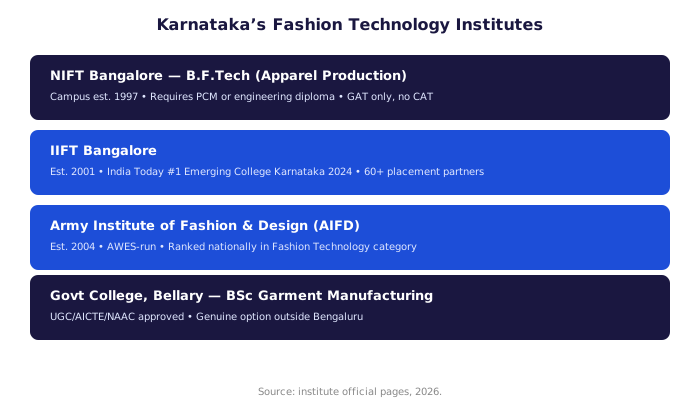
| Institute | City | Established | Programme | Notable strength |
|---|---|---|---|---|
| NIFT Bangalore | Bengaluru | Campus est. 1997 | B.F.Tech (Apparel Production) | Strongest technical curriculum, national brand, AI/quality-management coursework |
| Indian Institute of Fashion Technology (IIFT) | Bengaluru | 2001 | BSc Fashion & Apparel Design (Bangalore University affiliated) | India Today's #1 Emerging College in Karnataka (2024), 60+ placement partners |
| Army Institute of Fashion & Design (AIFD) | Bengaluru | 2004 | BSc Fashion & Apparel Design (Bengaluru North University) | Ranked nationally specifically in the Fashion Technology category |
| Government college, Bellary | Bellary | UGC/AICTE/NAAC approved | BSc (Garment Manufacturing) | Genuine government option outside Bengaluru |
IIFT Bangalore's own figures are worth knowing in some detail since they're unusually specific for a private institute: established in 2001 by Sri B. Vedhagiri under the BVG Educational Trust, the institute reports 10,000+ alumni, 60+ placement partners including Tommy Hilfiger, Arvind, Lifestyle, and Shoppers Stop, and holds a Limca Book of Records entry. It offers diploma options after Class 10 alongside its university-affiliated BSc programme, giving it a wider entry-point range than NIFT's stricter eligibility criteria.
Admission: A Different Process from Fashion Design
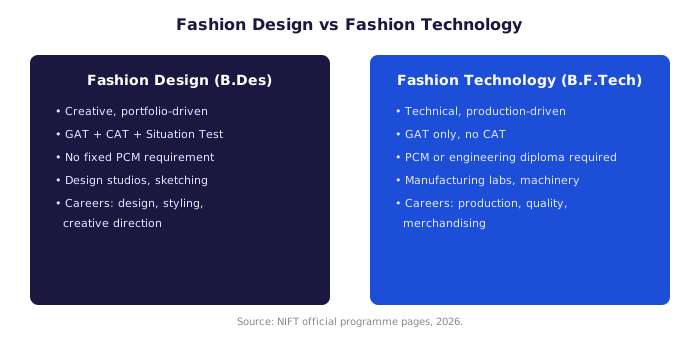
For NIFT's B.F.Tech specifically, admission runs through the NIFT Entrance Exam's General Ability Test (GAT) – notably without the Creative Ability Test (CAT) component required for B.Des programmes, since this track assesses technical and analytical aptitude rather than creative and design aptitude. This is a meaningful practical difference if you're deciding between Fashion Technology and Fashion Design: you're not required to demonstrate design portfolio skills for B.F.Tech admission the way you would for B.Des, though you will need the PCM academic background. Private institutes like IIFT and AIFD run their own merit-based or college-specific admission processes, generally more accessible than NIFT's competitive entrance exam.
What Studying Fashion Technology Actually Looks Like
Expect a curriculum that blends textile science, garment construction technology, industrial engineering principles applied to apparel manufacturing, quality management systems, and production planning software and methods. Lab and practical work centres on manufacturing processes and machinery rather than design studios – you'll spend meaningful time understanding cutting, stitching, and finishing technology at an industrial scale, quality control testing methods, and increasingly, the software and AI tools used in modern apparel manufacturing for tasks like defect detection and production scheduling.
If you're deciding between Fashion Design and Fashion Technology, the honest question to ask yourself is whether you're more energised by creating and designing garments, or by understanding and optimising how they get made at scale. Both lead into the same broader apparel industry, but the daily coursework, required academic background, and immediate career destinations differ meaningfully – Fashion Technology graduates are far more likely to move directly into production, quality, and merchandising roles, while Fashion Design graduates more often move into design, styling, and creative-direction roles first. If neither creative field appeals and you're more drawn to a pure science-track manufacturing degree instead, Food Technology shares Fashion Technology's production-and-quality-management orientation, just applied to food rather than apparel.
Funding Your Degree
NIFT's institute-wide scholarship schemes, including income-based financial assistance programmes, apply to B.F.Tech students on the same basis as B.Des students. If you're an SC, ST, OBC, or minority-category student, Karnataka's State Scholarship Portal (SSP) – covered in our SSP scholarship guide – is worth checking for eligibility, and private institutes like IIFT and AIFD often have their own merit and need-based scholarship schemes separate from government portals.
Career Paths and Realistic Salary Ranges
Fashion Technology graduates in Karnataka move into apparel production management, quality control and quality assurance roles at garment manufacturers, merchandising positions bridging design and production, industrial engineering roles within apparel manufacturing units, and increasingly, roles applying data and AI tools to production optimisation and quality management – a growing niche given Karnataka's, and Bengaluru's particularly, overlap between manufacturing and technology sectors.
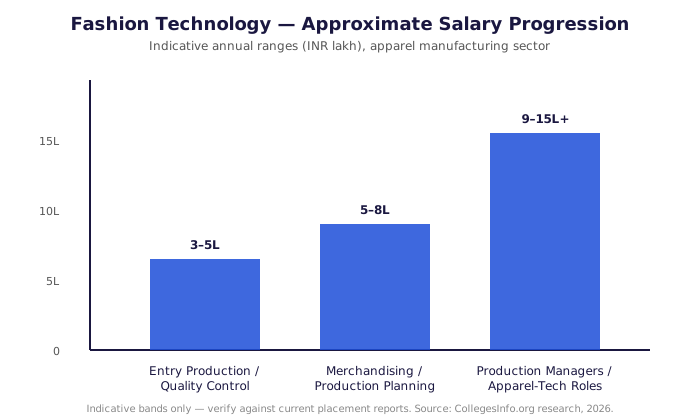
Salary ranges vary by role and employer, so treat these as approximate bands: entry-level production or quality control roles typically start around Rs 3-5 lakh per year, merchandising and production planning roles with a few years' experience in the Rs 5-8 lakh range, and experienced production managers, quality heads, or those in specialised apparel-tech roles moving into the Rs 9-15+ lakh range at established manufacturers or export houses. These figures should be cross-checked against current placement reports for your specific institute, since apparel manufacturing compensation varies by company size and whether the employer is domestic-market or export-focused.
Beyond Bangalore: The Bellary Government Option
Unlike Fashion Design, where private institutes dominate outside Bengaluru, Fashion Technology has at least one genuine government college option outside the city: a UGC, AICTE, and NAAC-approved college on the Jnana Sagara Campus in Bellary offering a BSc in Garment Manufacturing. If cost is a major factor and you're open to relocating away from Bengaluru specifically for a government-affiliated programme, this is worth researching directly – government college fees for this kind of programme are typically meaningfully lower than Bengaluru's private institute fees, though you should weigh that against Bengaluru's much stronger concentration of apparel industry employers for internships and placements.
Government Support for India's Apparel Manufacturing Sector
Fashion Technology graduates benefit from the same active government policy environment supporting India's textile and apparel manufacturing sector that shapes opportunities across the broader fashion and textile field – the PM MITRA (Mega Integrated Textile Region and Apparel) scheme in particular is specifically about building integrated textile manufacturing infrastructure, directly relevant to Fashion Technology's production and manufacturing focus in a way that's arguably even more directly applicable than for creative-design-focused Fashion Design graduates. Export-oriented apparel manufacturing is also a significant and ongoing part of India's textile economy, creating demand for production and quality professionals who understand both domestic and international quality and compliance standards.
Who Should Actually Choose Fashion Technology
If you're weighing Fashion Technology's PCM-and-process-driven approach against other technical fields with a genuine creative-industry connection, it's worth a quick comparison: architecture shares a similar blend of technical rigour and creative-industry output, and hotel management shares the production-and-service-systems thinking, even though both lead to entirely different careers than apparel manufacturing.
This path suits students with a genuine interest in the technical, engineering, and systems side of how products get made – quality control, production efficiency, manufacturing technology – applied specifically to the apparel industry, rather than students whose primary interest is design and creative aesthetics. A PCM (Physics, Chemistry, Mathematics) academic background and comfort with technical, process-oriented thinking matter more here than portfolio-building or design sketching skills. If you're unsure whether Fashion Design or Fashion Technology fits you better, it's worth assessing whether you're more drawn to creating a garment's look, or to understanding and optimising how it's actually manufactured – these lead to different four years and different career starting points.
Before You Enrol: A Quick Verification Checklist
Given the meaningful differences between NIFT's B.F.Tech and various private BSc Fashion Technology programmes, confirm these specifics directly before committing: the exact eligibility requirements for your target programme (PCM background is mandatory for NIFT's B.F.Tech specifically), current fee structures including any additional lab or material fees typical of a manufacturing-focused curriculum, the institute's actual placement data and recruiter list for this specific programme rather than an institute-wide average that might be dominated by design-track placements, and whether the programme's practical/lab facilities include genuine access to industrial-scale manufacturing equipment rather than only classroom-based theory.
IIFT and AIFD: A Closer Look at the Private Options
Since IIFT and AIFD are the two most established private options for the production/technology side of fashion education in Bengaluru, they're worth comparing in a bit more depth. IIFT, established in 2001, has built a long track record – 25 years of operation, a Limca Book of Records entry, and India Today's #1 Emerging College in Karnataka ranking for 2024 – and offers a lower entry barrier than NIFT, with diploma options available straight after Class 10 alongside its Bangalore University-affiliated BSc. AIFD, run by the Army Welfare Education Society (itself established in 1983 to serve the educational needs of army personnel's families), has a specific national ranking track record in the Fashion Technology category – 6th all-India for placements and 3rd among private Fashion Technology colleges according to rankings the institute cites. Both offer BSc-level Fashion & Apparel Design degrees affiliated to Bengaluru-area universities (Bangalore University for IIFT, Bengaluru North University for AIFD) rather than NIFT's own degree-granting authority.
NEP 2020 and Fashion Technology Programmes
Under the National Education Policy 2020's four-year undergraduate framework, several Karnataka-affiliated fashion technology programmes have moved toward a structure with multiple exit points and a stronger emphasis on industry-aligned skill credits alongside core coursework. For a manufacturing-and-production-focused degree like this one, the practical effect is often a more structured internship or industrial-training component built into the credit system, reflecting how central hands-on manufacturing exposure is to this specific field compared to a purely classroom-based science degree. Ask any programme you're considering directly how their NEP-era credit structure handles industrial training hours, since this varies by institute and affects how much genuine factory-floor exposure you'll get before graduating.
Campus Life and Gender Representation
Fashion technology and apparel manufacturing programmes at the national NIFT level show notably strong female representation – national data for NIFT's apparel-production-focused specialisations has shown male-to-female ratios skewing heavily toward women students, reflecting broader patterns across India's apparel and garment manufacturing workforce, where women make up a substantial share of both production-floor and management roles. This is worth knowing if student community composition factors into your college decision. Campus facilities at NIFT Bangalore, IIFT, and AIFD all include hostel options, labs, and manufacturing-technology equipment, though the specific scale and recency of manufacturing equipment varies meaningfully between a national institute like NIFT and smaller private colleges – ask to see actual lab and machinery facilities directly rather than relying on prospectus photos alone.
Karnataka's Fashion Technology Landscape in the National Picture
Fashion Technology as a distinct manufacturing-focused degree exists at NIFT campuses across all 19 of the institute's locations nationally, plus at private institutes in most major Indian cities with a garment manufacturing presence – Tirupur (Tamil Nadu), Ludhiana (Punjab), and the broader NCR region are all significant national hubs for apparel manufacturing education, arguably with deeper industrial ecosystems than Bengaluru specifically for pure manufacturing-scale production work. What Bengaluru offers that's harder to find elsewhere is the overlap between apparel manufacturing and Bengaluru's technology sector specifically – the AI and data-driven quality management angle NIFT's own curriculum highlights is more naturally supported by Bengaluru's broader tech ecosystem than by a manufacturing hub without the same concentration of technology companies and talent.
Karnataka's Textile Manufacturing Base: A Real Advantage
Fashion Technology students in Karnataka benefit from a genuine regional manufacturing context that goes beyond Bengaluru's tech-sector overlap alone. Karnataka has a real garment and textile manufacturing base, with export-oriented apparel manufacturing units operating across the state, alongside the state's broader silk and handloom heritage – including Karnataka Silk Industries Corporation's GI-protected Mysore silk production, discussed in more depth in relation to Fashion Design. For a Fashion Technology student specifically – someone focused on production, quality, and manufacturing systems rather than creative design – proximity to genuine, operating manufacturing facilities for internships and industrial exposure matters more directly than it does for a purely design-focused student, making Karnataka's manufacturing base a practical, not just theoretical, advantage.
A Quick Word on Choosing Between the Options
If you can compete for NIFT's B.F.Tech seat and meet the PCM eligibility requirement, it remains the strongest single option for a technical, industry-connected Fashion Technology education in Karnataka – the curriculum's direct engagement with quality management, production planning, and increasingly AI-driven manufacturing tools reflects real industry direction, not just marketing language. But NIFT's competitive entrance process and specific academic eligibility requirement mean it isn't accessible to every interested student. IIFT's longer operating history, documented placement partner network, and lower entry barrier (diploma options from Class 10) make it a reasonable alternative if NIFT isn't a fit for your academic background or exam performance. AIFD's specific national ranking in the Fashion Technology category, alongside its structured, disciplined institutional culture reflecting its Army Welfare Education Society management, may particularly suit students who value a more structured, less purely design-school environment. And the Bellary government option is worth serious consideration if cost is your primary constraint and you're open to a smaller-city campus in exchange for meaningfully lower fees.
Notable Employers in Karnataka's Apparel Manufacturing Sector
Beyond the fashion-brand recruiters that show up in NIFT placement reports, Karnataka's own apparel manufacturing sector includes export-oriented garment units, quality assurance and testing labs, and textile testing facilities that hire Fashion Technology graduates directly for production and quality roles rather than design roles. If your interest leans toward production and quality management over creative design, research these manufacturing-sector employers specifically rather than assuming your career path will mirror a Fashion Design graduate's – the recruiting landscape, interview process, and day-to-day work differ meaningfully between the two tracks even when both graduates technically work "in fashion."
Frequently Asked Questions
What's the difference between Fashion Design and Fashion Technology?
Fashion Design focuses on creative design, garment construction aesthetics, and portfolio-driven work. Fashion Technology focuses on apparel manufacturing, quality management, production planning, and the technical/engineering side of how garments are produced at scale.
Do I need Physics, Chemistry and Mathematics for Fashion Technology?
For NIFT's B.F.Tech specifically, yes – PCM at the 10+2 level (or a diploma in engineering/technology) is required, unlike NIFT's B.Des programmes which don't require this specific academic background.
Is there a Creative Ability Test for Fashion Technology admission?
No, not for NIFT's B.F.Tech – admission uses the General Ability Test (GAT) component only, without the Creative Ability Test (CAT) required for B.Des programmes.
Can I study Fashion Technology outside Bengaluru in Karnataka?
Yes, to a limited extent – a government college in Bellary offers a UGC, AICTE, and NAAC-approved BSc in Garment Manufacturing, though options outside Bengaluru are more limited than for Fashion Design.
What career options exist after Fashion Technology beyond design roles?
Apparel production management, quality control and assurance, merchandising, industrial engineering within manufacturing units, and increasingly, roles applying data and AI tools to production optimisation.
Which is more competitive to get into: Fashion Design or Fashion Technology at NIFT?
Both go through NIFT's entrance process, but the specific competition level varies by programme and year based on applicant numbers and seat intake – Fashion Technology's PCM eligibility requirement narrows the applicant pool somewhat compared to Fashion Design's broader eligibility, though this doesn't necessarily make it easier to get into.
Is IIFT Bangalore a good alternative to NIFT for Fashion Technology?
IIFT offers a Bangalore University-affiliated BSc in Fashion & Apparel Design with a long track record (established 2001) and documented placement partners, making it a reasonable option if NIFT's competitive entrance exam or PCM eligibility requirement doesn't work for your situation, though it's a different degree structure from NIFT's own B.F.Tech.
Can Fashion Technology graduates work internationally?
Yes, particularly graduates with strong quality management and export-compliance knowledge, since India's apparel manufacturing sector is heavily export-oriented and international compliance standards are a core part of the Fashion Technology curriculum at institutes like NIFT.
Last Updated: September 7, 2026
Need help with admission?