CMA (Cost and Management Accountant) is a 3-stage professional qualification run directly by ICMAI — a separate statutory body from ICSI (which runs CS), though both operate under the Ministry of Corporate Affairs. A genuine legal mandate (Section 148, Companies Act 2013) requires certain companies to get their cost records specifically audited by a CMA, distinct from and in addition to their regular financial audit.
| Course | Cost and Management Accountant (CMA) |
|---|---|
| Governing Body | Institute of Cost Accountants of India (ICMAI), statutory body under a 1959 Act of Parliament |
| Stages | Foundation → Intermediate → Final |
| Total Duration | Roughly 3 years, including 15 months mandatory practical training |
| Eligibility | Class 12 pass (40% marks, any stream except fine arts) for Foundation; graduates can skip directly to Intermediate |
| Total Academic Fee | Roughly Rs 40,000-70,000 across all stages (inland students, excluding coaching) |
| Passing Requirement | 40% per paper, 50% aggregate per group |
| Final Designation | Associate Cost Accountant, post-training and Final exam |
🎯 Use the Free KCET Rank Predictor — Enter your rank and category to instantly see which commerce and management colleges you can get in 2026. No login required. Try KCET Predictor →
Is CMA the Same as CS or CA?
This is worth clarifying immediately, since the three are commonly confused. CMA (Cost and Management Accountant) is regulated by ICMAI and focuses specifically on cost accounting, cost audit, and management accounting. CS (Company Secretary) is regulated by a separate body, ICSI, and focuses on corporate law and governance. CA (Chartered Accountant) is regulated by ICAI and focuses on financial accounting and statutory audit. All three are statutory professional bodies functioning under the Ministry of Corporate Affairs, but they're separate qualifications with separate registration processes, separate exams, and separate legal roles — passing one doesn't grant any standing in the others, though cross-body exemptions exist for specific papers in some cases.
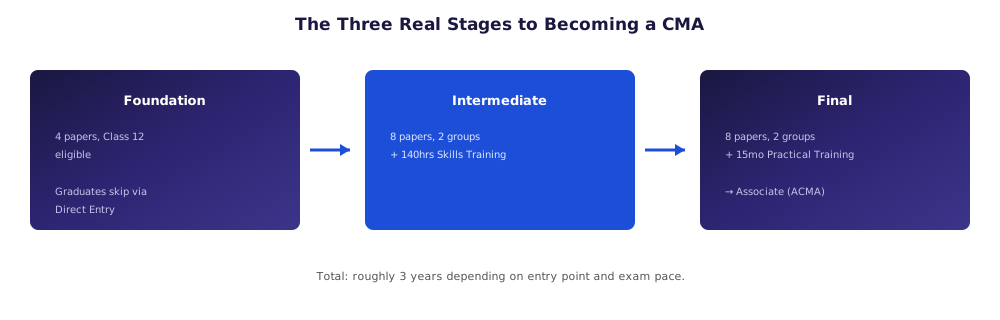
What Are the Three Real Stages?
CMA Foundation is the entry stage, open to anyone who has passed Class 12 in any stream except fine arts, covering essentials of accounting, cost fundamentals, and business mathematics across four papers. CMA Intermediate is the second stage, spanning eight papers across two groups, covering in-depth finance, taxation, and cost and management accounting, alongside a mandatory 140-hour Skills Training component. CMA Final is the most advanced stage, also eight papers across two groups, covering advanced financial strategy, audit, and compliance with elective options, alongside 15 months of mandatory Practical Training. After clearing Final and completing training, candidates can apply for ICMAI membership and use "ACMA" (Associate Cost and Management Accountant) after their name.
Can Graduates Skip Foundation Entirely?
Yes, — any graduate, regardless of stream, qualifies for direct entry into CMA Intermediate, skipping Foundation completely. This is a meaningfully faster route if you've already completed a bachelor's degree, since it removes an entire stage's exam and preparation time. Students who've cleared Part I and Part II of ICMAI's own Certificate in Accounting Technicians (CAT) course, or the Intermediate level of ICAI's own CA course, also qualify for direct entry into CMA Intermediate.
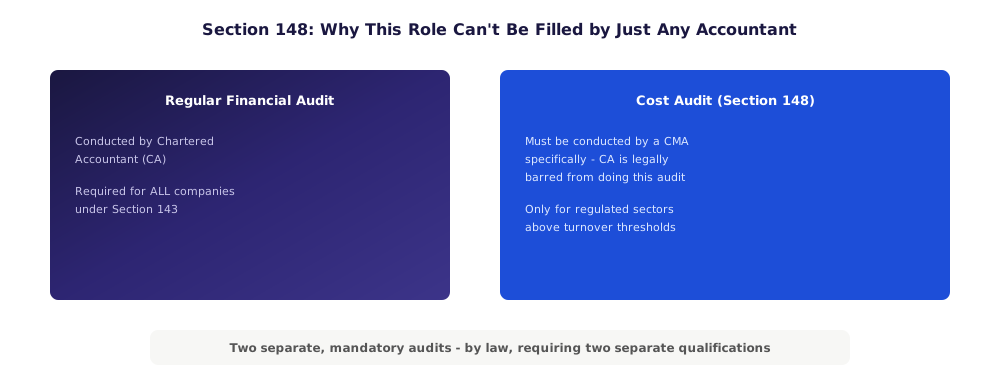
Why Does This Career Have Genuine, Legally-Mandated Demand?
This is the single most important thing to understand about CMA as a career choice, and like CS, it's not marketing language — it's actual law. Section 148 of the Companies Act, 2013, read with the Companies (Cost Records and Audit) Rules, 2014, authorises the Central Government to mandate cost audits for companies in specific regulated sectors — telecommunications, petroleum products, fertilisers, and certain pharmaceuticals among them — once they cross prescribed turnover thresholds. Critically, Section 148(3) explicitly requires this cost audit to be conducted by a Cost Accountant in Practice, and explicitly prohibits the company's own existing statutory financial auditor from conducting it — meaning a CA cannot substitute for a CMA in this specific role, by law. This audit runs in addition to, not instead of, the regular financial audit. India was the first country in South Asia to make cost audits mandatory for certain business sectors this way, and non-compliance carries a fine of not less than Rs 25,000. Given Bengaluru's substantial manufacturing, pharmaceutical, and technology-adjacent corporate base, this creates genuine, structural demand for qualified CMAs specifically in roles no other professional qualification can legally fill.
What Does the Full Course Actually Cost?
Total academic fees across all three stages run roughly Rs 40,000-70,000 for inland students, varying by how many papers you attempt per sitting and whether you qualify for Direct Entry (skipping Foundation). Foundation itself costs around Rs 6,000. Intermediate, attempting both groups together, runs around Rs 25,900. Final, similarly, runs around Rs 28,200. Graduates who skip Foundation via Direct Entry pay meaningfully less overall, since they avoid that stage's fee entirely. This is one of the more affordable professional qualifications covered on this site, and ICMAI itself notes it's among the lowest-priced global-standard accounting certifications available in India specifically.
What Does the Full Timeline Actually Look Like?
Total duration runs roughly 3 years for the complete qualification, though this varies by your starting point and exam pace. an important, often-overlooked component: candidates must complete 140 hours of Skills Training during Intermediate and 15 months of Practical Training during the Final stage — these aren't optional add-ons, they're mandatory requirements alongside passing all three stages' examinations. Exams are held twice yearly, in June and December, and attempting both groups of a stage together in a single sitting is generally faster than splitting them across multiple attempts.
Career Scope and Salary — An Honest Range
Career destinations include Cost Accountant and Finance Manager roles at manufacturing and regulated-sector companies specifically required to maintain cost records under Section 148, Chief Financial Officer (CFO) positions at larger organisations, and independent Cost Accountant in Practice work conducting cost audits for companies that need one. Salary reporting varies considerably by role, sector, and company size, so treat any specific figure cautiously — roles specifically tied to mandatory cost-audit compliance at larger, regulated-sector companies in Bengaluru tend to command stronger, more stable compensation than general cost-accounting roles at smaller firms, given the genuine legal weight the position carries at that scale.
Who Should Pursue CMA?
- Students interested in cost structures, manufacturing economics, and management accounting rather than pure statutory financial audit
- Commerce graduates specifically, who can meaningfully shorten their path via Direct Entry into Intermediate
- Those drawn to Bengaluru's substantial manufacturing, pharmaceutical, and regulated-sector corporate presence specifically, given the genuine Section 148 demand described above
- Anyone weighing this against CA or CS specifically who wants a distinct professional identity focused on cost and management, not general audit or corporate governance
Comparing CMA Against Related Fields
If you're weighing CMA against CA or CS specifically, our CS Course Guide covers the corporate-governance-focused alternative regulated by ICSI, sharing a similar three-stage structure and Ministry of Corporate Affairs oversight but leading toward a different professional role. If you're still exploring broader commerce options, our courses directory covers the wider range of undergraduate paths that could feed into any of these three qualifications after graduation.
Funding Your CMA Education
If you're SC, ST, OBC, or minority-category, our SSP scholarship guide covers Karnataka's post-matric scholarship system. ICMAI itself also offers fee waivers and scholarships for reserved categories per its own periodic notices, worth checking directly given the affordable base fee structure this course already has.
A Quick Verification Checklist Before You Register
Given ICMAI updates its fee structure and specific requirements periodically, verify these directly before committing: current fees and registration deadlines at icmai.in specifically, since these change periodically; whether you qualify for Direct Entry into Intermediate based on your specific academic background; the actual coaching institute's track record if you're considering one, since ICMAI itself provides free official study materials; and the specific Skills Training and Practical Training placement process for your mandatory components.
Frequently Asked Questions
Is CMA the same qualification as CA or CS?
No — all three are separate statutory professional qualifications under the Ministry of Corporate Affairs, but CMA (ICMAI) focuses on cost and management accounting, CA (ICAI) on financial accounting and statutory audit, and CS (ICSI) on corporate governance and law.
Can I skip CMA Foundation if I'm already a graduate?
Yes — any graduate, regardless of stream, qualifies for direct entry into CMA Intermediate, skipping Foundation entirely.
Why is there genuine, legally-mandated demand for CMAs specifically?
Section 148 of the Companies Act, 2013 requires certain regulated-sector companies to have their cost records audited specifically by a Cost Accountant in Practice — and explicitly prohibits the company's own statutory financial auditor (a CA) from conducting this audit instead.
What is the total cost of the CMA course?
Roughly Rs 40,000-70,000 across all three stages for inland students, excluding optional coaching, with graduates who skip Foundation paying meaningfully less overall.
How long does it take to become a qualified CMA?
Roughly 3 years total, including 140 hours of Skills Training during Intermediate and 15 months of Practical Training during the Final stage.
What does ACMA mean after someone's name?
Associate Cost and Management Accountant — the designation earned after passing CMA Final and completing the required Skills and Practical Training, marking full ICMAI membership.
Need help figuring out whether CMA is the right path and how it compares to CA or CS for your goals? WhatsApp +91 6363 330 233 and we'll help you think it through. We help you get the best admission to your preferred colleges without hassle.
Information on this page is compiled from publicly available ICMAI and Ministry of Corporate Affairs sources, cross-checked across multiple sources given genuine variation in fee figures across reporting sites. Always confirm current fees and deadlines directly at icmai.in. Published by L K Monu Borkala, founder of OneCity Technologies — publishing Karnataka education directories since 2006.