KCET 2026 results are expected in the last week of May 2026. The Karnataka Examination Authority (KEA) releases results at cetonline.karnataka.gov.in. This page covers everything you need to know — when to check, what the result contains, how your rank is calculated, what cutoffs to expect and exactly what to do in the next 48 hours after your result is out.
Result date: Last week of May 2026 | Check at: cetonline.karnataka.gov.in | Your result shows: Marks (not rank) | Rank comes: Separately in June | Next step: Use the KCET Rank Predictor with both KCET + PUC marks now
When Will KCET 2026 Result Be Declared?
Based on past KEA timelines, KCET results follow a consistent pattern. The exam was held in April 2026 and KEA typically announces results 4–6 weeks after the exam. Here is how the timeline has looked in recent years:
| Year | Exam Date | Result Date | Gap |
|---|---|---|---|
| 2025 | April 2025 | May 2025 | ~5 weeks |
| 2024 | April 2024 | May 2024 | ~4 weeks |
| 2023 | April 2023 | May 2023 | ~5 weeks |
| 2026 (expected) | April 2026 | Last week of May 2026 | ~4–5 weeks |
Keep checking cetonline.karnataka.gov.in and the official KEA notice board. Results are typically released on a weekday morning. There is no SMS notification — you must check actively.
How to Check KCET 2026 Result — Step by Step
The KEA result portal is straightforward but gets extremely slow on result day due to heavy traffic. Follow these steps carefully:
- Go to cetonline.karnataka.gov.in — the only official result portal
- Look for the "KCET 2026 Result" or "Check KCET Marks" link on the homepage banner
- Enter your CET Application Number (from your KCET 2026 hall ticket)
- Enter your Date of Birth in DD/MM/YYYY format
- Enter the captcha code shown on screen
- Click "Submit" — your subject-wise marks appear on screen
- Download and save the result PDF immediately — you will need this for counselling
What Your KCET Result Contains
Many students are confused when they see the result — it shows marks, not a rank. Here is exactly what appears:
| Field on Result | What It Means |
|---|---|
| Physics Marks | Out of 60 — marks scored in KCET Physics paper |
| Chemistry Marks | Out of 60 — marks scored in KCET Chemistry paper |
| Mathematics Marks | Out of 60 — marks scored in KCET Mathematics paper |
| Biology Marks (if appeared) | Out of 60 — for students who appeared for Biology paper |
| Total KCET Marks | Sum of Physics + Chemistry + Mathematics (max 180) |
| Rank | NOT shown in result — rank comes in the separate merit list |
This is where most students get confused. Your KCET result does not show your rank. Your rank is released separately in the merit list a few weeks later. To estimate your rank right now, use the KCET Rank Predictor — it uses both your KCET marks and your 2nd PUC board marks to run the official KEA formula.
The KCET 2026 Rank Formula — Why Your Board Marks Matter as Much as KCET
This is the single most important thing most KCET students do not understand. Your KCET rank is not based on your KCET marks alone. KEA uses a 50:50 formula that equally weights your KCET performance and your 2nd PUC (or 12th board) performance in Physics, Chemistry and Mathematics.
Combined Score = (KCET Marks / 180 × 50) + (2nd PUC PCM Marks / 300 × 50)The combined score is out of 100. Students are ranked in descending order — highest combined score gets rank 1.
Worked Example — Two Students, Same KCET Marks, Very Different Ranks
| Student | KCET Marks (/180) | PUC PCM (/300) | Combined Score (/100) | Estimated Rank |
|---|---|---|---|---|
| Student A | 130 | 280 | 82.8 | ~3,000–5,000 |
| Student B | 130 | 220 | 72.8 | ~15,000–20,000 |
Both students scored 130/180 in the KCET exam — identical performance. But their 2nd PUC marks differ by 60 points, causing a rank gap of 10,000–15,000. This is why the KCET Rank Predictor asks for both sets of marks — without the PUC marks, any rank estimate is inaccurate.
Expected KCET 2026 Cutoffs — Top Engineering Colleges
The following are approximate closing ranks based on 2024–25 KEA counselling data. These change every year by ±500–2,000 ranks depending on competition and seat availability. Use these as planning benchmarks, not guarantees.
| College | Branch | GM Closing Rank (approx) | Annual Fees |
|---|---|---|---|
| RVCE Bangalore | CSE | ~500–650 | ₹70,000 |
| BMS College of Engineering | CSE | ~700–1,000 | ₹80,000 |
| UVCE Bangalore (Govt) | CSE | ~900–1,300 | ₹25,000 |
| RV College of Engineering | CSE | ~1,500–2,500 | ₹80,000 |
| BMSCE Bangalore | CSE | ~2,500–4,000 | ₹80,000 |
| PES University | CSE | ~3,000–5,500 | ₹2.5L |
| DSCE Bangalore | CSE | ~4,000–7,000 | ₹85,000 |
| SDMCET Dharwad | CSE | ~8,000–15,000 | ₹70,000 |
| KLE Technological University | CSE | ~6,000–12,000 | ₹65,000 |
| Govt Engineering Colleges (GEC) | Civil / Mech | Up to 1,00,000+ | ₹30,000–50,000 |
Based on KEA 2024–25 counselling data. GM = General Merit. SC/ST/OBC categories have higher (more accessible) closing ranks. Verify exact 2026 cutoffs at cetonline.karnataka.gov.in after results. Source: KEA official portal.
What to Do in the 48 Hours After KCET Result
Most students either panic or celebrate. Neither is productive. Here is the exact sequence of actions that puts you ahead:
In the first 2 hours:
- Download your result PDF and save it in at least 3 places (phone, email, drive)
- Note your exact marks in Physics, Chemistry and Mathematics separately
- Gather your 2nd PUC PCM marks (you need both sets for rank calculation)
- Use the KCET Rank Predictor — enter both KCET marks AND board marks
In the first 24 hours:
- Based on your estimated rank, identify your realistic college range — see our guides: rank under 1,000, rank 1,000–5,000, rank 10,000–50,000, or rank above 80,000
- Shortlist 8–10 colleges across your realistic range — not aspirational picks
- Check each shortlisted college on CollegesInfo Karnataka college database
- Note fees, hostel availability, NAAC grade and placement data for each
In the first 48 hours:
- Visit or call your top 3 shortlisted colleges directly to verify current fees
- If medical courses interest you, check the NEET College Predictor — separate from KCET
- If your rank is uncertain or borderline, talk to a counsellor — admission assistance here
- Do not pay any fees or sign any documents until KEA counselling officially opens
KCET Counselling 2026 — Complete Process After Result
Understanding counselling before results arrive saves enormous stress when it opens. Here is how KEA counselling works from start to finish:
Step 1: KEA Counselling Registration
After the merit list is released, KEA opens an online registration window — typically 2–3 weeks. You register at cetonline.karnataka.gov.in with your KCET result, 2nd PUC marks, category certificate, domicile certificate and Aadhaar. Registration fee: approximately ₹650 for General category.
Step 2: Document Verification
KEA requires in-person document verification at designated help centres across Karnataka. Documents needed: KCET 2026 scorecard, 2nd PUC marks card, 10th marks card, domicile certificate, category certificate (SC/ST/OBC/EWS if applicable), Aadhaar card, passport photos. Get originals plus 5 sets of self-attested photocopies.
Step 3: Choice Filling
This is the most critical step and where most students make costly mistakes. You enter your college and branch preferences in order. The system uses your rank to allot the best available option from your choices. Key rules:
- Fill as many choices as possible — 100+ options if available
- Order matters: put your most-wanted combination first
- Include "safe" choices at lower-ranked colleges to ensure you get something
- Do not omit Government Engineering Colleges — they are underrated and financially smart
- Cannot change choices after the window closes
Step 4: Seat Allotment Rounds
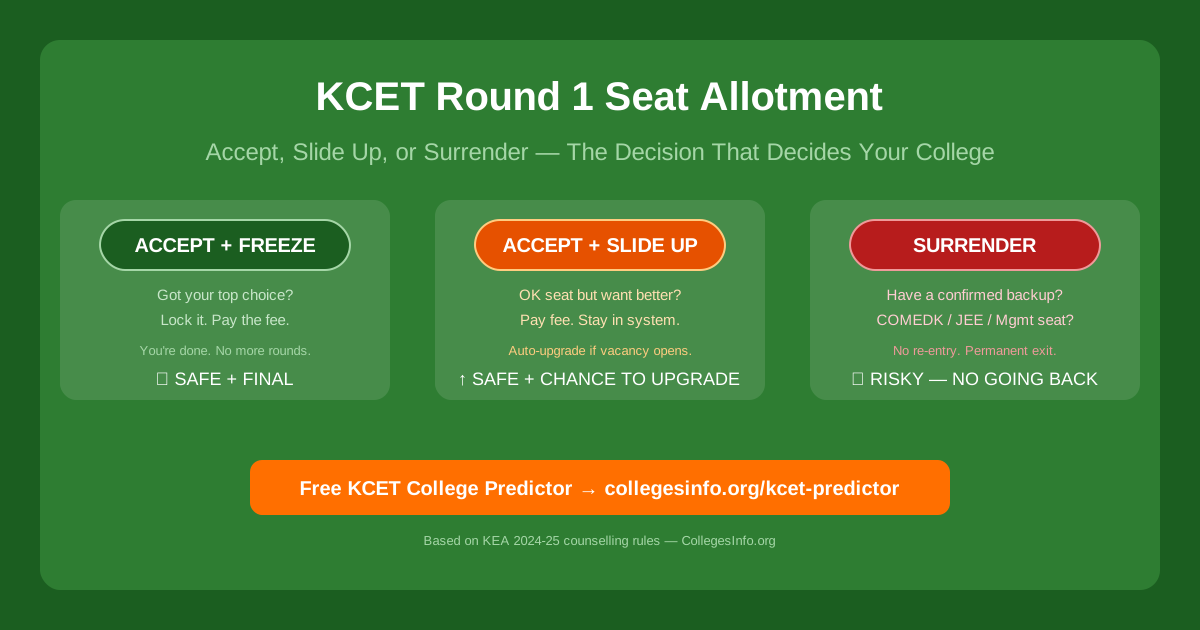
KEA typically runs 3–4 regular rounds plus a spot round. After each round: accept the allotment and pay the seat acceptance fee, or give up the seat and wait for the next round hoping for a better option (risky). Most students get their final seat by Round 2. The spot round in August fills remaining vacant seats — all ranks eligible.
Step 5: Admission at College
After accepting a seat, report to the allotted college with original documents within the KEA deadline. Pay the first-year fees directly to the college — never to any third party. Collect your admission letter and register for classes.
KCET 2026 Category-wise Explanation
Karnataka's KEA counselling has multiple categories that significantly affect rank and seat availability:
| Category | Who Qualifies | Rank Impact |
|---|---|---|
| GM (General Merit) | All Karnataka domicile students | Base rank — highest competition |
| SCH (SC Category) | Scheduled Caste certificate holders | Separate seat pool — closing ranks 3–5× higher than GM |
| STH (ST Category) | Scheduled Tribe certificate holders | Separate seat pool — closing ranks significantly higher |
| OBC (2A/2B/3A/3B) | OBC certificate holders by sub-category | Separate reservation — closing ranks higher than GM |
| Kannada Medium (KM) | Studied in Kannada medium school | 5% additional reservation — valuable at borderline ranks |
| HKR (Hyderabad-Karnataka) | Students from 6 HK districts | Article 371(J) reservation — 8% seats in HK region colleges |
If you qualify for any reservation category, apply for the correct certificate before counselling opens — it can shift your effective rank by thousands of positions. The Kannada-medium bonus (KM) is particularly underused — many eligible students don't apply for it.
Engineering vs Other Streams After KCET
KCET qualifies you for Engineering, Pharmacy, Agriculture and Veterinary courses — not just engineering. If your rank is not competitive for your target engineering college, consider:
- B.Pharma in Karnataka — KCET-based, good career scope, lower competition for seats
- B.Sc Agriculture in Karnataka — Government colleges, low fees, strong placement through ICAR network
- B.Sc Veterinary — KCET-based, limited seats, consistent demand
- BBA → MBA route — bypasses KCET entirely, strong career outcomes
Common Mistakes After KCET Result — What Not to Do
After 21 years of guiding Karnataka students through KCET counselling, I have seen the same mistakes repeated every year. Here are the ones that cause the most damage:
Mistake 1: Using KCET marks alone to predict rank
Already covered above — your PUC board marks contribute equally. Students who only look at KCET marks get shocked by their actual rank. Use the KCET Rank Predictor with both sets of marks from day one.
Mistake 2: Only shortlisting the college, not the branch
A student gets excited about RVCE and fills only RVCE choices — but their rank gets them Mechanical or Civil, not CSE. For most students targeting IT careers, branch matters more than college brand beyond the top 5. Think college AND branch together.
Mistake 3: Waiting for the official rank before planning
The official KCET merit list comes 2–3 weeks after results. Students who wait lose the most preparation time. Use the predictor now, shortlist colleges now, research fees and hostel now. Counselling opens fast after the merit list — being prepared is the only advantage you can control.
Mistake 4: Trusting consultants who guarantee specific seats
No consultant can guarantee a specific KEA seat — seat allotment is purely algorithmic. Anyone claiming to guarantee RVCE CSE or BMS CSE for a fee is lying. The legitimate path is KEA counselling. Management quota seats at private colleges exist but cost 3–5× more and don't go through KEA. Our admission assistance service gives honest guidance — no guarantees, no fees charged to students.
Mistake 5: Ignoring Government Engineering Colleges
GECs in Karnataka — Bapuji Institute, Government Engineering College Haveri, GEC Raichur — are RGUHS affiliated, government job eligible, and cost ₹30,000–50,000/year. At ranks 30,000–80,000, a GEC with a good branch often beats a private college with average placements at 3× the cost. See our guide to Karnataka engineering colleges for complete data.
Rank-wise College Guides — Detailed Guides for Every Rank Range
Based on your estimated rank from the predictor, read the specific guide for your range:
- 📗 KCET rank under 1,000 — RVCE, UVCE, BMS: what you can get
- 📘 KCET rank 1,000 to 5,000 — RV College, BMSCE, PES, DSCE options
- 📙 KCET rank 10,000 to 50,000 — mid-tier Bangalore + good outside-Bangalore options
- 📕 KCET rank above 80,000 — Government colleges, spot round, alternatives
Frequently Asked Questions — KCET Result 2026
KCET vs COMEDK — Which Route Should You Take?
Many Karnataka engineering aspirants appeared for both KCET and COMEDK 2026. After results, one of the most common questions is: which route gives better outcomes? The honest answer depends entirely on your specific rank in each exam and your target college.
| Factor | KCET | COMEDK |
|---|---|---|
| Seat type | Government + Aided + Private (KEA quota) | Private colleges only (management quota) |
| Fees | ₹25,000–₹1.5L/year (regulated) | ₹1.5L–₹3L/year (higher) |
| Government job eligibility | Yes — RGUHS + govt colleges | Yes — same colleges, higher fees |
| UVCE / Govt colleges access | ✅ Yes — only via KCET | ❌ Not available |
| Competition | 1.8L+ students | ~80,000 students |
| Best for | Government college seats, aided college seats, budget-conscious students | Students targeting specific private colleges at ranks where KCET doesn't give access |
Rule of thumb: if KCET gives you CSE at a comparable or better college than COMEDK, go KCET. The seat is regulated, fees are lower and government job eligibility is the same. COMEDK makes sense when it gives access to a significantly better college or branch than your KCET rank allows.
Branch-wise Career Scope — What Different Engineering Branches Actually Offer
With KCET results out and rank estimates in hand, many students face the branch vs college trade-off. Here is an honest breakdown of career outcomes by branch — based on actual hiring trends in Karnataka and the broader Indian tech industry.
Computer Science Engineering (CSE)
The most demanded branch in Karnataka engineering. Starting salaries at Tier-1 companies (TCS, Infosys, Wipro, Accenture) are ₹3.5–6L/year for campus placements. Product companies (Google, Amazon, Microsoft) recruit from top Karnataka colleges at ₹15–50L+ packages. CSE closes at the highest KCET ranks at every college. If you can get CSE at a decent college, take it — but don't accept CSE at a genuinely weak college over ECE or ISE at a strong one. The curriculum matters as much as the label.
Electronics and Communication Engineering (ECE)
Second most competitive after CSE in Karnataka. Core electronics industry (ISRO, DRDO, semiconductor firms, embedded systems companies in Bangalore) actively recruits ECE graduates. Many ECE graduates also enter IT roles — the branch is versatile. VLSI, embedded systems and communication engineering have growing demand in Bangalore's hardware ecosystem. ECE closing ranks at top colleges are 1,500–3,000 higher than CSE at the same college — an important consideration.
Information Science and Engineering (ISE)
Often considered CSE's sibling — curriculum has significant overlap. Most IT companies hire ISE graduates for the same roles as CSE. If you can get ISE at RVCE but not CSE at RVCE, take ISE — the outcome difference is minimal in IT careers. Placements and salary ranges are comparable to CSE at most Karnataka colleges.
Mechanical Engineering
Karnataka has a strong manufacturing and aerospace cluster — HAL, BEL, Toyota Kirloskar, Bosch, Volvo in Bangalore and Pune. Mechanical engineers from good Karnataka colleges get absorbed into this ecosystem. Starting salaries are typically ₹3–5L/year in core manufacturing. Many mechanical graduates also shift to IT roles through data-driven manufacturing (Industry 4.0) positions. RVCE and BMS Mechanical are strong choices if you're genuinely interested in the discipline.
Civil Engineering
Consistent demand from construction, infrastructure and real estate sectors. Karnataka's infrastructure build-out (metro expansion, road projects, smart cities) generates steady employment. Government sector — PWD, BBMP, NHAI — actively recruits civil engineers with starting pay around ₹30,000–50,000/month. Not as flashy as CSE but stable career trajectories. Government college Civil at lower fees often makes more financial sense than private college Civil at high fees.
Artificial Intelligence and Machine Learning (AI/ML)
A relatively new branch offered by most major Karnataka colleges now. In practice, the AI/ML curriculum is largely identical to CSE with additional electives in machine learning, deep learning and data science. Placement outcomes mirror CSE at the same college. The brand value of "AI/ML" on a degree is real — companies do shortlist it specifically. If you're choosing between CSE and AI/ML at the same college with the same rank, AI/ML has no meaningful downside and some upside.
City-wise Guide — Bangalore vs Mangalore vs Other Karnataka Cities for Engineering
Your college's city affects your experience and career outcomes in ways most students don't fully consider before choosing.
Bangalore
Home to 380+ colleges and India's largest tech employment hub. Internship opportunities, startup culture, alumni networks and campus recruitment are strongest here. The trade-off: cost of living is significantly higher (hostel + food = ₹8,000–15,000/month vs ₹5,000–8,000 outside Bangalore), traffic is brutal, and lower-tier Bangalore private colleges often have worse placements than comparable-ranked colleges in Tier-2 cities. See our complete list of engineering colleges in Bangalore.
Mangalore
A strong engineering education hub — NITK Surathkal (NIT, one of India's best), NMAMIT Nitte, SDMCET, Manipal Institute of Technology. Strong placement records, lower cost of living than Bangalore, good hostel infrastructure. Mangalore colleges consistently outperform equivalent-ranked Bangalore private colleges on placements in manufacturing and core engineering roles. See engineering colleges in Mangalore.
Hubli-Dharwad
KLE Technological University (formerly BVB College) is one of North Karnataka's strongest engineering colleges — consistently good placements in IT and manufacturing. SDMCET Dharwad is similarly well-regarded. KCET closing ranks are 5,000–15,000 higher (more accessible) than comparable Bangalore colleges. Good choice for students from North Karnataka who want quality at lower competition. See engineering colleges in Hubli-Dharwad.
Mysuru
NIE, JSS Science and Technology University, Vidyavardhaka College — solid engineering colleges with good local placement networks. Lower cost of living than Bangalore. For students targeting manufacturing or government sector roles in South Karnataka, Mysuru colleges are underrated. See engineering colleges in Mysuru.
Scholarships Available After KCET 2026
Most Karnataka engineering students don't fully exploit scholarship opportunities. Here are the key ones to apply for immediately after result and counselling:
| Scholarship | Who Qualifies | Amount | Apply via |
|---|---|---|---|
| Karnataka Rajyotsava Scholarship | Karnataka domicile, merit-based | ₹4,000–8,000/year | Department of Education Karnataka |
| SC/ST Post-Matric Scholarship | SC/ST category, income limit applies | Full fee reimbursement + maintenance | Social Welfare Department Karnataka |
| OBC Post-Matric Scholarship | OBC category, income limit applies | Partial fee + maintenance allowance | Backward Classes Welfare Dept |
| National Merit Scholarship | Top KCET ranks, income under ₹4.5L | ₹12,000/year | NSP (National Scholarship Portal) |
| Minority Scholarship (Maulana Azad) | Muslim/Christian/Sikh/Buddhist minority | ₹10,000–20,000/year | NSP |
| Vidyasiri Scholarship (EWS) | EWS category, income under ₹8L | ₹2,000/month maintenance | ePass Karnataka |
Apply for all scholarships you qualify for — applications open shortly after admission. Do not wait until mid-year. The ePass Karnataka portal (epass.kar.nic.in) handles most state government scholarships.
What If You Don't Get a Seat in Any KCET Round?
It happens — and it's not the end. Here are the realistic options if KCET counselling doesn't yield a seat:
Option 1: COMEDK Counselling
If you appeared for COMEDK 2026, its counselling runs parallel to KCET. Even a decent COMEDK rank gives access to many Bangalore private colleges for CSE and ECE. Check your COMEDK rank on the official COMEDK portal.
Option 2: Management Quota Direct Admission
Private engineering colleges have 15% management quota seats that are filled outside KEA counselling. No rank required — just KCET qualification (minimum marks). Fees are higher (₹1.5L–₹3L/year) but seats are available after counselling. Contact colleges directly in August–September. Our admission assistance team can guide you on legitimate management quota options.
Option 3: Consider a Different Stream
BCA at a good Bangalore college (Christ University, Jain, Kristu Jayanti) → MCA is a well-established tech career route that bypasses KCET entirely. Many major IT companies explicitly recruit BCA + MCA candidates for software roles. BSc Computer Science at a strong university is another underrated option. BBA + MBA for those interested in business roles.
Option 4: Lateral Entry After Diploma
Complete a 3-year Polytechnic Diploma in Engineering, then apply for Lateral Entry into the 2nd year of B.E. through DCET (Diploma CET) conducted by KEA. This route takes the same total time (diploma: 3 years + B.E. 3 years = 6 years vs B.E. 4 years) but gives a second chance at engineering with a fresh competitive exam. Strong for students who want hands-on technical education from year one.
Education Loan for Engineering in Karnataka
For families where fees are a concern, education loans are more accessible than many students realise. Banks that actively lend for Karnataka engineering admissions:
- State Bank of India (SBI): Student Loan scheme up to ₹10L without collateral; up to ₹40L with collateral. Interest rate around 8.15–9.65% p.a. for education loans.
- Vidya Lakshmi Portal: Government portal at vidyalakshmi.co.in — apply to multiple banks simultaneously. Free, no middleman.
- Canara Bank: IBA Model Education Loan scheme with subsidised interest for SC/ST students under the Central Sector Interest Subsidy (CSIS) scheme.
- Karnataka Bank: Local bank with good understanding of Karnataka college fee structures and processing speed.
Key tip: Apply for the loan before taking the seat — some colleges ask for proof of fee payment readiness during admission. Pre-approval letter from a bank works. Our counselling team connects students with education loan facilities as part of the admission assistance service.
Tools Available at CollegesInfo.org for KCET 2026
We have built several free tools specifically for Karnataka students going through the KCET 2026 process:
- 🎯 KCET Rank Predictor — Enter KCET marks + PUC marks, get estimated rank using KEA's official formula
- 🏥 NEET College Predictor — If you also appeared for NEET, see which Karnataka medical colleges match your score
- 🏛 1,782+ Karnataka College Database — Fees, placements, NAAC grade, hostel, affiliation for every college
- 📊 College Comparison Tool — Compare any two Karnataka colleges side by side
- 📚 Entrance Exam Guide — KCET, COMEDK, NEET, CMAT and other Karnataka entrance exams explained
How to Use KCET Cutoff Data for Smart Choice Filling
Choice filling is where most KCET counselling outcomes are won or lost. Students who understand how to read and apply cutoff data systematically get significantly better allotments than those who fill choices based on name recognition alone. Here is the systematic approach we recommend to every student we counsel.
Step 1 — Build your Master Cutoff Sheet
Download the KEA 2024–25 counselling closing rank data from cetonline.karnataka.gov.in. This is public data — free to access. Create a spreadsheet with three columns: College Name, Branch, Closing Rank (GM or your category). Filter for colleges within rank 1 to your rank + 20,000 (safety buffer). This is your working universe of realistic options.
Step 2 — Apply the 70-20-10 Rule
Divide your choices into three buckets. Seventy percent of your choices should be colleges and branches where you have a high probability of allotment — closing rank well above your estimated rank. Twenty percent should be slight reaches — colleges where closing rank is 1,000–3,000 ahead of your estimated rank. Ten percent can be aspirational reaches — top colleges where your rank is a stretch but the seat still exists in some category. This structure ensures you always get a seat while keeping ambitious options open.
Step 3 — Fill All Available Choices
KEA allows up to 100+ college-branch combinations in choice filling. Fill every single one. Students who fill only 15–20 choices lose options when their preferred seats get taken. The system allots the best available option from your list — there is no penalty for adding more choices at the bottom. A Government Engineering College Civil branch at rank 80,000 as choice number 95 costs you nothing but guarantees you do not go without a seat.
Step 4 — Check Hostel and Cost Before Finalising
Annual fees are one line item. Total cost of attendance includes hostel (₹40,000–₹1.2L/year), food, transport, books and personal expenses. A college charging ₹80,000 in fees but ₹1.2L for hostel costs ₹2L/year total. A Government Engineering College charging ₹30,000 in fees with ₹60,000 hostel costs ₹90,000/year total. The second option saves your family ₹4.4L over 4 years — enough to fund a postgraduate degree. Check hostel availability and rates for each shortlisted college on our college database before locking your choices.
Step 5 — Cross-verify NAAC Grade and Placement Data
NAAC grade is the fastest quality signal. A+ and A++ colleges have passed rigorous independent quality assessment. Check placement percentages from the college's own NIRF data submission — this is mandatory public data for any college ranked by NIRF. A college claiming "100% placement" in brochures but showing 40% in NIRF data is giving you the real number through the NIRF disclosure. Use the NIRF data, not the brochure.
If you want personalised choice-filling guidance — which colleges to prioritise, which to skip, how to sequence your list for maximum allotment probability — our counsellors at CollegesInfo Admissions offer this as part of admission assistance during KCET 2026 counselling season. Call or WhatsApp +916363330233.
Stay Updated During KCET 2026 Counselling
Counselling season moves fast — seat allotment dates, document verification windows and spot round announcements come with short notice. The best way to stay on top of it: bookmark cetonline.karnataka.gov.in and check it every morning during counselling season (June–August 2026). We also publish KEA updates on our entrance exam updates page and in our admission guides blog as official KEA announcements come in — typically within hours of the official notification. If you want direct updates for your rank range, our counsellors send personalised alerts — contact us at CollegesInfo Admissions to register for admission assistance support during the KCET 2026 season.
About the Author
CollegesInfo.org has been covering KCET admissions data since 2019, building on OneCity's print directories published since 2006 — from result day to final seat allotment. The confusion around the rank formula, the counselling process, and the pressure from fake consultants are the same every year. This guide is written from direct experience to help you navigate this without getting misled. Every fact here is sourced from official KEA data. If you have a specific question about your rank and college options, our counselling service is free — contact us at CollegesInfo Admissions. Last updated: May 2026.