By L K Monu Borkala · Tracking Karnataka engineering admissions since 2006
At a glance
Acharya closed Computer Science at rank 21,183 in Round 1 of KEA UGCET-2026, General Merit, Rest of Karnataka. An earlier version of this page gave 19,409, which could not be traced to the official sheet.
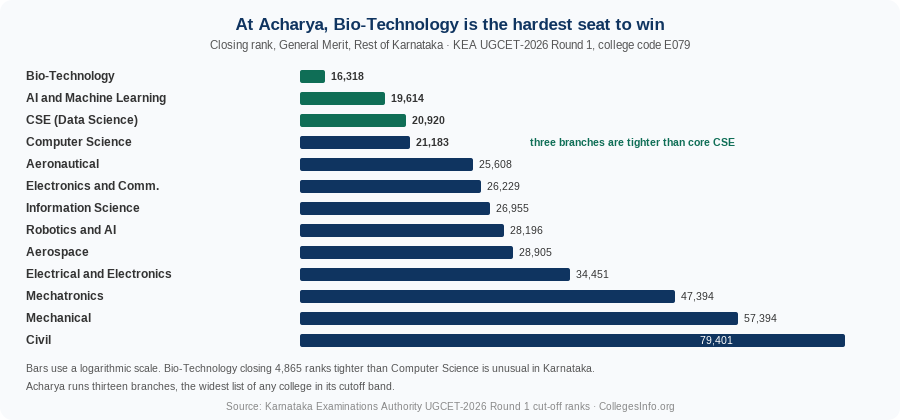
Bio-Technology is the hardest seat on the campus, closing at 16,318 – nearly 5,000 ranks tighter than Computer Science. Artificial Intelligence at 19,614 and Data Science at 20,920 are also tighter than core CSE.
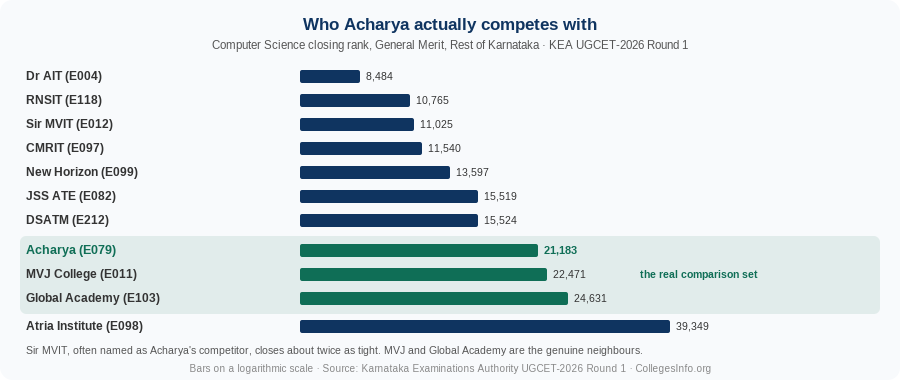
Its real competitors are MVJ and Global Academy, at 22,471 and 24,631. Sir MVIT, which this page used to name as a competitor, closes at 11,025 – about twice as tight.
Thirteen branches, the widest list in its band. Aerospace, Aeronautical, Mechatronics and Robotics all admit here, which is unusual at this cutoff level.
Every closing rank on this page comes from the Karnataka Examinations Authority UGCET-2026 cut-off rank sheets, for the General Merit seat type under the Rest of Karnataka quota, read round by round under college code E079. KEA prints the institution as "Acharya Institute of Technology, Soldevanahalli, Chikkabanavara post, Bangalore" on Hesaraghatta Main Road. The sheets are published at cetonline.karnataka.gov.in.
What KCET rank do you need for Acharya?
Rank 21,183 or better secured Acharya Computer Science in Round 1 of KEA UGCET-2026, and 30,032 by Round 2. The Round 3 figure is not quoted here because that row does not render cleanly enough in the official sheet to attribute with confidence.
If you came to this page expecting about 19,400, that figure was on the earlier version and does not appear in the KEA sheets. The difference matters at the margin: a candidate at rank 20,500 would read 19,409 as out of reach and 21,183 as comfortable, and that is exactly the band this college admits.
Bio-Technology is the hardest seat here, not Computer Science
Bio-Technology closed at 16,318 in Round 1, almost 5,000 ranks tighter than Computer Science at 21,183. Artificial Intelligence and Machine Learning at 19,614 and CSE Data Science at 20,920 are also tighter than the core computing branch.
This is the reverse of the usual Karnataka pattern, where core Computer Science is the most contested seat and everything else follows behind it. Three branches here beat it. For Bio-Technology the likely reason is scale rather than fashion: it is a small intake, and a small intake fills at a tighter rank even with modest demand. The practical consequence for option entry is that you cannot assume the computing branches are the hard ones at this college. If you want Bio-Technology you need a better rank than if you want CSE.
| Branch | Round 1 | Round 2 | Round 3 |
|---|---|---|---|
| Bio-Technology | 16,318 | 31,858 | 63,790 |
| Artificial Intelligence and Machine Learning | 19,614 | 26,738 | 37,629 |
| CSE (Data Science) | 20,920 | 30,950 | not readable |
| Computer Science and Engineering | 21,183 | 30,032 | not readable |
| Aeronautical Engineering | 25,608 | 35,324 | 81,587 |
| Electronics and Communication | 26,229 | 35,051 | 50,876 |
| Information Science and Engineering | 26,955 | 37,959 | 71,146 |
| Robotics and Artificial Intelligence | 28,196 | 38,217 | 88,142 |
| Aerospace Engineering | 28,905 | not readable | not readable |
| Electrical and Electronics | 34,451 | 47,149 | not readable |
| Mechatronics | 47,394 | 62,409 | 116,978 |
| Mechanical Engineering | 57,394 | 68,080 | 165,204 |
| Civil Engineering | 79,401 | 90,561 | 212,092 |
Thirteen branches is the widest list of any college in this cutoff band, and the spread from Bio-Technology at 16,318 to Civil at 79,401 is almost five-fold. An earlier version of this page gave branch cutoffs as ranges such as 15,000 to 22,000 and 22,000 to 28,000; those ranges do not correspond to the figures above and have been replaced with the round-by-round numbers.
The move from Round 1 to Round 2 is worth reading separately, because it is unusually large here. Bio-Technology nearly doubles, from 16,318 to 31,858, and Computer Science goes from 21,183 to 30,032. A branch that widens that much in one round was taken early by candidates who then upgraded away, which means a rank that looks short on the Round 1 column is often comfortable by the second round. The flip side is that the branch you wanted may already be full even though the threshold has moved past your rank, so waiting buys you a wider gate and a thinner choice at the same time.
The unusual branches, and whether they are worth it
Acharya offers Aerospace at 28,905, Aeronautical at 25,608, Mechatronics at 47,394 and Robotics and Artificial Intelligence at 28,196. Very few colleges at this cutoff level run any of these, let alone all four.
Breadth of this kind cuts both ways and the honest answer is that the cutoff cannot tell you which. A niche branch at a loose cutoff may mean a genuine specialism that few places offer, or an intake that does not fill. What the official sheet does show is that the two aviation branches admit at tighter ranks than Mechanical at 57,394 and Civil at 79,401, so they are not the least-wanted seats on campus. Before choosing one, ask the department directly how many students are in the current final year and where they went, because for a small specialised intake those two numbers tell you more than any ranking.
Who Acharya actually competes with
Acharya's nearest neighbours by cutoff are MVJ College of Engineering at 22,471 and Global Academy of Technology at 24,631. An earlier version of this page said it "competes with Sir MVIT", but Sir MVIT closed at 11,025, roughly twice as tight, and is not in the same band.
Getting the comparison set right changes what you do with the page. A candidate at rank 21,000 choosing between Acharya, MVJ and Global Academy is making a real decision between three reachable colleges. The same candidate treating Sir MVIT or RNSIT as alternatives is comparing against seats that closed at half the rank, which turns a live choice into a false one.
| College | KEA code | Round 1 | Against Acharya |
|---|---|---|---|
| Dr Ambedkar Institute of Technology | E004 | 8,484 | 2.5 times tighter |
| RNS Institute of Technology | E118 | 10,765 | 2 times tighter |
| Sir M Visvesvaraya Institute of Technology | E012 | 11,025 | 1.9 times tighter |
| CMR Institute of Technology | E097 | 11,540 | 1.8 times tighter |
| New Horizon College of Engineering | E099 | 13,597 | 1.6 times tighter |
| JSS Academy of Technical Education | E082 | 15,519 | 1.4 times tighter |
| Acharya Institute of Technology | E079 | 21,183 | – |
| MVJ College of Engineering | E011 | 22,471 | practically level |
| Global Academy of Technology | E103 | 24,631 | 1.2 times looser |
| Atria Institute of Technology | E098 | 39,349 | 1.9 times looser |
Two colleges that often appear on lists alongside Acharya are missing from this table on purpose. REVA University and SJB Institute of Technology both have rows in the official sheet that do not render cleanly enough to attribute a General Merit figure to, so no number is published for either rather than a figure that might belong to the neighbouring column. For the wider field see the Bangalore engineering colleges comparison and the rank 10,000 to 20,000 guide.
Acharya is not autonomous, and several of its neighbours are
KEA prints Acharya without the autonomous marker that it attaches to many colleges in the same band. RNSIT, MVJ, Atria, Global Academy, New Horizon, SJB and Dayananda Sagar Academy of Technology and Management all carry "(AUTONOMOUS)" in the 2026 register. Acharya, Sir MVIT, CMR Institute of Technology and JSS Academy of Technical Education do not.
This is one of the few institutional differences in this band that can be read from an official source rather than inferred from marketing. An autonomous college sets its own syllabus and runs its own examinations within the university framework; an affiliated one follows the university's. Which you prefer is a genuine question rather than a ranking, and it is worth asking current students at both kinds how it works in practice. Affiliation and examination rules here run through Visvesvaraya Technological University.
What a reserved category is worth at Acharya
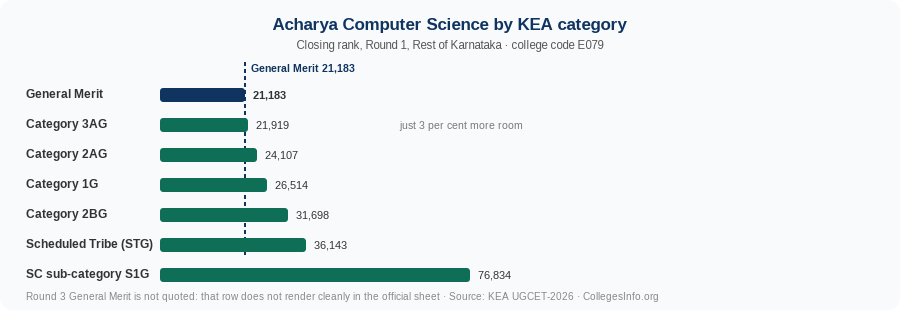
Almost nothing for Category 3AG, which closed at 21,919 against a General Merit rank of 21,183, about 3 per cent more room. Category 2AG at 24,107 and Category 1G at 26,514 add more, and the Scheduled Caste sub-category S1G at 76,834 is where the difference becomes large.
KEA considers a candidate in both the General Merit pool and their own category pool, and the seat comes from whichever closes later for them. A narrow gap between the two, as here, is a sign the college is not being bid up: General Merit is already close to where the category pools sit, because supply is adequate at this rank. The practical step is to read your own category column rather than assuming a category always buys meaningful room.
| Category | Closing rank | Against General Merit |
|---|---|---|
| General Merit | 21,183 | – |
| 3AG | 21,919 | 3 per cent more room |
| 2AG | 24,107 | 14 per cent more room |
| 1G | 26,514 | 25 per cent more room |
| 2BG | 31,698 | 50 per cent more room |
| Scheduled Tribe (STG) | 36,143 | 71 per cent more room |
| SC sub-category S1G | 76,834 | 3.6 times more room |
Round 3 category figures are not published here. The General Merit row for Round 3 does not render cleanly in the official sheet, and without it the category comparisons for that round would have no baseline. Category codes follow KEA's own notation, where 1G, 2AG, 2BG and 3AG are backward class categories.
What you will actually pay
No fee figure is quoted on this page. Acharya's own website says fees "vary by programme and institution" and links to a separate fee structure document without stating amounts, and the figures in the earlier version of this page could not be traced to the KEA fee notification.
What was there is worth naming so you know what has gone: a per-branch fee table running from Rs 70,000 to Rs 1,00,000 a year, a management-quota range of Rs 2,00,000 to Rs 3,50,000, hostel fees of Rs 40,000 to Rs 80,000 and four-year totals built on top of those. None of it was sourced. The structure that does hold is the three-channel one: a seat allotted through KCET counselling is priced by the Karnataka government fee agreement and published in the KEA fee notification, a COMEDK seat sits above it, and a management-quota seat is set by the institution and is the highest. The Bangalore management quota guide and the COMEDK against KCET comparison cover the other two routes. For the cheapest options in the city see the government engineering colleges in Bangalore.
Placements and accreditation, and why neither is quoted
Acharya publishes no placement numbers and no NAAC grade on its own website. The earlier version of this page gave "placements avg Rs 3.5 to 5.5 LPA" and "NAAC A", and neither can be sourced.
The site links to a Training and Placements section and shows a recruiters graphic, but gives no count of students placed, no average and no highest package. On accreditation it names NAAC among its recognitions without a grade, a CGPA or a validity period. The CollegesInfo database holds A plus for the institution, which is not a primary source. A grade with no cycle attached is worth little in a comparison, and the authoritative record is the institutional accreditation entry on the NAAC portal at naac.gov.in. Where a college does publish its own figures, as some in this band do, this site quotes them with attribution; here there are none to quote.
What each KCET rank band reaches
Acharya is a Round 1 option from about rank 16,000 for Bio-Technology and about 21,000 for Computer Science. Below 16,000 the colleges above it in the table come into range and are measurably more selective.
| Your rank | What is in reach | What to weigh |
|---|---|---|
| Under 16,000 | Every branch at Acharya | New Horizon, CMRIT, Sir MVIT and RNSIT are all tighter; compare first |
| 16,000 to 19,600 | Bio-Technology, and everything below it | Bio-Technology is the only tight seat in this band |
| 19,600 to 21,200 | AI and Machine Learning, Data Science, CSE | Three computing options within 1,600 ranks of each other |
| 21,200 to 29,000 | Aeronautical, ECE, Information Science, Robotics, Aerospace | MVJ at 22,471 and Global Academy at 24,631 are the alternatives |
| 29,000 to 48,000 | Electrical and Electronics, Mechatronics | CSE reopens at 30,032 in Round 2 if you can wait |
| Above 48,000 | Mechanical, Civil | A core branch here or a computing branch at a looser college |
If your rank is well under 16,000 it is worth reading the rank 1 to 5,000 guide or the state-wide engineering college list before settling. The KCET rank predictor works off the same official sheets, the option entry order guide explains how the rounds interact, and the college choice checklist covers the questions a cutoff cannot answer.
How to apply for 2027-28 admission
Acharya admits through KCET for the government-quota seats covered on this page, with the 2027 examination feeding the 2027-28 academic year. Registration, the examination, results and three counselling rounds all run through the KEA portal.
The sequence is stable: online application and document upload, the examination, provisional results and rank card, document verification, then option entry followed by the three allotment rounds. Option entry decides the outcome, because the allotment runs on the order of your choices. At a college with thirteen branches spread across a five-fold range of cutoffs, the order you list those branches in matters more than whether you list the college at all. Figures here will be updated when the 2027 sheets are published.
The Acharya Institute of Technology profile carries the department and campus detail, and the full college directory covers the rest.
Frequently Asked Questions
What KCET rank is needed for Acharya CSE?
Rank 21,183 or better secured Acharya Computer Science in Round 1 of KEA UGCET-2026 under the General Merit, Rest of Karnataka seat type, and 30,032 by Round 2. The Round 3 figure is not quoted because that row does not render cleanly in the official sheet.
Is the Acharya cutoff 19,409?
No. That figure appeared in an earlier version of this page and cannot be traced to the KEA cut-off sheets. The Round 1 General Merit closing rank for Computer Science under code E079 is 21,183.
Which is the hardest branch to get into at Acharya?
Bio-Technology, which closed at 16,318 in Round 1, nearly 5,000 ranks tighter than Computer Science at 21,183. Artificial Intelligence at 19,614 and Data Science at 20,920 are also tighter than core CSE.
Does Acharya compete with Sir MVIT?
Not on selectivity. Sir MVIT closed CSE at 11,025 against Acharya at 21,183, about twice as tight. Acharya's nearest neighbours are MVJ College of Engineering at 22,471 and Global Academy of Technology at 24,631.
Is Acharya Institute of Technology autonomous?
No. KEA prints it without the autonomous marker it attaches to RNSIT, MVJ, Atria, Global Academy, New Horizon and others in the same band. Acharya is affiliated to Visvesvaraya Technological University.
How many branches does Acharya offer through KCET?
Thirteen appear in the KEA UGCET-2026 register, including Aerospace, Aeronautical, Mechatronics and Robotics and Artificial Intelligence. That is the widest branch list of any college in its cutoff band.
What is the Acharya fee?
No figure is quoted here. Acharya's own website says fees vary by programme and links to a separate document without stating amounts, and the government-quota fee is set by the Karnataka fee agreement and published in the KEA fee notification each year.
What are Acharya placements?
The college publishes no placement count, no average and no highest package on its own website, so none is quoted here. An earlier version of this page gave an average of Rs 3.5 to 5.5 LPA, which could not be sourced.
What NAAC grade does Acharya hold?
Its own website names NAAC among its recognitions without stating a grade, CGPA or validity period, so this page does not claim one. The institutional record on the NAAC portal is where a grade should be read from.
Does a reserved category help at Acharya?
Only a little for most categories. Category 3AG closed at 21,919 against a General Merit rank of 21,183, about 3 per cent more room, while the Scheduled Caste sub-category S1G at 76,834 is 3.6 times more room.