By L K Monu Borkala · Tracking Karnataka engineering admissions since 2006
At a glance
RNSIT closed Computer Science at rank 10,765 in Round 1 of KEA UGCET-2026, General Merit, Rest of Karnataka. An earlier version of this page gave 11,545, which could not be traced to the official sheet.
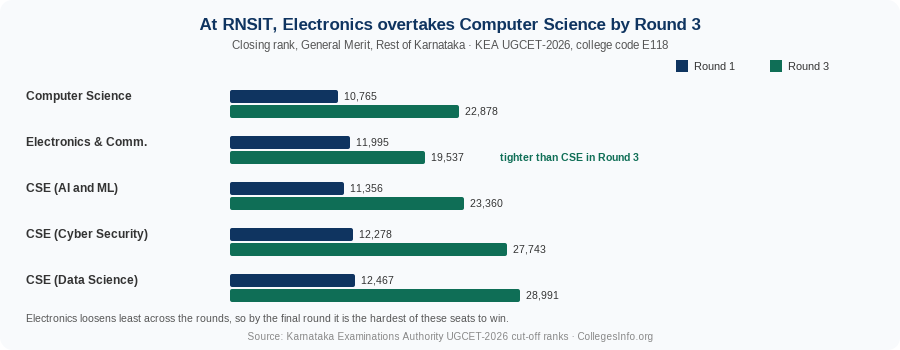
Electronics is the harder seat by the final round. ECE closes at 11,995 in Round 1 against CSE at 10,765, but by Round 3 ECE is at 19,537 and CSE has widened to 22,878. Electronics overtakes it.
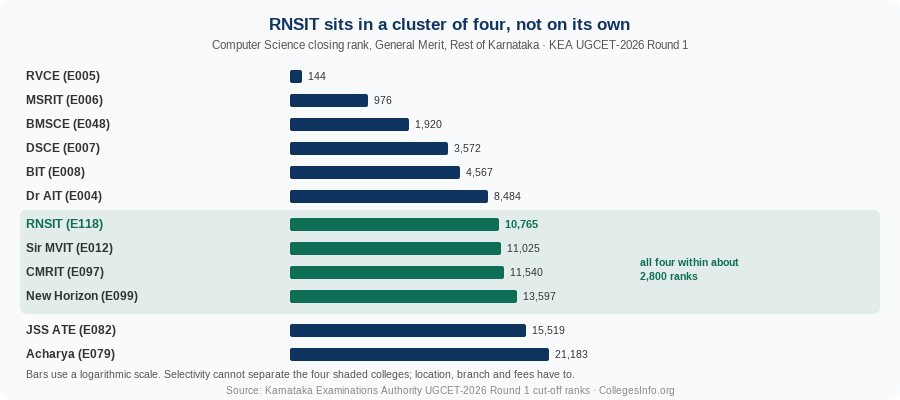
It sits in a tight cluster of four. Sir MVIT closed at 11,025, CMR Institute of Technology at 11,540 and New Horizon at 13,597, all within about 2,800 ranks of RNSIT. These four are genuine alternatives to each other.
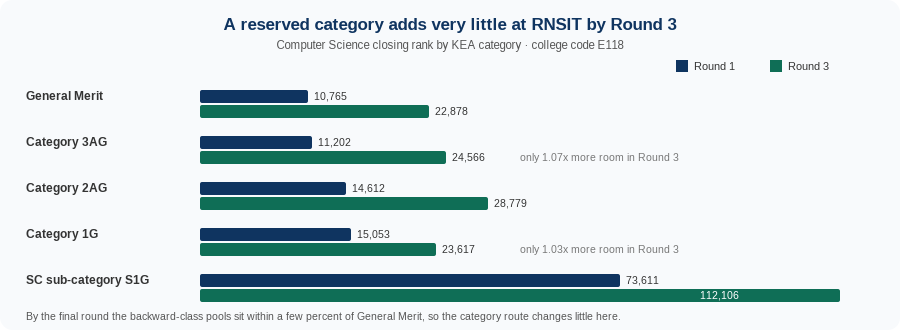
A reserved category adds little here by Round 3. Category 1G closes at 23,617 against a General Merit rank of 22,878, about 3 per cent more room.
Every closing rank on this page comes from the Karnataka Examinations Authority UGCET-2026 cut-off rank sheets, for the General Merit seat type under the Rest of Karnataka quota, read round by round under college code E118. KEA prints the institution as "RNS Institute of Technology, Bangalore (AUTONOMOUS)" at Channasandra on the Uttarahalli-Kengeri main road. The sheets are published at cetonline.karnataka.gov.in.
What KCET rank do you need for RNSIT?
Rank 10,765 or better secured RNSIT Computer Science in Round 1 of KEA UGCET-2026. By Round 2 the closing rank had widened to 14,549 and by Round 3 to 22,878, so the answer depends entirely on which round you are planning around.
That spread matters more at RNSIT than at a college in heavier demand. A candidate at rank 20,000 has no Round 1 path to CSE here and a realistic Round 3 one. A candidate at 11,000 is just outside in Round 1 and comfortable by Round 2. Planning against a single number, as most pages present it, hides the round that actually decides the outcome.
Branch by branch, and why Electronics is the surprise
Electronics and Communication is the hardest RNSIT seat to win by the final round, not Computer Science. ECE closes at 19,537 in Round 3 while CSE has widened to 22,878, because ECE loosens far less across the rounds than any computing branch here.
The reason is demand behaviour rather than quality. Computing seats at a college in this band are heavily chosen in Round 1 by candidates who then upgrade away in later rounds, which pushes the closing rank out. Electronics attracts a smaller, steadier set of candidates who tend to hold their seat. The practical consequence is that if you want ECE at RNSIT, Round 1 is not meaningfully easier than Round 3, and if you want CSE, waiting does help.
| Branch | Round 1 | Round 2 | Round 3 |
|---|---|---|---|
| Computer Science and Engineering | 10,765 | 14,549 | 22,878 |
| CSE (Artificial Intelligence and Machine Learning) | 11,356 | 15,360 | 23,360 |
| Electronics and Communication | 11,995 | 15,076 | 19,537 |
| CSE (Cyber Security) | 12,278 | 16,930 | 27,743 |
| CSE (Data Science) | 12,467 | 16,767 | 28,991 |
| Computer Science and Business Systems | 13,112 | 18,025 | 33,469 |
| Electronics (VLSI Design and Technology) | 13,784 | 17,746 | 29,862 |
| Electrical and Electronics | 17,223 | 27,116 | 45,688 |
| Mechanical Engineering | 33,392 | 39,117 | 62,385 |
| Civil Engineering | 55,967 | 74,946 | 171,355 |
The five computing variants sit within about 1,700 ranks of each other in Round 1, from CSE at 10,765 to Computer Science and Business Systems at 13,112. That is a narrow band, and it means the choice between them is a question of what you want to study rather than what your rank forces on you. By Round 3 they have fanned out to more than 10,000 ranks apart, with the specialised streams loosening fastest.
How far each branch moves between rounds
The spread between Round 1 and Round 3 is not the same for every branch, and the difference is large enough to change how you order your choices. Computer Science and Business Systems widens by 2.6 times across the three rounds; Electronics and Communication by only 1.6 times.
Read that as a measure of how firmly each seat is held. A branch that widens a lot was taken early by candidates who later moved to something they preferred, releasing seats back into the pool. A branch that barely widens was taken by candidates who stayed. For option entry the consequence is practical: for the branches at the top of this table there is real benefit in listing them even if your rank looks short in Round 1, because the seat may come to you later. For Electronics there is not much benefit in waiting, so if it is what you want it belongs high in your list from the start.
| Branch | Round 1 | Round 3 | Widens by |
|---|---|---|---|
| Computer Science and Business Systems | 13,112 | 33,469 | 2.6 times |
| CSE (Data Science) | 12,467 | 28,991 | 2.3 times |
| CSE (Cyber Security) | 12,278 | 27,743 | 2.3 times |
| Electronics (VLSI Design and Technology) | 13,784 | 29,862 | 2.2 times |
| Computer Science and Engineering | 10,765 | 22,878 | 2.1 times |
| CSE (Artificial Intelligence and Machine Learning) | 11,356 | 23,360 | 2.1 times |
| Electronics and Communication | 11,995 | 19,537 | 1.6 times |
The branches outside computing
Electrical and Electronics closes at 17,223, Mechanical at 33,392 and Civil at 55,967 in Round 1, so the non-computing branches sit well clear of the computing band. Civil is the loosest seat at RNSIT by a wide margin and widens furthest, reaching 171,355 by Round 3.
That gap of roughly 45,000 ranks between Computer Science and Civil at the same college, with the same faculty and the same degree certificate, is the single largest determinant of what your rank buys here. A candidate at rank 40,000 who wants to study at RNSIT can have Mechanical or Civil but no computing branch in any round. A candidate at 12,000 can have any of them. Branch, not college, is the real decision at this level of the Karnataka table, and it is worth being honest with yourself about whether you want the subject or the address.
Where RNSIT actually sits in Bangalore
RNSIT sits in a cluster of four colleges within about 2,800 ranks of each other: itself at 10,765, Sir M Visvesvaraya Institute of Technology at 11,025, CMR Institute of Technology at 11,540 and New Horizon College of Engineering at 13,597. For a candidate in this band all four are live options, and the cutoff does not separate them meaningfully.
That is worth stating because selectivity is the one thing that cannot distinguish these four. A difference of 260 ranks between RNSIT and Sir MVIT, or 2,800 between RNSIT and New Horizon, is inside the noise of how a single year's allotment runs. The decision has to be made on location, the specific branch you want, the fee channel you enter through and what each campus is actually like. Dr Ambedkar Institute of Technology at 8,484 is the next real step up, and JSS Academy of Technical Education at 15,519 and Dayananda Sagar Academy of Technology and Management at 15,524 the next step down.
| College | KEA code | Round 1 | How it compares with RNSIT |
|---|---|---|---|
| RVCE | E005 | 144 | 75 times tighter |
| MSRIT | E006 | 976 | 11 times tighter |
| BMSCE | E048 | 1,920 | 5.6 times tighter |
| DSCE | E007 | 3,572 | 3 times tighter |
| Bangalore Institute of Technology | E008 | 4,567 | 2.4 times tighter |
| Dr Ambedkar Institute of Technology | E004 | 8,484 | 1.3 times tighter |
| RNSIT | E118 | 10,765 | – |
| Sir M Visvesvaraya Institute of Technology | E012 | 11,025 | practically level |
| CMR Institute of Technology | E097 | 11,540 | practically level |
| New Horizon (NHCE) | E099 | 13,597 | 1.3 times looser |
| JSS Academy of Technical Education | E082 | 15,519 | 1.4 times looser |
| Acharya Institute of Technology | E079 | 21,183 | 2 times looser |
If your rank reaches RNSIT it also reaches Sir MVIT, CMRIT and New Horizon, so the choice among those four comes down to location, branch availability and fees rather than selectivity. For the full Bangalore picture see the Bangalore engineering colleges comparison, and for the cheaper state-funded options the government engineering colleges in Bangalore guide.
What a reserved category is worth at RNSIT
Very little by the final round. Category 1G closes at 23,617 in Round 3 against a General Merit rank of 22,878, about 3 per cent more room, and Category 3AG at 24,566 is about 7 per cent.
KEA considers a candidate in both the General Merit pool and their own category pool, and the seat comes from whichever closes later for them. At a college in heavy demand that gap is wide, because General Merit is bid up far beyond the category pools. At RNSIT the pools sit close together, which tells you the college is not being bid up: there is enough supply that the General Merit rank is already near the category ranks. The exception is the Scheduled Caste sub-category, where S1G closes at 73,611 in Round 1 against 10,765 General Merit.
| Round | GM | 1G | 2AG | 2BG | 3AG | STG | S1G |
|---|---|---|---|---|---|---|---|
| Round 1 | 10,765 | 15,053 | 14,612 | 18,584 | 11,202 | 25,236 | 73,611 |
| Round 3 | 22,878 | 23,617 | 28,779 | 36,446 | 24,566 | 40,960 | 112,106 |
An earlier version of this page gave an "OBC cutoff" of about 17,162 and an SC cutoff of about 59,614. Neither figure appears in the official sheet, and OBC is not a KEA category at all: the sheet uses 1G, 2AG, 2BG, 3AG and 3BG for the backward classes. Both numbers have been replaced with the categories KEA actually publishes. Category codes follow that notation, where STG is Scheduled Tribe and S1G is a Scheduled Caste sub-category.
What RNSIT publishes about its own placements
RNSIT's own website reports 1,060 students placed for 2025 with a highest package of 50 LPA, and 945 placed for 2026 with the cycle marked ongoing and a highest package of 20.87 LPA. It does not publish an average package.
That last point is why no average appears here. An earlier version of this page gave "Rs 4-6 LPA average", which is not a figure the college states anywhere, and an average is the number most worth having and most often invented. The highest package is also worth reading carefully: a 50 LPA peak describes one offer, not the distribution, and the drop to 20.87 LPA in an ongoing cycle shows how much that single number moves year to year. Figures are as published at rnsit.ac.in and are the institution's own, not independently audited.
What you will actually pay
RNSIT's website links to fee-structure documents for the COMEDK and management-quota routes but states no amounts on the page itself, so no fee figure is quoted here. An earlier version gave Rs 55,000 to Rs 90,000 a year for the government quota, which could not be traced to the KEA fee notification.
The structure is what to understand. A seat allotted through KCET counselling is priced by the Karnataka government fee agreement and published in the KEA fee notification. A COMEDK seat sits above it. A management-quota seat is priced by the institution and is the highest, often several times the government-quota figure, as the Bangalore management quota guide sets out. Which channel you enter through affects the total cost of the degree far more than which college in this band you pick. The difference between the KCET and COMEDK routes is covered in the COMEDK against KCET comparison.
A note on the NAAC grade
RNSIT's own website lists NAAC under its accreditations but states no grade, no CGPA and no validity period. This page therefore does not claim one, although the CollegesInfo database holds A plus for the institution.
An earlier version carried "NAAC A+" in its meta description. A grade with no cycle and no validity date attached is worth little in a comparison, and the authoritative record is the institutional accreditation entry on the NAAC portal at naac.gov.in. What can be said from the official register is that KEA prints RNSIT as autonomous, and the college was established in 2001.
Who RNSIT suits, and who it does not
RNSIT fits a candidate in the 8,000 to 15,000 band who wants a computing branch in Bangalore and is choosing between it and Sir MVIT. Below about 8,000 the question changes, because Dr AIT, BIT and DSCE come into range and they are measurably more selective.
| Your rank | What is in reach | What to weigh |
|---|---|---|
| Under 8,500 | Everything at RNSIT, and better elsewhere | Dr AIT, BIT and DSCE are all tighter; compare before settling |
| 8,500 to 10,800 | CSE in Round 1 | Sir MVIT at 11,025 is the direct alternative |
| 10,800 to 12,500 | CSE by Round 2, ECE and the AI stream in Round 1 | ECE at 11,995 holds its value better across rounds |
| 12,500 to 14,000 | Cyber Security, Data Science, CS and Business Systems | These three loosen fastest; Round 1 is the expensive round for them |
| 14,000 to 23,000 | CSE and ECE by later rounds | CSE reaches 22,878 by Round 3, ECE only 19,537 |
| Above 23,000 | EEE, Mechanical, Civil | A core branch here often beats a computing branch at a far looser college |
If your rank is under 5,000 this page is probably not the right one to be reading. The rank 1 to 5,000 guide covers what that band reaches, and the rank 10,000 to 20,000 guide covers the band RNSIT actually sits in. The KCET rank predictor works off the same official sheets, and the option entry order guide explains how the rounds interact. For a broader framework there is the college choice checklist.
How to apply for 2027-28 admission
RNSIT admits through KCET for the government-quota seats covered on this page, with the 2027 examination feeding the 2027-28 academic year. Registration, the examination, results and three counselling rounds all run through the KEA portal.
The sequence is stable: online application and document upload, the examination, provisional results and rank card, document verification, then option entry followed by the three allotment rounds. Option entry decides the outcome, because the allotment runs on the order of your choices. Given how differently the branches at RNSIT behave across rounds, the order you put them in matters more here than the college-level decision. Affiliation and examination rules run through Visvesvaraya Technological University, with RNSIT holding autonomous status. Figures on this page will be updated when the 2027 sheets are published.
The RNSIT college profile carries the department and facility detail, and the state-wide engineering college list and full college directory cover everything else.
Frequently Asked Questions
What KCET rank is needed for RNSIT CSE?
Rank 10,765 or better secured RNSIT Computer Science in Round 1 of KEA UGCET-2026 under the General Merit, Rest of Karnataka seat type. By Round 2 it had widened to 14,549 and by Round 3 to 22,878.
Is the RNSIT cutoff 11,545?
No. That figure appeared in an earlier version of this page and cannot be traced to the KEA cut-off sheets. The Round 1 General Merit closing rank for Computer Science under code E118 is 10,765.
Which is harder to get at RNSIT, CSE or Electronics?
It depends on the round. Computer Science is tighter in Round 1 at 10,765 against 11,995 for Electronics, but by Round 3 Electronics is the harder seat at 19,537 against 22,878 for CSE.
Is RNSIT comparable to NHCE?
Yes, on selectivity they are close. RNSIT closed CSE at 10,765 in Round 1 and New Horizon at 13,597, about 1.3 times looser. Sir MVIT at 11,025 and CMR Institute of Technology at 11,540 sit between them, so all four are genuine alternatives.
Does a reserved category help much at RNSIT?
Not by the final round. Category 1G closes at 23,617 in Round 3 against a General Merit rank of 22,878, roughly 3 per cent more room. The Scheduled Caste sub-category is the exception, closing at 73,611 in Round 1.
What are RNSIT placements?
RNSIT reports 1,060 students placed for 2025 with a highest package of 50 LPA, and 945 placed for 2026 with that cycle marked ongoing. The college does not publish an average package, so none is quoted here.
What is the RNSIT fee?
No figure is quoted on this page. RNSIT links to fee documents rather than stating amounts, and the government-quota fee is set by the Karnataka fee agreement and published in the KEA fee notification each year.
Is RNSIT autonomous?
Yes. KEA prints the institution as RNS Institute of Technology, Bangalore (AUTONOMOUS) in the UGCET-2026 register, and examination rules run through Visvesvaraya Technological University.
What NAAC grade does RNSIT hold?
Its own website lists NAAC among its accreditations without stating a grade, cycle or validity period, so this page does not claim one. The institutional record at naac.gov.in is where a grade should be read from.
Which branch at RNSIT loosens most between rounds?
Computer Science and Business Systems, which moves from 13,112 in Round 1 to 33,469 in Round 3. Electronics and Communication moves least, from 11,995 to 19,537.