Last Updated: August 26, 2026
Diploma in Engineering (Polytechnic) is one of Karnataka's most undervalued educational pathways. While most SSLC toppers rush toward PU Science, the diploma route offers something PU cannot: hands-on technical skills, immediate employability after 3 years, and a lateral entry shortcut to BTech that saves one full year compared to the PU + engineering route. Karnataka has 56+ polytechnic colleges producing technically skilled graduates who are increasingly in demand across manufacturing, IT, construction, and emerging technology sectors.
Having worked in Karnataka education since 2006, we have seen diploma graduates build careers that match or exceed many degree holders in practical skills and early earning potential. This guide covers the best polytechnic colleges in Karnataka, the admission process through DCET, branch selection, fee structures, lateral entry to engineering, and honest career prospects for 2026.
Why Consider Diploma Over PU?
Most families dismiss diploma as an option for students who "could not get into PU Science." This perception is factually wrong and financially costly. Here is the honest comparison.
Time to career: PU (2 years) + BTech (4 years) = 6 years before you start earning. Diploma (3 years) gets you working in 3 years. Even with lateral entry to BTech (3 more years), the total is still 6 years but you have been earning for 3 years before the BTech graduate starts.
Practical skills: Diploma education is 60-70% practical and lab-based. Students work with machines, circuits, software, and construction materials from the first semester. BTech through PU route is more theoretical in the first 2 years (PU) before practical engineering begins.
Cost comparison: Government polytechnic diploma costs Rs 5,000-15,000 per year. Total 3-year cost: Rs 15,000-45,000. PU Science + Private BTech costs Rs 50,000-3,00,000 per year combined. Total 6-year cost: Rs 5-15 lakh. The diploma path saves Rs 3-12 lakh compared to PU + private engineering.
Lateral entry advantage: After diploma, students can enter BTech 2nd year directly through lateral entry (DCET counselling). This means a diploma holder completes BTech in 3 more years (total 6 years) getting the same BTech degree as a PU + engineering student but with stronger practical skills and at lower total cost.
Immediate employment: A diploma holder can start working after 3 years at Rs 12,000-25,000 per month. This is valuable for families where early earning is essential. The student can work and pursue BTech through lateral entry part-time or evening colleges if desired.
Diploma Admission in Karnataka: DCET Process
Eligibility: Pass SSLC (10th standard) with minimum 35% aggregate. Some competitive branches may require higher marks informally. Age: minimum 15 years at admission.
DCET (Diploma Common Entrance Test): Karnataka conducts DCET for admission to government and private polytechnics. The test covers basic Mathematics, Science, and General Knowledge at the 10th standard level. DCET is conducted by the Board of Technical Examinations (BTE), Karnataka.
Counselling: After DCET results, students participate in online counselling at bfrte.karnataka.gov.in or designated portal. Choice filling for government and private polytechnics based on DCET rank.
Direct admission: Private polytechnics also offer direct admission based on SSLC marks without DCET for management quota seats.
Best Government Polytechnics in Karnataka
Government Polytechnic KR Puram, Bangalore
The most prestigious government polytechnic in Karnataka, located in KR Puram, East Bangalore. Offers diploma programs in Computer Science, Electronics, Mechanical, Civil, Electrical, and Automobile Engineering. Faculty are experienced government-appointed specialists. Labs and workshops are well-equipped with industry-standard machines. DCET cutoff is the highest among Karnataka polytechnics. Placement support through the polytechnic placement cell with IT and manufacturing companies recruiting regularly.
Fees: Rs 5,000-15,000 per year. Best for: Top DCET rank holders wanting the strongest government polytechnic education in Bangalore.
MEI Polytechnic Bangalore
Mysore Electrical Industries Polytechnic is another highly respected Bangalore polytechnic with a long history of producing quality diploma engineers. Located in Rajajinagar, West Bangalore, with excellent lab facilities particularly for Electrical and Electronics branches. Strong alumni network in Bangalore manufacturing and IT sectors.
Fees: Rs 5,000-15,000 per year. Best for: Students targeting electrical and electronics diploma careers.
Sri Jayachamarajendra Polytechnic Bangalore
SJ Polytechnic is one of Bangalore oldest and most established polytechnics. Located near Majestic area with excellent accessibility. Offers thorough diploma programs across engineering branches. Historical reputation for producing skilled technicians and supervisors for Bangalore industries.
Fees: Rs 5,000-15,000 per year. Best for: Central Bangalore students wanting heritage polytechnic education.
Government Polytechnic Mangalore
The premier government polytechnic for coastal Karnataka. Serves students from Dakshina Kannada, Udupi, and Uttara Kannada districts. Strong Mechanical, Civil, and Electronics departments reflecting the coastal industrial landscape. Many graduates find employment in Mangalore MRPL refinery, port operations, and construction sectors.
Fees: Rs 5,000-15,000 per year. Best for: Coastal Karnataka students wanting affordable technical education.
Bapuji Polytechnic Davangere
Part of the Bapuji Educational Association, one of central Karnataka's largest education trusts. The polytechnic has strong connections with the Davangere industrial area including textile manufacturing, small-scale industries, and the growing IT sector. Well-equipped workshops and labs for practical training.
Fees: Rs 5,000-15,000 per year. Best for: Central Karnataka students wanting trust-backed polytechnic education.
Government Polytechnics Across Districts
Karnataka has government polytechnics in most district headquarters including Mysore, Hubli, Belgaum, Tumkur, Hassan, Shimoga, Kalaburagi, Raichur, Bellary, and others. Each provides affordable diploma education at Rs 5,000-15,000 per year. Students from smaller towns can access technical education without relocating to Bangalore.
Best Private Polytechnics in Karnataka
Private polytechnics complement government options, particularly for students with moderate DCET ranks or those seeking management quota admission.
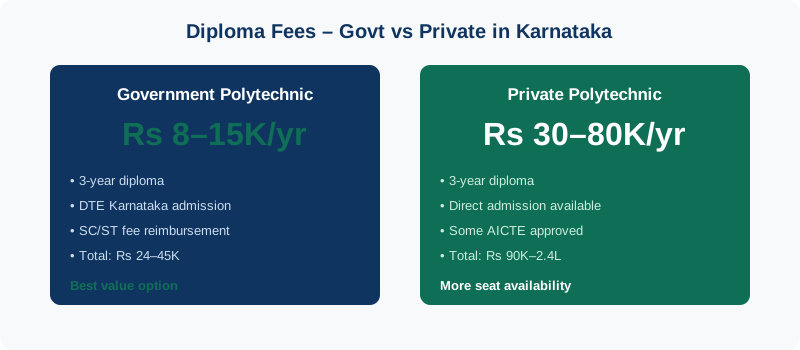
Fees range: Rs 30,000-80,000 per year for private polytechnics. Total 3-year cost: Rs 90,000-2.4 lakh. Significantly cheaper than private engineering colleges even at private polytechnic rates.
When choosing private polytechnics, verify AICTE approval and Board of Technical Examinations (BTE) affiliation. Check placement records specifically for diploma graduates (not clubbed with degree program statistics). Visit workshops and labs to assess practical training infrastructure.
Popular Diploma Branches and Career Outcomes
Computer Science and Engineering (CSE)
The most in-demand diploma branch. Covers programming (C, Java, Python), data structures, web development, database management, networking, and operating systems. Career outcomes: junior software developer, web developer, IT support technician, data entry specialist, computer hardware technician. Starting salary Rs 15,000-25,000 per month in Bangalore IT companies. With 2-3 years experience: Rs 25,000-40,000 per month. Lateral entry to BTech CSE opens full software engineering career pathway.
Electronics and Communication Engineering (ECE)
Covers analog and digital electronics, microprocessors, communication systems, embedded systems, and instrumentation. Career outcomes: electronics technician, PCB designer, embedded systems developer, telecom technician, maintenance engineer. Starting salary Rs 12,000-22,000 per month. Strong demand in Bangalore electronics manufacturing cluster (Peenya, Rajajinagar industrial areas).
Mechanical Engineering
Covers manufacturing processes, CNC machining, CAD/CAM, thermodynamics, hydraulics, and machine design. Career outcomes: CNC operator, quality inspector, maintenance supervisor, production technician, tool room operator. Starting salary Rs 12,000-20,000 per month. Strong demand in Bangalore, Tumkur, Mysore, and Hubli manufacturing zones. Toyota Kirloskar, Bosch, and many auto component companies hire diploma Mechanical graduates.
Civil Engineering
Covers surveying, construction technology, structural design, concrete technology, AutoCAD, and estimation. Career outcomes: site supervisor, surveyor, quantity surveyor, draftsman, quality control inspector. Starting salary Rs 12,000-20,000 per month. Karnataka construction boom (infrastructure projects, real estate) creates steady demand for Civil diploma graduates.
Electrical and Electronics Engineering (EEE)
Covers electrical machines, power systems, control systems, wiring and installation, and electrical safety. Career outcomes: electrician supervisor, substation operator, electrical contractor, power plant technician, BESCOM and other utility positions. Starting salary Rs 12,000-20,000 per month. Government electrical positions (KPTCL, BESCOM, HESCOM) recruit diploma EEE graduates.
Automobile Engineering
Covers vehicle systems, engines, transmission, chassis, automotive electronics, and vehicle maintenance. Career outcomes: automobile service technician, service advisor, spare parts manager, showroom technical staff. Starting salary Rs 12,000-18,000 per month. Bangalore, Bidadi (Toyota plant), and Dharwad (Tata Motors) have strong automobile industry presence.
Information Science and Engineering
Similar to CSE with more focus on information systems, database management, and IT infrastructure. Career outcomes similar to CSE diploma. Growing demand for IT support, system administration, and network management roles.
Fees Comparison: Government vs Private Polytechnics
Government polytechnics: Rs 5,000-15,000 per year. Total 3-year cost: Rs 15,000-45,000. SC/ST students get free education through scholarships.
Private polytechnics (government quota): Rs 20,000-50,000 per year. Total: Rs 60,000-1.5 lakh.
Private polytechnics (management quota): Rs 40,000-80,000 per year. Total: Rs 1.2-2.4 lakh.
Compare with PU Science (Rs 40,000-2,50,000 per year) + BTech (Rs 1-3 lakh per year). The diploma route is dramatically cheaper at every price point.
Lateral Entry to BTech: The Diploma Advantage
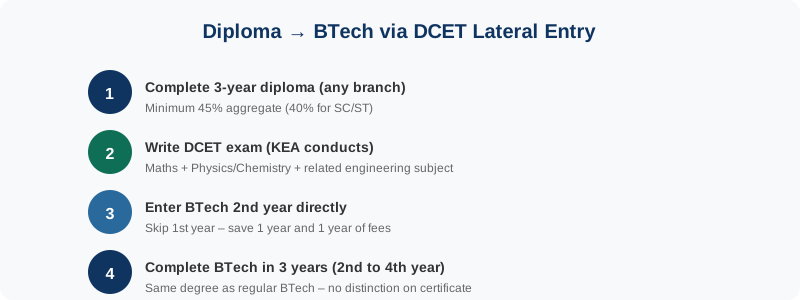
This is the most important section for diploma aspirants. Lateral entry allows diploma holders to enter BTech 2nd year directly, skipping the first year entirely.
How it works: After completing 3-year diploma, appear for DCET (Diploma CET for lateral entry, different from the polytechnic admission DCET). Based on your DCET rank, get admission to BTech 2nd year at VTU-affiliated engineering colleges across Karnataka.
The math: Diploma (3 years) + Lateral entry BTech (3 years) = BTech degree in 6 years. PU (2 years) + Regular BTech (4 years) = BTech degree in 6 years. Same total time, but the diploma student has practical skills from day one and paid significantly less in total.
Which engineering colleges accept lateral entry? Most VTU-affiliated engineering colleges in Karnataka accept lateral entry students. SIT Tumkur, DSCE, BIT, RNSIT, NHCE, and many other colleges have lateral entry seats. Top colleges like RVCE and BMSCE also have limited lateral entry seats but with very competitive DCET cutoffs.
Success stories: Many successful software engineers, project managers, and entrepreneurs in Bangalore started with diploma and entered BTech through lateral entry. The practical foundation from diploma combined with BTech theoretical depth creates a powerful professional profile.
Career Paths After Diploma Without BTech
Not every diploma graduate needs to pursue BTech. Many build successful careers directly after diploma.
Government jobs: KPTCL, BESCOM, HESCOM, CESC recruit diploma holders for Junior Engineer and Technician positions. Starting salary Rs 25,000-40,000 per month with government benefits. Karnataka PWD, BWSSB, and other departments hire diploma Civil and Mechanical engineers.
Railways: Indian Railways recruits diploma holders through RRB exams for Junior Engineer, Technician, and other technical positions. Excellent job security with government benefits.
Defence: Indian Army, Navy, and Air Force recruit diploma holders for technical positions. Starting salary with military allowances Rs 30,000-50,000 per month.
Private sector: Manufacturing companies, construction firms, IT support, telecom companies, and automobile service centers actively hire diploma graduates. Starting salaries Rs 12,000-25,000 per month depending on branch and location.
Self-employment: Diploma holders can start electrical contracting businesses, automobile service workshops, computer repair and networking services, and construction supervision practices. Many diploma entrepreneurs earn more than degree holders in salaried positions.
Diploma vs ITI: Which is Better?
Diploma (3 years): Broader technical education covering theory and practice. Leads to lateral entry BTech. Eligible for Junior Engineer government positions. Higher starting salary. Better career growth ceiling.
ITI (1-2 years): Trade-specific skill training (Electrician, Fitter, Welder, Turner). Faster entry into workforce. Lower fees. Limited to technician-level positions. No direct pathway to BTech.
Recommendation: If you can invest 3 years, diploma is better for long-term career growth. If you need to start earning within 1-2 years, ITI is the practical choice. Both are valid depending on family circumstances.
Scholarships for Diploma Students
Diploma students from Karnataka have access to multiple scholarship schemes that can make education effectively free.
SC/ST Post Matric Scholarship: Full tuition + maintenance through SSP Karnataka. Effectively free diploma education for SC/ST students.
OBC/Backward Classes scholarships: Tuition coverage through SSP Karnataka for eligible categories.
Minority scholarships: Post-matric scholarship for minority community students.
State government schemes: Fee reimbursement for students from families below income thresholds.
Apply for all eligible scholarships through ssp.karnataka.gov.in. Many diploma students receive education at zero effective cost after scholarships.
How to Choose the Right Polytechnic
Step 1: Government first. Always target government polytechnics through DCET. Fees are 5-10x cheaper than private. Quality is comparable or better.
Step 2: Choose branch based on local industry. In Bangalore: CSE and ECE for IT jobs. In Mangalore: Mechanical and Civil for industrial and port sector. In Hubli-Dharwad: Mechanical for manufacturing. In Davangere: Mechanical and Electrical for textile industry.
Step 3: Check workshop quality. Visit the polytechnic and inspect workshops, labs, and equipment. Diploma education is practical; outdated equipment means outdated skills.
Step 4: Ask about placement support. Good polytechnics have active placement cells with company tie-ups. Ask for last 3 years placement data specifically for diploma graduates.
Frequently Asked Questions
Is diploma better than PU Science?
Different paths, not better or worse. Diploma is better for students who want practical skills, early employment, and lower costs. PU Science is better for students targeting NEET for medicine or JEE for IITs. For KCET engineering, both diploma (via lateral entry) and PU reach the same BTech destination.
Can diploma holders get IT jobs in Bangalore?
Yes. Diploma CSE and ISE graduates find jobs as junior developers, web developers, IT support, and testing roles in Bangalore. Starting salary Rs 15,000-25,000 per month. With self-learned coding skills (Python, Java, web frameworks), diploma holders compete for the same entry-level IT jobs as degree holders.
What is the salary after diploma in Karnataka?
Starting salary varies by branch and location. CSE: Rs 15,000-25,000 per month. Mechanical/Civil/Electrical: Rs 12,000-20,000 per month. Government positions: Rs 25,000-40,000 per month. With experience and lateral entry BTech, salaries match regular BTech graduates.
Can I do BTech after diploma?
Yes, through lateral entry. Pass DCET (Diploma CET) and get admitted to BTech 2nd year at VTU engineering colleges. You complete BTech in 3 more years after diploma.
What is DCET for polytechnic admission?
DCET for polytechnic admission is the entrance test for diploma colleges after SSLC (10th). Different from DCET for lateral entry (which is after diploma for BTech entry). Both are conducted by BTE Karnataka but serve different purposes.
Recommended Reading
- After 10th Career Options Karnataka
- Top Engineering Colleges Karnataka
- Karnataka Scholarships Guide
- SSP Karnataka How to Apply
Diploma (Polytechnic) Colleges Karnataka – Comparison
| College Type | Annual Fee | Admission | Best Branches | After Diploma |
|---|---|---|---|---|
| Government Polytechnic | Rs. 8,000-18,000 | DCET merit | ME, Civil, EC, CS | B.E. lateral entry (2nd year) |
| Government Aided Polytechnic | Rs. 15,000-30,000 | DCET merit | ME, Civil, EC | B.E. lateral entry |
| Private Polytechnic | Rs. 25,000-60,000 | DCET or direct | All branches | B.E. lateral entry or jobs |
| BTE Karnataka Polytechnic | Rs. 8,000-15,000 | DCET | All branches | B.E. lateral entry |
Official Sources: Information on this page is sourced from Directorate of Technical Education Karnataka (DTE) and All India Council for Technical Education (AICTE), the primary regulatory bodies governing this subject in India.