
Last Updated: September 7, 2026
Finishing SSLC (10th standard) in Karnataka is a turning point. The stream and course you choose now directly shapes which entrance exams you can write, which degree programs you qualify for, and which careers open up for you in 3 to 7 years. Having been covering Karnataka education since 2006 through our print and online directories, the most common mistake we see is choosing a stream based on peer pressure or parent expectations rather than genuine interest and aptitude.
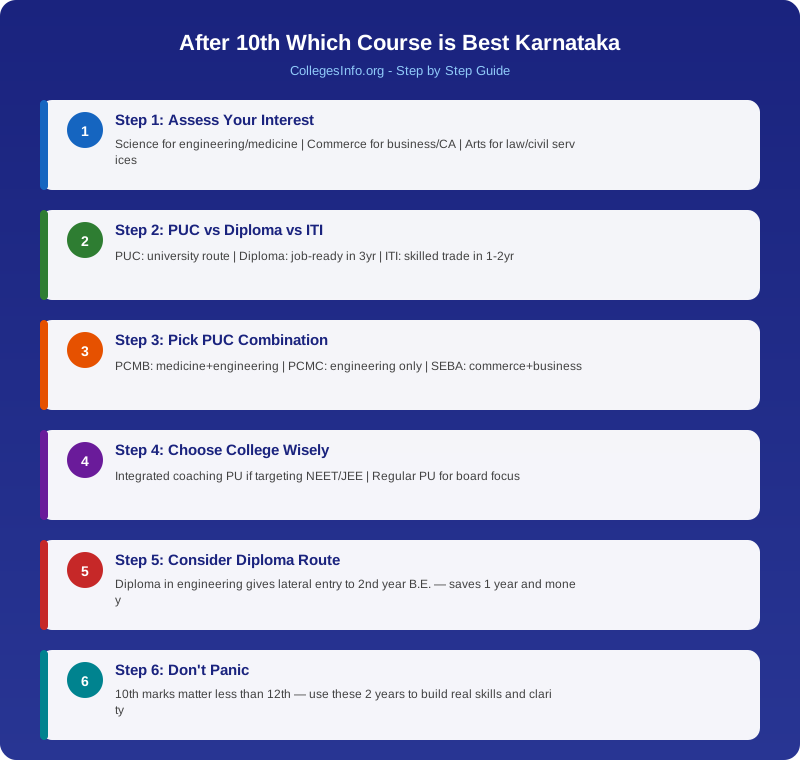
This guide covers every pathway available to Karnataka SSLC students in 2026, with specific fees, eligibility, and career outcomes for each option.
Last Updated: September 11, 2026
The 5 Main Pathways After 10th in Karnataka
After completing SSLC, Karnataka students have five broad pathways: PU (Pre-University) in Science, Commerce, or Arts; Diploma in Engineering (Polytechnic); ITI (Industrial Training Institute); Vocational courses; and alternative pathways like NIOS or bridge courses. Each serves a different career goal.
Pathway 1: PU Science (PCMB or PCMC)
PU Science is the most popular choice for Karnataka SSLC toppers. It leads to engineering, medicine, and pure science careers. Students study Physics, Chemistry, Mathematics, and either Biology (PCMB) or Computer Science (PCMC) under the Karnataka Pre-University Education Board.
PCMB (Physics, Chemistry, Maths, Biology) keeps both medical and engineering doors open. You can write NEET for MBBS, BDS, BAMS, BHMS, BSc Nursing. You can also write KCET for engineering, agriculture, pharmacy, and veterinary. PCMB is the safest choice if you are unsure about your career direction at 15-16 years old.
PCMC (Physics, Chemistry, Maths, Computer Science) is focused on engineering and IT careers. You can write KCET and JEE for engineering but you cannot write NEET. Choose PCMC only if you are 100% certain you have zero interest in medicine.
Eligibility: Minimum 50% in SSLC for most private PU colleges. Top colleges like Christ, Deeksha, and BASE require 80%+ or scholarship test scores. Government PU colleges accept lower percentages.
Fees: Government PU colleges charge Rs 3,000-10,000 per year. Private colleges range from Rs 40,000 to Rs 2,50,000 depending on coaching integration. Residential programs cost Rs 2,50,000-4,00,000.
Career outcomes: After II PUC Science, students typically enter BTech/BE (4 years), MBBS (5.5 years), BDS (5 years), BSc (3 years), BPharm (4 years), or BArch (5 years).
Pathway 2: PU Commerce
PU Commerce is ideal for students interested in business, accounting, finance, banking, and management careers. The core subjects include Accountancy, Business Studies, Economics, plus an elective like Computer Science, Statistics, or Mathematics.
Popular combinations: CEBA (Computer Science, Economics, Business Studies, Accountancy), SEBA (Statistics, Economics, Business Studies, Accountancy), and MEBA (Mathematics, Economics, Business Studies, Accountancy). MEBA is recommended for students planning to pursue CA or actuarial science.
Career outcomes after Commerce PU: BCom (3 years, leads to CA/CS/CMA), BBA (3 years, leads to MBA), BCA (3 years, leads to IT career), BBM, BA Economics, and direct professional courses like CA Foundation and CS Foundation which can be started during PU itself.
Fees: Rs 25,000 to Rs 1,50,000 per year depending on college. CMS Jain and Christ are premium Commerce PU colleges in Bangalore.
Best for: Students who enjoy numbers, business concepts, and want careers in banking, CA, finance, startups, or management.
Pathway 3: PU Arts (Humanities)
PU Arts is often underrated but opens doors to some of the most prestigious careers including civil services (IAS, IPS, KAS), law, journalism, psychology, social work, and public policy. Common subjects include History, Economics, Political Science, Sociology, Psychology, and languages.
Career outcomes after Arts PU: BA (3 years, multiple specializations), BBA, LLB (5-year integrated after PU or 3-year after degree), BSW (Social Work), BA Journalism, BA Psychology, Hotel Management, and competitive exam preparation for civil services.
Best for: Students who enjoy reading, current affairs, debating, creative writing, and social issues. Students targeting law or civil services should seriously consider Arts as it builds the foundational knowledge needed for these careers.
Fees: Rs 10,000 to Rs 80,000 per year. Arts is the most affordable PU stream.
Pathway 4: Diploma in Engineering (Polytechnic)
Diploma is a 3-year program after SSLC that provides direct technical training without going through PU. It is administered by the Board of Technical Education, Karnataka. This is one of the most underrated pathways in Karnataka education.
Why consider Diploma? You save one year compared to the PU + BTech route (3 years diploma + 3 years lateral entry BTech = 6 years total vs 2 years PU + 4 years BTech = 6 years). You get practical, job-ready skills. You can start earning after 3 years with a diploma or continue to BTech through lateral entry into the 2nd year of engineering. Many diploma holders find technical jobs that pay Rs 15,000-25,000 per month immediately after completing the program.
Popular branches: Computer Science, Electronics, Mechanical, Civil, Electrical, Automobile, and Information Science. Computer Science and Electronics diplomas are in high demand in Bangalore IT corridor.
Eligibility: SSLC pass with minimum 35% aggregate. Admission through DCET (Diploma Common Entrance Test) for government colleges or direct admission for private polytechnics.
Fees: Government polytechnics charge Rs 5,000-15,000 per year. Private polytechnics range from Rs 30,000-80,000 per year.
Top polytechnics in Karnataka: Government Polytechnic KR Puram Bangalore, MEI Polytechnic Bangalore, Sri Jayachamarajendra Polytechnic Bangalore, Government Polytechnic Mangalore, and Bapuji Polytechnic Davangere.
Pathway 5: ITI (Industrial Training Institute)
ITI courses are 1-2 year skill-based programs for students who want to start earning quickly. Trades include Electrician, Fitter, Welder, Turner, Mechanic Motor Vehicle, COPA (Computer Operator and Programming Assistant), and Draughtsman. ITI is ideal for students from families where early earning is essential.
Duration: 6 months to 2 years depending on the trade.
Eligibility: SSLC pass for most trades. Some trades accept 8th pass.
Fees: Government ITIs are nearly free (Rs 500-2,000 per year). Private ITIs charge Rs 10,000-40,000.
Career outcomes: Government and private sector jobs in manufacturing, construction, railways, defence, and maintenance. Starting salary Rs 10,000-18,000 per month. ITI certificate holders are eligible for many government technical posts.
How to Decide: A Framework for Students and Parents
Step 1: Identify your interests. Do you enjoy science experiments and problem-solving? Go for PU Science. Do you enjoy reading about business, money, and markets? Go for Commerce. Do you enjoy reading, debates, and social issues? Consider Arts. Do you want to work with your hands and machines? Consider Diploma or ITI.
Step 2: Consider your SSLC marks. If you scored 85%+, you have every pathway open. If you scored 60-85%, PU Science is still possible but consider whether you can handle the rigor. If you scored below 60%, Diploma or ITI may provide a more practical and rewarding path than struggling through PU Science.
Step 3: Consider your family financial situation. If budget is tight, Government PU or Government Polytechnic gives the best value. If you need to start earning in 2-3 years, Diploma or ITI is the fastest path. If your family can support 6-8 years of education, PU followed by professional degree is ideal.
Step 4: Think about the end goal, not just the next step. What career do you want at 25? Work backwards from there. Doctor needs PCMB. Software engineer can come from PCMC or Diploma CSE. CA needs Commerce. Lawyer needs Arts or Commerce. Government officer can come from any stream.
Common Mistakes to Avoid
Choosing Science because everyone else is. If you dislike Physics and Maths, forcing yourself through PU Science for two years will lead to poor marks, failed entrance exams, and wasted time. Choose the stream that matches your strengths.
Looking down on Diploma and ITI. A diploma holder working as a software tester in Bangalore earns more than many degree holders. Skill-based education is increasingly valued by employers. Do not dismiss these pathways based on social prestige alone.
Not researching beyond your city. Many students limit their options to colleges in their hometown. Karnataka has excellent institutions across Bangalore, Mysore, Mangalore, Hubli, Dharwad, and other cities. Hostel facilities make it possible to study anywhere.
Frequently Asked Questions
Which course has the highest salary after 10th?
There is no single answer. BTech CSE from a top college can lead to Rs 8-15 lakh starting salary. MBBS leads to Rs 5-10 lakh initially but grows significantly. CA leads to Rs 7-12 lakh. Even Diploma CSE can lead to Rs 3-5 lakh in the first year. The salary depends on your college quality, skills, and effort, not just the stream.
Can I change my stream after joining PU?
Yes, within the first few weeks of I PUC (typically before mid-November), subject to seat availability. After this window, changing requires repeating the year.
Is Diploma better than PU for engineering?
If your goal is BTech, both paths reach the same destination. PU + KCET gives you entry into 1st year BTech. Diploma + Lateral Entry gives you direct entry into 2nd year BTech, saving one year. The quality of engineering education is the same either way.
My parents want me to take Science but I want Commerce. What should I do?
Have an honest conversation with your parents about your career goals. Show them the career options after Commerce (CA earns more than many engineers). If you force yourself into Science against your interest, you may score poorly and end up in a worse position than choosing Commerce and excelling.
What is the scope of Arts in Karnataka?
Arts graduates can pursue law (5-year LLB), civil services (UPSC, KPSC), journalism, psychology, social work, teaching, public policy, and many government jobs. The Karnataka Administrative Service (KAS) exam is accessible to all degree holders. Many IAS officers studied Arts in PU and graduation.
Need help with admission?
Recommended Reading
- PCMB vs PCMC - Which Stream to Choose
- Best PU Colleges in Bangalore
- Career Options After 12th Commerce
- Career Options After BSc
After 10th – Stream Comparison for Karnataka Students
| Path | Duration | Cost | Career Options | Best For |
|---|---|---|---|---|
| PUC Science (PCMB) | 2 years | Rs. 5,000-3,00,000/yr | Engineering, Medicine, BSc, Nursing | NEET/KCET aspirants |
| PUC Science (PCMC) | 2 years | Rs. 5,000-3,00,000/yr | Engineering, BSc, BCA | Engineering focused |
| PUC Commerce | 2 years | Rs. 5,000-80,000/yr | BCom, BBA, CA, MBA | Business/finance careers |
| PUC Arts | 2 years | Rs. 3,000-50,000/yr | BA, Law, Civil Services, Journalism | Humanities, government careers |
| Diploma (Polytechnic) | 3 years | Rs. 15,000-50,000/yr | Junior Engineer, Lateral entry B.E. | Job-ready, engineering hands-on |
| ITI | 1-2 years | Rs. 5,000-20,000/yr | Skilled trades, government jobs | Immediate employment focus |
Official Sources: Information on this page is sourced from Department of Pre-University Education Karnataka and Karnataka School Examinations and Assessment Board (KSEAB), the primary regulatory bodies governing this subject in India.