Science and Emerging Fields Colleges in Karnataka 2026 — Complete Comparison Guide
Compare all science and emerging-field degrees in Karnataka: Biotechnology, Microbiology, Food Technology, Genetics, Environmental Science. Fees, admission and career guide.
Karnataka's science and emerging-fields cluster covers five genuinely distinct undergraduate paths — Biotechnology, Microbiology, Food Technology, Genetics, and Environmental Science — each with its own admission process, concentration of colleges, and career direction. Some are widely available across dozens of colleges; others are concentrated at just two or three specific institutions. This page compares all five side by side so you can shortlist the right one before reading the detailed guide for your chosen field.
| Field | How It's Offered | Where It's Concentrated | Admission Route | Career Direction |
|---|---|---|---|---|
| Biotechnology | Standalone BSc, widely available | Bengaluru, Mysuru, and other major cities | Direct merit on PUC marks (most colleges) | Pharma, biotech industry, research, further postgraduate study |
| Microbiology | Standalone BSc, widely available | Bengaluru, Mysuru, and other major cities | Direct merit on PUC marks (most colleges) | Diagnostic labs, food and pharma quality control, research |
| Food Technology | Standalone BSc/B.Tech, concentrated | Bengaluru (UAS Bengaluru) and Dharwad (UAS Dharwad) specifically | KCET or ICAR AIEEA | Food manufacturing, quality assurance, food safety, entrepreneurship |
| Genetics | Almost always bundled into a combination degree | Bengaluru only, at autonomous private colleges | Direct merit on PUC marks | Genetic testing, research, biotech, genetic counselling (with further study) |
| Environmental Science | Standalone BSc, dedicated departments | Bengaluru, Mysuru, Shimoga, and via distance learning | Direct merit on PUC marks | Pollution control, environmental consultancy, corporate ESG, government roles |

Biotechnology: The Broadest Option
Biotechnology is the most widely available of the five fields covered here, offered as a standalone BSc at colleges across Bengaluru, Mysuru, and other Karnataka cities. It gives the broadest foundation — genetic engineering, bioprocessing, molecular biology — and the widest range of downstream career and postgraduate options, from pharmaceutical and biotech industry roles to research positions and further specialisation in genetics, microbiology, or biotechnology-specific postgraduate programmes. If you want maximum flexibility and the most college choices, this is usually the safest starting point among the five — see the full Biotechnology guide for the complete college and admission breakdown.
Microbiology: The Diagnostic and Industrial Track
Microbiology runs a close second in availability, also offered as a standalone BSc across a wide range of colleges. It leans toward the study of microorganisms specifically — bacteria, viruses, fungi — with career paths concentrated in diagnostic laboratories, food and pharmaceutical quality control, and research. Students choosing between biotechnology and microbiology often find the decision comes down to whether they want a broader, more applied-engineering-adjacent foundation (biotechnology) or a more focused, lab-science-driven one (microbiology) — the full Microbiology guide covers this comparison in more depth.
Food Technology: Concentrated and Industry-Specific
Food Technology is a much narrower field in Karnataka, concentrated almost entirely at two agricultural universities — University of Agricultural Sciences, Bengaluru (at the GKVK campus) and University of Agricultural Sciences, Dharwad. Unlike biotechnology and microbiology, admission runs through KCET or ICAR AIEEA rather than pure direct merit, and the field channels directly into food manufacturing, quality assurance, and food safety careers, with a genuinely active industrial training pipeline through named companies like CFTRI, MTR Foods, and Cadbury's. If you want a smaller, more industry-focused field with clear career direction from day one, this is worth serious consideration — read the full Food Technology guide for the complete admission and college breakdown.
Genetics: Understand the Combination-Degree Structure First
Genetics is the field most likely to surprise applicants, because it's almost never offered as a standalone degree in Karnataka — instead, it's bundled into combination degrees like "BSc Biotechnology and Genetics" or "BSc Genetics, Biochemistry and Biotechnology" at a small number of autonomous private colleges, all in Bengaluru. If genetics specifically interests you, the real decision isn't just which college, but which specific combination of subjects fits your longer-term direction. See the full Genetics guide for the complete breakdown of which colleges offer which combinations.
Environmental Science: The Civic and Regulatory Track
Environmental Science stands apart from the other four fields in one important way: it's genuinely offered as its own dedicated department at multiple established universities — Bangalore University, University of Mysore, Kuvempu University, and others — rather than concentrated at one or two institutions or bundled into a combination degree. It also leads toward a distinctly different career direction: pollution control boards, environmental consultancy, corporate ESG compliance, and government forestry and wildlife roles, rather than lab-based industry or research work. Read the full Environmental Science guide for a university-by-university comparison.
How to Actually Choose Between These Five
Start with the question of scope versus specificity. If you're not yet sure exactly what you want to specialise in, biotechnology or microbiology give you the broadest foundation and the most college choices, keeping your options open for postgraduate specialisation later. If you already know you want a career specifically in food manufacturing, food technology's concentrated, industry-linked structure is a strong direct path despite having fewer college choices. If genetics specifically draws you, go in understanding you're choosing a combination degree, not a standalone one, and research the exact subject pairing carefully. If your interest is civic, regulatory, or conservation-focused rather than industrial or lab-based, environmental science is the clear fit among these five, and it's also the only one of the five genuinely available at multiple cities across Karnataka rather than concentrated in Bengaluru alone.
NEP 2020 Across All Five Fields
All five fields are being restructured under Karnataka's rollout of the National Education Policy 2020's four-year undergraduate framework, with broadly similar features across the board: multiple exit points (certificate after one year, diploma after two, degree after three, Honours degree with a research component after four), major-minor elective structures, and a stronger emphasis on skill-based and vocational credits alongside core coursework. The specific implementation details — how electives are weighted, how research components are structured — vary by college and field, so always confirm the current NEP-era credit structure directly with your shortlisted college rather than assuming it's identical across all five fields.
Funding Your Degree Across These Fields
Karnataka's State Scholarship Portal (SSP) — covered in our SSP scholarship guide — covers science degrees broadly across all five of these fields for SC, ST, OBC, and minority-category students. Government institutions (the agricultural universities for Food Technology, and the public universities for Environmental Science) tend to have meaningfully lower base fees than the private autonomous colleges that dominate Biotechnology, Microbiology, and Genetics options, so factor institution type into your cost planning alongside scholarship eligibility.
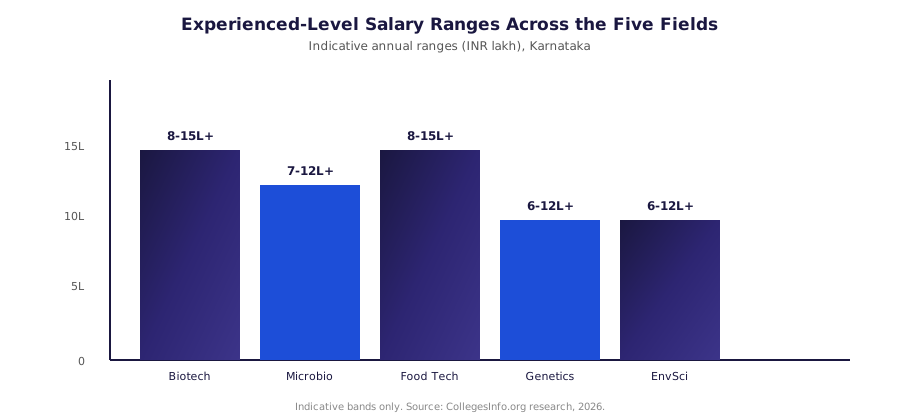
Salary Ranges Across All Five Fields
| Field | Entry-Level (Rs/year) | Mid-Level (Rs/year) | Experienced (Rs/year) |
|---|---|---|---|
| Biotechnology | 2.5-4.5 lakh | 4-7 lakh | 8-15+ lakh |
| Microbiology | 2.5-4 lakh | 4-6 lakh | 7-12+ lakh |
| Food Technology | 2.5-4.5 lakh | 4-7 lakh | 8-15+ lakh |
| Genetics (combination) | 2.5-4 lakh | 3.5-6 lakh | 6-12+ lakh |
| Environmental Science | 2.5-4 lakh | 3.5-6 lakh | 6-12+ lakh |
These bands are broadly similar across all five fields at the entry level, which makes sense — most graduates across all five start in lab, quality-control, or junior research-adjacent roles regardless of specific subject. The real differentiation happens at the experienced end, where biotechnology and food technology graduates who move into industry leadership or specialised technical roles tend to see somewhat higher ceilings, largely because both fields feed into larger, more established industrial sectors (pharma and biotech manufacturing, food processing) than genetics-combination or environmental science graduates, whose experienced-level roles are more concentrated in research, consultancy, or government positions with different compensation structures.
Geography: Where Each Field Is Actually Available
Bengaluru is the one city where all five fields are genuinely available, making it the default choice if you're not tied to a specific location. Beyond Bengaluru, the picture changes a lot by field: Mysuru has real biotechnology, microbiology, and environmental science options, but essentially no dedicated food technology or genetics-combination programmes. Dharwad is a genuine food technology hub (through UAS Dharwad) but doesn't offer the other four fields in any comparable depth. Shimoga has a real environmental science option through Kuvempu University, reflecting the region's forestry and Western Ghats context, but isn't a hub for any of the other four fields. If your field of choice is Genetics specifically, Bengaluru isn't just the best option — for practical purposes, it's the only option in Karnataka.
Lab Facilities and Practical Exposure: What to Ask About
Practical, hands-on lab work matters across all five fields, but what "lab work" actually means varies meaningfully. Biotechnology, microbiology, and genetics-combination programmes centre on molecular biology, microbiological, and genetic-engineering lab techniques — PCR, electrophoresis, culturing, and increasingly bioinformatics tools. Food technology's practical work is more industrial in character — processing equipment, quality testing instruments, and industrial-scale training through partner companies. Environmental science's practical work is the most fieldwork-heavy of the five, involving water and soil sampling, biodiversity surveys, and site visits rather than purely indoor lab work. Whichever field you're considering, ask any shortlisted college directly what specific equipment and facilities students actually get hands-on time with, rather than assuming a "well-equipped lab" claim in a prospectus translates to genuine practical exposure — colleges recognised under the DBT-Star College Scheme are a more reliable signal of genuinely vetted lab infrastructure than marketing language alone. This scheme, run by the Department of Biotechnology under India's Ministry of Science and Technology, has supported science departments at more than 300 colleges nationally since 2008, funding both laboratory equipment and faculty development rather than just handing out a certificate.
Government Schemes Relevant Across These Fields
Several government schemes touch multiple fields in this cluster. The INSPIRE Scholarship (Department of Science and Technology) supports meritorious students across basic and natural sciences broadly, relevant to all five fields covered here. The DBT-Star College Scheme specifically strengthens lab infrastructure at colleges teaching biotechnology, microbiology, and related life sciences — worth checking whether your shortlisted college holds this recognition. For food technology specifically, the PMFME scheme and broader Ministry of Food Processing Industries initiatives shape the industry your graduates enter. For environmental science, the National Green Tribunal and state Pollution Control Boards drive much of the regulatory demand for graduates. Understanding which government ecosystem surrounds your chosen field gives you a genuinely more informed picture of where the real job demand is coming from, beyond just counting college seats.
A Quick Decision Framework
If you're still undecided after reading the comparisons above, here's a simpler way to think about it. Ask yourself three questions in order. First: do you want to keep your options open for postgraduate specialisation, or do you already know your career direction? If you want flexibility, start with biotechnology or microbiology. Second: are you drawn to industrial production and manufacturing specifically, or to lab research and diagnostics? Food technology fits production; biotechnology, microbiology, and genetics fit research and diagnostics. Third: is your genuine interest scientific and lab-based, or civic and regulatory? If it's the latter, environmental science is the clear outlier among these five and probably your best fit regardless of how the other questions answer. None of these five choices is a mistake — they're just genuinely different four-year experiences leading to different first jobs, and being honest with yourself about which questions you're actually answering "yes" to will serve you better than picking based on a college's reputation or a friend's recommendation alone.
Accreditation Signals Worth Checking Across All Five Fields
Accreditation markers mean different things depending on which of these five fields you're evaluating, and it's worth knowing what to actually look for rather than treating "NAAC accredited" as a single uniform stamp of quality. For biotechnology, microbiology, and genetics-combination colleges, DBT-Star College Scheme recognition is a genuinely useful government-vetted signal of lab infrastructure investment, distinct from a college's overall NAAC grade. For food technology, since the field is concentrated at two agricultural universities rather than spread across many colleges, the more relevant check is the specific department's own standing and industrial training partnerships rather than a general institutional grade. For environmental science, given the field spans multiple public universities, comparing NAAC grades and NIRF rankings across Bangalore University, University of Mysore, and Kuvempu University directly is more informative than looking at any single college in isolation, since you're really choosing between university departments rather than individual colleges in most cases. Whichever field you choose, treat institutional accreditation as one input among several — genuine lab facilities, documented industry placements, and specific faculty research output tell you more about actual teaching quality than a grade letter alone.
Who Actually Studies These Fields
Gender representation and student demographics vary somewhat across these five fields, worth knowing if campus community composition factors into your decision. Life sciences fields — biotechnology, microbiology, and genetics-combination degrees — in Karnataka's autonomous private college sector tend to see strong representation of women students, consistent with broader patterns across Indian life-sciences education generally. Food technology, taught primarily at agricultural universities, reflects the broader gender patterns typical of agricultural science programmes, which vary more by specific institution. Environmental science similarly reflects the general demographic patterns of Karnataka's public university science departments. None of these five fields has any formal restriction by gender, and all report mixed-gender cohorts, but if the specific balance at a shortlisted college matters to you, it's worth asking the admissions office directly for current enrolment figures rather than assuming based on the field's general reputation.
Timing Your Application Across These Fields
Application timelines differ enough across these five fields that it's worth planning ahead rather than assuming a single admission calendar applies everywhere. KCET-route admissions (relevant to Food Technology) follow Karnataka's centralised KEA counselling calendar, typically running through the middle of the year with multiple rounds. Direct-merit admissions at autonomous private colleges (relevant to Biotechnology, Microbiology, and Genetics-combination degrees) often open earlier and run on a rolling or first-come basis, meaning popular colleges can fill seats before the KCET counselling calendar even concludes. Public university admissions for Environmental Science generally follow standard government college merit-list timelines. If you're keeping multiple fields on your shortlist simultaneously, track each one's specific application window separately rather than assuming they'll align, since missing an early direct-merit deadline while waiting on KCET results is a genuinely common and avoidable mistake.
Frequently Asked Questions
Which of these five fields has the most college options in Karnataka?
Biotechnology and Microbiology, both offered as standalone degrees at a wide range of colleges across Bengaluru, Mysuru, and other cities. Food Technology, Genetics, and Environmental Science are each more concentrated, though for different reasons.
Do any of these five fields require NEET or KCET?
NEET is not required for any of these five. KCET is used for Food Technology admissions (alongside ICAR AIEEA); the other four generally use direct merit based on PUC marks through each college's own admission process.
Which field has the clearest, most direct career path?
Food Technology and Environmental Science both have clearer, more direct career destinations — food manufacturing and food safety for the former, environmental consultancy and regulatory roles for the latter. Biotechnology and Microbiology are broader, useful precisely because they don't force an early specialisation. Genetics depends heavily on which combination degree you choose.
Can I switch between these fields after starting one?
Switching entirely between degrees isn't usually possible without restarting, but the underlying science overlaps enough (particularly between biotechnology, microbiology, and genetics) that postgraduate specialisation can pivot your direction significantly even if your undergraduate degree doesn't change.
Is genetics really not available as its own degree anywhere in Karnataka?
Based on current research, no standalone BSc Genetics degree exists in Karnataka — it's taught exclusively as part of combination degrees at a small number of Bengaluru autonomous colleges.
Which field requires the least competitive admission process?
Genetics-combination degrees and Environmental Science both use direct merit on PUC marks with no dedicated entrance exam, generally making them more accessible than Food Technology's KCET/ICAR AIEEA route, though specific college cutoffs still vary considerably.
Do employers value these five fields differently?
Employer perception varies more by specific college reputation and practical skill demonstration than by which of these five fields you studied — a well-regarded college with genuine lab or fieldwork exposure in any of these five fields will generally serve you better than a weaker college in a "more prestigious-sounding" field.
For admission guidance on any of these science degrees in Karnataka, WhatsApp +91 6363 330 233. We help you get the best admission to your preferred colleges without hassle.