By L K Monu Borkala · Tracking Karnataka admissions since 2006 · Last checked against official records on 12 November 2026
At a glance
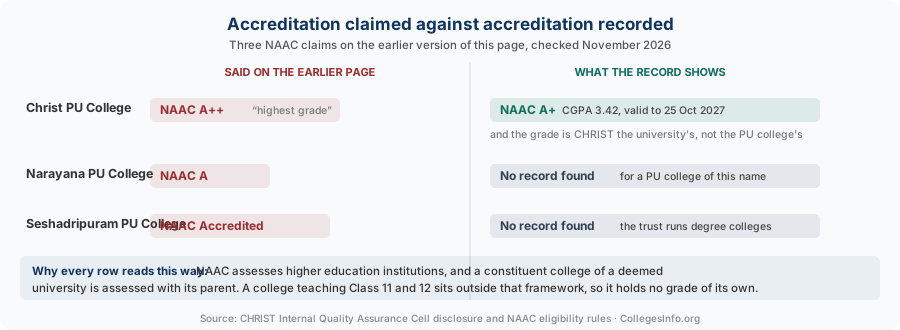
CHRIST holds NAAC A+, not A++. The university's own quality assurance office records Grade A+ with a CGPA of 3.42 on a four-point scale, valid to 25 October 2027. An earlier version of this page said A++ in three places and called it the highest grade in the framework.
No pre-university college in Bangalore holds a NAAC grade of its own. NAAC assesses higher education institutions. Where a PU college advertises a grade, it belongs to a degree institution run by the same trust, and it says nothing about the Class 11 and 12 wing your child would attend.
The state's position is that PU seats go unfilled, not that they fill in days. On 31 October 2026 the Department of School Education and Literacy put out a draft notification proposing to stop approving new private PU colleges for three years from 2027-28, because Karnataka's 6,000-plus PU colleges leave thousands of sanctioned seats empty each year.
No fee figure appears on this page. Karnataka sets no fee ceiling for unaided PU colleges and publishes no official schedule for them, so any rupee range quoted as fact cannot be sourced. Ask each college for its own fee circular in writing.
This page was rewritten on 12 November 2026 after an audit against primary records: the Karnataka School Examination and Assessment Board, which conducts the II PUC examination; the Karnataka Department of School Education (Pre-University) Rules, 2024, which replaced the 2006 rules on 12 September 2024; CHRIST's own quality assurance disclosure; and Namma Metro's published station list. Where a claim on the earlier version could not be traced to a record of that kind, it has been removed rather than softened. What follows says plainly which parts of a PU college decision can be checked before you pay and which cannot.
What the official record says about accreditation
CHRIST is accredited by the National Assessment and Accreditation Council with Grade A+ and a CGPA of 3.42 on a four-point scale, valid up to 25 October 2027, according to the university's Internal Quality Assurance Cell. The earlier version of this page said A++ in the section heading, in the specification table and again in the opening question of its FAQ.
The grade is also the university's, not the pre-university college's. NAAC assesses higher education institutions, and a constituent college of a deemed university is assessed together with its parent rather than separately. A pre-university college teaching Class 11 and 12 sits outside that framework entirely. So when you read that a PU college is "NAAC A accredited", what exists is a grade held by a degree college or university under the same trust. It is not a statement about the PU wing's teaching, its lecturers or its results, and it should carry no weight in the decision you are making.
That matters here because accreditation was doing a lot of work on the earlier page. It appeared in two of the ten section headings and in the fee table as a label beside a college name, where a parent scanning quickly would read it as a quality mark on the PU college itself. Two of the three accreditation claims could not be found on any official record at all.
| Claim on the earlier page | What the record shows |
|---|---|
| Christ PU College – NAAC A++ | CHRIST holds Grade A+, CGPA 3.42, valid to 25 October 2027. The grade is the university's. |
| NAAC A++ is "the highest grade in India's university quality framework" | A++ is the top band, but it is not the grade CHRIST holds. |
| Narayana PU College – NAAC A | No NAAC record found for a pre-university college of this name. |
| Seshadripuram PU College – NAAC Accredited | No NAAC record found for the pre-university college. The trust runs accredited degree colleges. |
| "Private (NAAC A)" as a college type in the fee table | Accreditation is not a category of management. The type is private unaided. |
Seats do not fill in days, and the state has said so
The earlier version told readers that "PCMB seats at top private colleges fill within days of opening" and to "apply immediately". The state's own reading of the market is the opposite.
On 31 October 2026 the Department of School Education and Literacy issued a draft notification proposing to amend the Karnataka Department of School Education (Pre-University) Rules, 2024, so that no new private PU college is approved for three academic years, from 2027-28 to 2029-30. The reason given is oversupply: Karnataka has more than 6,000 PU colleges, and many fail to fill their sanctioned intake year after year. The Karnataka State Pre-University College Lecturers' Association had asked for the restriction on the same grounds. Stakeholders were given fifteen days to object, and the government decides after that, so treat this as proposed and not yet law.
Falling enrolment in the arts stream has been reported across Karnataka PU colleges for the same reason, leaving vacant seats and smaller classes. None of this means a particular branch at a particular well-known college will wait for you: a popular science section at a sought-after Bangalore campus can and does close early. What it does mean is that the system as a whole has spare capacity, so a family being told to pay a deposit today or lose the seat is being sold urgency rather than shown it. Ask how many seats are sanctioned in the section you want and how many are already confirmed, and ask for the answer in writing.
What II PUC results are actually published
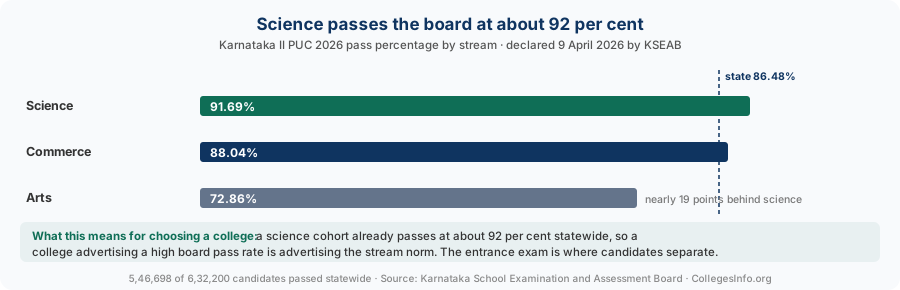
The Karnataka School Examination and Assessment Board declared the II PUC 2026 results on 9 April 2026. 5,46,698 candidates passed of 6,32,200 who appeared, a pass rate of 86.48 per cent. By stream, science was reported at 91.69 per cent, commerce at 88.04 per cent and arts at 72.86 per cent.
The science figure is the one worth holding on to. A science cohort passing at about 92 per cent against a state average of 86 per cent tells you that the board examination is not the hard part of these two years, and that a college advertising a high board pass rate is advertising something close to the stream norm. The entrance examination is where candidates separate, and no board result measures that.
| Measure | Figure | Note |
|---|---|---|
| Appeared | 6,32,200 | Statewide, first examination |
| Passed | 5,46,698 | 86.48 per cent |
| Science stream | 91.69 per cent | About five points above the state figure |
| Commerce stream | 88.04 per cent | Close to the state figure |
| Arts stream | 72.86 per cent | Nearly 19 points below science |
| Bengaluru South and Bengaluru North | About 90 per cent each | Reported in press coverage, both above the state figure |
| College-level pass percentage | Not published | No official table exists; see below |
Two cautions on that table. Bengaluru is split across Bengaluru South, Bengaluru North and Bengaluru Rural in the board's district reporting, so there is no single Bangalore figure, and the district numbers circulating after results day differ between outlets, which is why they appear here as approximate. The district-wise breakdown is also not published as a downloadable statement on the board's own site, so anything more precise than this would be a press figure dressed up as an official one.
The board does not publish a college-level pass percentage table. This is the single most important thing to know about any page that ranks PU colleges by results, including the earlier version of this one, which promised results in its title and gave none. A college's own pass rate exists only in the college's own records. Ask the office for the figure for the most recent completed year, for the number of students who appeared alongside it, and for the number who qualified in NEET, JEE or KCET rather than a percentage. A pass rate of 100 per cent means little if the section had eighteen students and the weaker ones were moved to a different category of candidate before the examination.
Government PU colleges: the fee is near zero, the staffing is the risk
Government PU colleges in Bangalore, including the ones in Jayanagar and Malleswaram, charge a small fraction of any private college. One sourced change helps further: from 2026-27 the late admission penalty has been withdrawn. The Department of School Education and Literacy cancelled the system introduced by an order of 20 March 2018, which had allowed a fine of Rs 670 for admission up to ten days late and a special fine of Rs 2,220 for up to twenty days late.
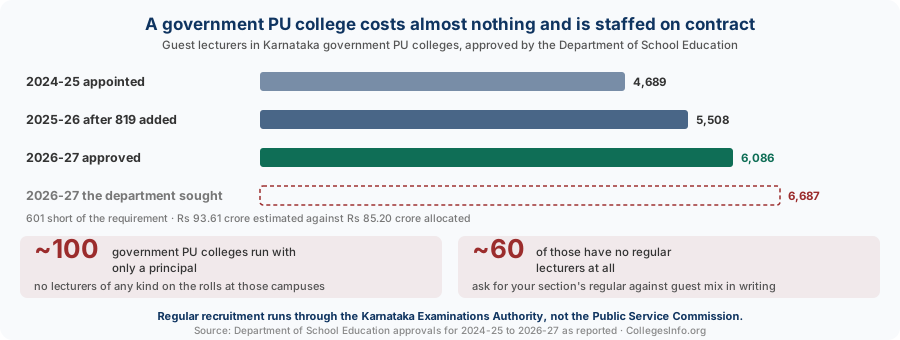
The real trade-off is staffing, and the earlier version of this page did not mention it. For 2026-27 the government approved the retention of 6,086 guest lecturers in government PU colleges, against a department requirement of 6,687, at an estimated Rs 93.61 crore against an allocation of Rs 85.20 crore. The same review recorded that about 100 government PU colleges function with only a principal, and about 60 of those have no regular lecturers at all. Guest appointments had already run at 4,689 in 2024-25 with 819 more added in 2025-26.
That is the question to ask at the gate of a government PU college, and it is answerable in one visit: how many of the physics, chemistry, mathematics and biology lecturers for the section you are joining are regular appointments, and how many are guest lecturers on a ten-month contract. A college where the science faculty is largely on annual contracts can still teach well, and many do. But continuity across two years matters more in PU than in almost any other stage, because the syllabus runs as one arc into the entrance examinations, and a lecturer who leaves in April is a gap that nobody fills until the next approval cycle.
Recruitment of regular staff runs through the Karnataka Examinations Authority, not the Karnataka Public Service Commission as the earlier version of this page stated. Applications for 247 Group-A principal posts in government PU colleges, 216 in the Residual Parent Cadre and 31 in the Kalyana Karnataka local cadre, were taken through the authority's portal with the deadline extended to 24 October 2026.
| Measure | Figure |
|---|---|
| Guest lecturers approved for 2026-27 | 6,086 |
| Guest lecturers the department sought | 6,687 |
| Estimated cost against allocation | Rs 93.61 crore against Rs 85.20 crore |
| Guest lecturers appointed 2024-25 | 4,689 |
| Added in 2025-26 | 819 |
| Colleges running with only a principal | About 100 |
| Of those, with no regular lecturers | About 60 |
| Principal posts advertised, 2026 | 247, through the Karnataka Examinations Authority |
Why no fee figure appears on this page
The earlier version carried fee ranges for twelve colleges, hostel ranges for six, and a figure in its meta description, none of it traceable to a published source. All of it has been removed, and the reason is structural rather than editorial.
Karnataka regulates fees for professional courses through a fee regulatory framework and a consensual agreement process. Pre-university education sits outside it. There is no fee ceiling for unaided PU colleges and no official fee schedule published for them, which means a rupee range for a private PU college cannot be sourced to anything but the college itself, and it changes between campuses of the same brand and between the integrated and the plain programme. Private PU colleges have separately been the subject of reporting on excess collection in the name of integrated courses, which is one more reason to get the number on the college's own letterhead rather than from a comparison table.
What you can do is ask for the fee circular for the coming academic year in writing, and ask for it to separate tuition, the coaching or integrated component, laboratory and development charges, examination fees, and the refund terms if your child leaves after Class 11. The refund clause is where families are hurt most often, and it is the one item never printed in a comparison table. Our Bangalore PU college fees guide sets out what to ask for; treat any figure there as indicative and the college's circular as the only binding statement.
The colleges, and what can be checked about each
The ten colleges below are the ones the earlier version described. The table says what can be verified about each from a record outside the college, and what cannot. It is deliberately not a ranking: no published measure exists that would support one.
| College | Type | Checkable | Not checkable |
|---|---|---|---|
| Christ PU College, Hosur Road | Private | Part of the CHRIST group; the university holds NAAC A+, CGPA 3.42, to 25 October 2027 | The PU wing's own fees, board results, admission test cut-off |
| Narayana PU College, several campuses | Private unaided | Multiple Bangalore campuses; runs its own scholarship test | The claimed NAAC A grade; fees; campus-wise results |
| Sri Chaitanya PU College, several campuses | Private unaided | Multiple Bangalore campuses; integrated coaching model | Fees, day or residential; results by campus |
| Deeksha, Kanakapura Road | Private unaided | Single large campus; runs its own scholarship test | The 96 per cent qualification rate, which is a group-wide marketing figure |
| Jain PU College, Jayanagar | Private unaided | Part of the Jain group; Jayanagar is a Green Line metro stop | Student strength, fees, the pedagogy claim |
| Seshadripuram PU College | Private | Run by the Seshadripuram Educational Trust, which also runs degree colleges | Its own NAAC grade; it is a PU college under the school education department, not affiliated to a university |
| Government PU College, Jayanagar | Government | Government fee scale; late admission penalty withdrawn from 2026-27; Jayanagar is Green Line | Year of establishment; the section's regular against guest lecturer mix, which you must ask for |
| Government PU College, Malleswaram | Government | Government fee scale; Mantri Square Sampige Road is the nearest Green Line stop | Year of establishment; faculty mix |
| Oxford PU College, Koramangala | Private unaided | Part of the Oxford group; Central Silk Board on the Yellow Line is the nearest operating station, and it is not close | Fees; the KCET qualifier record |
| Chinmaya Vidyalaya PU College, JP Nagar | Private, trust-run | Run by the Chinmaya Mission; Jaya Prakash Nagar is a Green Line stop | Year of establishment; fees |
Three further names appeared in the earlier version's fee table without ever being described: Kumarans, MLA Academy and East Point. They have been left out rather than carried forward, because a row of fee figures is not a description of a college.
Metro lines, corrected
The earlier version put three stations on the wrong line, and since families choose a PU college partly by commute, the error had practical weight. Jayanagar, Jaya Prakash Nagar and Mantri Square Sampige Road are all on the Green Line, which runs from Madavara to Silk Institute. The page had the first two on the Yellow Line and the third on the Purple Line.
| Station | Said on the earlier page | Actual line |
|---|---|---|
| Jayanagar | Yellow Line | Green Line |
| Jaya Prakash Nagar (JP Nagar) | Yellow Line | Green Line |
| Mantri Square Sampige Road | Purple Line | Green Line |
| Central Silk Board | Yellow Line | Yellow Line, and an interchange with the Blue Line when it opens |
| Rashtreeya Vidyalaya Road | Not named | Green and Yellow Line interchange |
One note on Christ PU College, which the earlier version gave as "Yellow Line (Hosur Road corridor)". The Yellow Line does run down Hosur Road from Rashtreeya Vidyalaya Road to Bommasandra, but no operating station is a short walk from the campus, and Dairy Circle, the nearest planned stop, is on the Pink Line and still under construction. Check the actual walk on a map before treating any of these colleges as metro-accessible.
PCMB or PCMC
This is the one decision on the page that no record can make for you, and it is the one that cannot be reversed after admission. PCMB keeps both the medical and engineering routes open through KCET; PCMC qualifies you for the engineering stream only.
| Factor | PCMB | PCMC |
|---|---|---|
| Fourth subject | Biology | Computer Science |
| Entrance examinations it fits | NEET, KCET medical and engineering | JEE, KCET engineering |
| KCET streams open to you | Both engineering and medical | Engineering only |
| Degree routes | MBBS, BDS, BAMS, BVSc, B Pharm, B Sc | B E, B Tech, BCA, B Sc in computing |
| Load | Biology carries 360 of NEET's 720 marks | Heavier mathematics and computing |
| Choose it if | Medicine is live, even as a maybe | Engineering or computing is settled |
If you are undecided, take PCMB. It costs you some time on biology you may never use, and it buys you the option of a medical application you cannot add back later. If engineering is already settled, PCMC is enough, and the KCET engineering route is unaffected. Our guide to choosing a degree college after PUC covers what follows either choice, and the KCET rank predictor works off the official cut-off sheets once you have a rank.
How admission and regulation work now
Two names on the earlier version are out of date. The II PUC examination is conducted by the Karnataka School Examination and Assessment Board, formed when the old secondary examination board and the pre-university examination wing were merged. PU colleges are regulated under the Karnataka Department of School Education (Pre-University) Rules, 2024, dated 12 September 2024, which replaced the 2006 pre-university rules. A page describing colleges as affiliated to a "PU Board" is describing a structure that no longer carries that name.
For a government college, admission runs on SSLC merit through the department's own process after results are declared, usually in May or June. For a private college, admission is direct, applications often open in March or April before SSLC results, and the larger chains run their own scholarship tests whose scores set the fee concession rather than the admission. Keep your SSLC marks card, transfer certificate, conduct certificate, caste or income certificate where it applies, and photographs ready, because the private confirmation window is short.
One regulatory change is worth knowing if you are weighing a newer private college: recognition for private unaided PU colleges now runs on a ten-year first renewal rather than five. A college can therefore hold a current recognition without having been reviewed recently, so ask when its recognition was last renewed and until when it runs.
Who each kind of college suits
| If this is you | Look at | Ask for |
|---|---|---|
| Cost is the binding constraint | Government PU colleges, where the fee is a small fraction of private and the late penalty is gone from 2026-27 | The regular against guest lecturer mix for your section, in writing |
| You want a balanced two years and a settled campus | Trust-run private colleges such as Chinmaya Vidyalaya or Seshadripuram | The fee circular with refund terms, and the board result for the last completed year |
| NEET or JEE is the whole point | The integrated chains, which run board and entrance preparation on one timetable | Qualifier counts rather than percentages, and what the integrated component costs separately |
| Your child needs structure and accountability | An integrated programme, where the schedule is fixed and attendance enforced | Daily hours, and what happens if your child cannot keep that pace |
| Your child works better unsupervised | A regular PU college with coaching chosen separately | Travel time between the two, measured at peak hour rather than estimated |
| You are coming from outside Bangalore | Colleges with hostels on or beside the campus | Warden arrangements, study hours and the mess, in person |
For the wider picture see our statewide PU college guide, the Bangalore PU college overview across all streams, and the comparison of the three large integrated chains. If your child would live away from home, the hostel guide for outstation students and the residential against day scholar comparison cover that decision, and there is a separate guide to women's PU colleges in Bangalore.
Frequently Asked Questions
Is Christ PU College NAAC A++?
No. CHRIST holds NAAC Grade A+ with a CGPA of 3.42 on a four-point scale, valid to 25 October 2027, according to the university's own quality assurance office. The grade belongs to the university, not to the pre-university college.
Which PU college in Bangalore has the best NAAC grade?
None of them has a NAAC grade. NAAC assesses higher education institutions, and a pre-university college teaching Class 11 and 12 falls outside that framework. Any grade you see advertised belongs to a degree college or university run by the same trust.
What is the fee for science PUC in Bangalore?
No figure is quoted here. Karnataka sets no fee ceiling for unaided PU colleges and publishes no official schedule for them, so a range cannot be sourced to anything but the college. Ask for the fee circular in writing, with the coaching component and refund terms separated out.
Do PCMB seats at top Bangalore PU colleges fill within days?
A particular section at a sought-after campus can close early, but the state's own position is that PU seats go unfilled. A draft notification of 31 October 2026 proposes freezing approvals for new private PU colleges for three years from 2027-28 because Karnataka's 6,000-plus colleges leave sanctioned seats empty.
What was the Karnataka II PUC 2026 pass percentage?
86.48 per cent. The Karnataka School Examination and Assessment Board declared the results on 9 April 2026, with 5,46,698 of 6,32,200 candidates passing. Science was reported at 91.69 per cent, commerce at 88.04 and arts at 72.86.
Which Bangalore PU college has the best board results?
The board does not publish a college-level pass percentage table, so no sourced answer exists. Ask the college for its own figure for the last completed year, together with how many students appeared and how many qualified in NEET, JEE or KCET.
Are government PU colleges in Bangalore worth it?
On cost, clearly: the fee is a small fraction of private, and the late admission penalty of Rs 670 and Rs 2,220 was withdrawn from 2026-27. The risk is staffing. About 100 government PU colleges in Karnataka run with only a principal, about 60 of those with no regular lecturers, and 6,086 guest lecturers were approved for 2026-27.
Which metro line is Jayanagar PU college on?
The Green Line. Jayanagar, Jaya Prakash Nagar and Mantri Square Sampige Road are all Green Line stations, which runs from Madavara to Silk Institute. An earlier version of this page placed the first two on the Yellow Line and the third on the Purple Line.
Is integrated PU coaching better than a regular college plus separate coaching?
Neither is better in the abstract. Integrated saves the travel between two timetables and enforces a schedule; separate coaching gives you a choice of centre and pace. The deciding factor is whether your child works better with external structure or without it.
Who conducts PU lecturer recruitment in Karnataka?
The Karnataka Examinations Authority, not the Public Service Commission. Applications for 247 Group-A principal posts in government PU colleges were taken through its portal with the deadline extended to 24 October 2026.
The full college directory covers PU and degree colleges across Karnataka, and the outstation student guide covers what to check on a campus visit.