Government vs Private Science Colleges Karnataka 2026 — Field by Field Guide
Government vs private colleges for Biotechnology, Microbiology, Food Technology, Genetics and Environmental Science in Karnataka - the honest, field-by-field picture.
The government-versus-private split looks genuinely different across each of the five science and emerging fields covered on this site — it isn't one uniform comparison. Food Technology is exclusively government (there is no standalone private Food Technology degree option in Karnataka). Genetics-combination degrees are exclusively private. Environmental Science and, to a lesser extent, Biotechnology and Microbiology sit somewhere in between. This page breaks down what's actually true for each field, rather than giving generic government-vs-private advice that doesn't hold up field by field.
| Field | Government Options | Private Options | Real Picture |
|---|---|---|---|
| Biotechnology | Some government first-grade colleges | Wide range of autonomous private colleges | Private colleges dominate; verify government options directly with your district's first-grade colleges |
| Microbiology | Some government first-grade colleges | Wide range of autonomous private colleges | Same pattern as Biotechnology |
| Food Technology | UAS Bengaluru, UAS Dharwad | None found | Exclusively government — no private alternative exists |
| Genetics | None found | M.S. Ramaiah, Kristu Jayanti, Jyoti Nivas, Seshadripuram | Exclusively private — no government alternative exists |
| Environmental Science | Bangalore University, University of Mysore, Kuvempu University | St. Joseph's University | Government-dominated with one clear private option |

Food Technology: Government-Only, and That's Worth Understanding Why
Food Technology's exclusively-government structure in Karnataka isn't an accident — it reflects the field's roots in agricultural science education, historically the domain of state agricultural universities rather than general private colleges. Both University of Agricultural Sciences, Bengaluru (GKVK campus) and University of Agricultural Sciences, Dharwad are public institutions under the state's agricultural university system, and neither has a private-college equivalent offering a comparable Food Technology degree anywhere in Karnataka. This means the usual "government is cheaper, private is more flexible on admission" comparison doesn't really apply here — there's no private alternative to compare against. Your genuine choice is between these two government campuses specifically, covered in full in the full Food Technology guide, not between government and private options.
Genetics: Private-Only, for a Different Reason
Genetics-combination degrees sit at the opposite extreme — all four Karnataka colleges offering this specific combination (M.S. Ramaiah College of Arts, Science and Commerce, Kristu Jayanti College, Jyoti Nivas College, Seshadripuram College) are autonomous private institutions. This reflects a different pattern from Food Technology: Genetics-as-a-combination-subject is a relatively newer curricular addition that autonomous private colleges, with more flexibility over their own course design, have moved on faster than government universities' more centrally-structured curricula. If a government-college Genetics option matters to you specifically for cost reasons, it's worth knowing upfront that this option doesn't currently exist in Karnataka — see the full Genetics guide for how to compare the four private options that do exist.
Environmental Science: Government-Dominated, One Private Alternative
Environmental Science sits closest to a genuine government-vs-private comparison among these five fields. Bangalore University's department (established 1992) anchors the government side, alongside University of Mysore and Kuvempu University, while St. Joseph's University offers a private alternative. The genuine trade-off here is real: Bangalore University's faculty hold documented civic and regulatory roles (Karnataka's Lake Rejuvenation Committee, High Court-mandated encroachment monitoring, the Ministry of Environment's Environment Clearance Committee) giving students indirect exposure to actual environmental governance — a distinctive advantage of the government route specifically for this field. Private options may offer smaller class sizes or more flexible admission processes in exchange. See the full Environmental Science guide for the complete comparison.
Biotechnology and Microbiology: The Private-Dominated Middle Ground
These two fields technically have both government and private options, but the practical reality strongly favours private autonomous colleges — most of the well-documented, actively-recruiting Biotechnology and Microbiology programmes in Karnataka are at private institutions. Government first-grade colleges do offer BSc Biotechnology and BSc Microbiology as general science degree options in many districts, though these tend to be less individually documented online and vary considerably in lab infrastructure and industry connections compared to the private autonomous colleges profiled in the full guides for these fields. If a government-college option specifically matters to you for cost reasons, contact your district's first-grade government colleges directly to confirm current availability and lab facilities, since this information isn't as centrally documented as the private-college landscape.
The General Cost Pattern Across All Five Fields
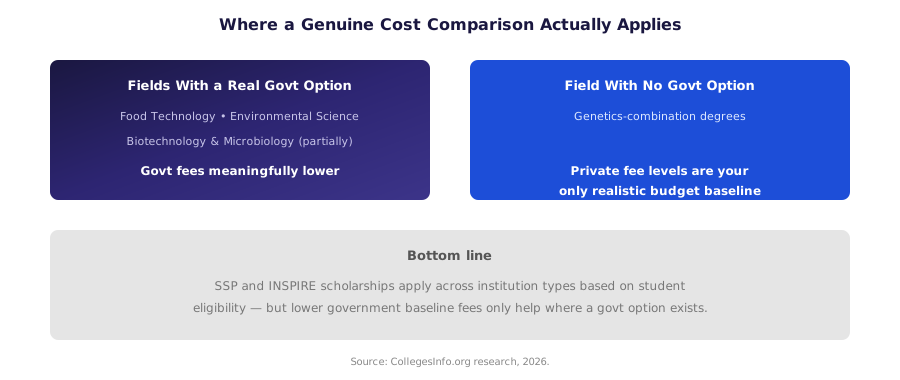
Despite the very different government/private availability per field, one pattern holds fairly consistently: where government options exist (Food Technology, Environmental Science, and to some extent Biotechnology/Microbiology), they run meaningfully cheaper than private autonomous colleges. UAS Bengaluru and UAS Dharwad's government fee structures for Food Technology are substantially lower than what a comparable private technical degree would cost. Bangalore University and University of Mysore's Environmental Science fees are similarly lower than St. Joseph's University's private fee structure. For Biotechnology, Microbiology, and Genetics specifically, since private autonomous colleges dominate or exclusively provide these fields, budget planning should assume private-college fee levels as your realistic baseline rather than hoping for a lower-cost government alternative that may not genuinely exist in your specific field or district.
Admission Process Differences: Government vs Private, Where It Actually Applies
Where a genuine government-vs-private choice exists (mainly Environmental Science, and district-level Biotechnology/Microbiology options), admission processes do differ meaningfully. Government university departments typically follow standard merit-list admission based on PUC marks, processed through the university's own centralised system. Private autonomous colleges often run their own admission timelines and processes independently, sometimes opening earlier and filling seats faster than government counterparts. If you're keeping both a government and private option on your shortlist for the same field, track each institution's specific deadline separately, since these processes don't always align.
Accreditation and Recognition: What Actually Differs
Both government and private options across these five fields are generally UGC-recognised where they hold university or affiliated-college status, so basic degree validity isn't usually the differentiator. What varies more is specific programme-level recognition — the DBT-Star College Scheme, for instance, recognises specific departments (government or private) based on independently-vetted lab infrastructure and teaching quality, rather than institution type alone. When comparing a government and private option within the same field, check for this kind of programme-specific recognition rather than assuming government status alone guarantees better facilities, or that private status alone guarantees worse ones.
Making Your Actual Decision
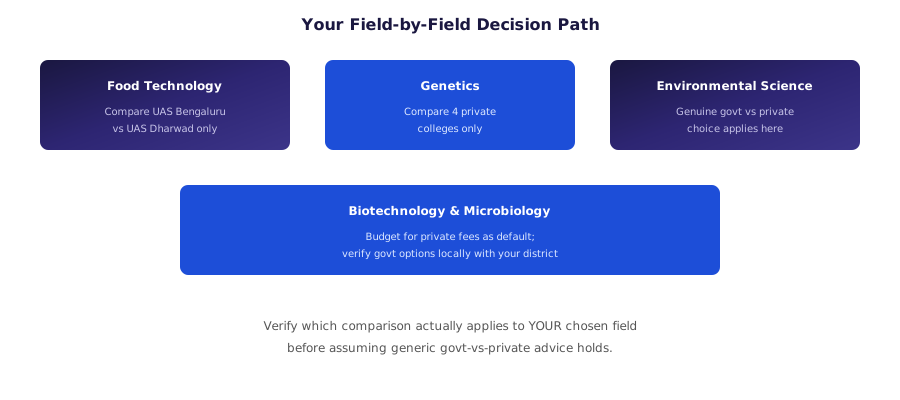
Given how differently this plays out per field, the practical decision tree looks like this: for Food Technology, your choice is between two government campuses, not government-versus-private. For Genetics, your choice is between four private colleges, with no government alternative to weigh. For Environmental Science, you have a genuine government-versus-private decision, with cost favouring government and possibly smaller class sizes or different admission flexibility favouring the private option. For Biotechnology and Microbiology, treat government options as a possibility worth checking locally, while planning your realistic budget around private-college fee levels, since that's where most of the genuinely well-documented, actively-recruiting programmes currently sit.
Faculty and Research Quality: Not Simply a Government-vs-Private Question
It's tempting to assume government institutions automatically have stronger research faculty, or that private colleges automatically invest more in modern facilities — neither assumption holds up consistently across this cluster. Bangalore University's Environmental Science faculty hold genuinely significant civic and regulatory roles specifically because it's a government institution with those institutional connections. Meanwhile, several private autonomous colleges offering Biotechnology and Genetics-combination degrees hold DBT-Star College Scheme recognition — a government-vetted signal of lab infrastructure investment that has nothing to do with the college being government or private, and everything to do with that specific department applying for and receiving this recognition. When comparing any two specific colleges within this cluster, check programme-level signals like this scheme, published faculty research, and documented placement records rather than assuming institution type alone predicts quality.
Campus Infrastructure: What Government and Private Options Actually Look Like
Government institutions in this cluster tend to be larger, more established campuses — UAS Bengaluru's GKVK campus and UAS Dharwad's main campus are substantial agricultural university campuses with their own research stations and farms, while Bangalore University, University of Mysore, and Kuvempu University are large public universities with correspondingly large campus footprints. Private autonomous colleges tend toward more compact, urban campus environments, which some students prefer for practical reasons (shorter commutes, closer to city amenities) and others find less appealing if they're drawn to a more spacious or rural-adjacent university environment. Neither is objectively better — this is genuinely a personal-preference factor worth weighing alongside academic considerations.
Placement and Industry Connections: Government vs Private in Practice
Placement quality across this cluster depends far more on individual institutional effort and industry relationships than on government-versus-private status generally. UAS Bengaluru's Food Technology programme, despite being a government institution, has genuinely structured industrial training partnerships with named food companies specifically because the department has built those relationships deliberately over decades. Private autonomous colleges offering Biotechnology and Microbiology similarly vary enormously in placement quality based on individual college effort — some maintain genuine industry partnerships with Bengaluru's biotech and pharma companies, while others rely more on generic campus placement drives with less specific industry alignment. Ask any college you're considering, government or private, for actual documented placement data and named recruiting companies rather than accepting general claims about "good placements."
A Word on NAAC and NIRF Rankings Across This Cluster
NAAC accreditation grades and NIRF rankings apply to both government and private institutions in this cluster, and neither ranking system inherently favours one institution type over the other. Bangalore University, University of Mysore, and the private autonomous colleges offering Biotechnology, Microbiology, and Genetics-combination degrees are all independently NAAC-assessed on the same criteria. When comparing specific institutions within this cluster, checking each one's current NAAC grade and, where applicable, NIRF ranking gives you a more useful, independently-verified comparison point than assuming government or private status predicts accreditation quality.
Scholarship Access: Government vs Private Institutions
Karnataka's State Scholarship Portal (SSP) — covered in our SSP scholarship guide — is generally accessible to eligible SC, ST, OBC, and minority-category students regardless of whether they're at a government or private institution, provided the specific college is recognised under the relevant scholarship scheme. The INSPIRE Scholarship, supporting meritorious students in basic and natural sciences, similarly applies across institution types based on individual student merit rather than institution ownership. Where government institutions have a genuine cost advantage isn't scholarship access specifically — it's the lower baseline tuition fee that government institutions charge before any scholarship is even applied, which compounds with scholarship eligibility to make government options meaningfully more affordable overall for eligible students, where a genuine government option exists for your chosen field.
Regional Access: Government Institutions and Geographic Spread
One genuine advantage government institutions offer across this cluster, where they exist, is regional accessibility beyond Bengaluru specifically. University of Mysore and Kuvempu University give Environmental Science students genuine options outside the capital, each with distinct regional character — Mysuru's more traditional university-town setting versus Kuvempu's Shimoga location giving direct access to Western Ghats forestry and biodiversity contexts. UAS Dharwad similarly gives Food Technology students in north Karnataka a genuine local option rather than requiring relocation to Bengaluru specifically. Private autonomous colleges in this cluster, by contrast, concentrate overwhelmingly in Bengaluru — Genetics-combination degrees exist at no institution outside the capital, and the great majority of Biotechnology and Microbiology's private-college options are similarly Bengaluru-concentrated. If reducing relocation distance or cost of living matters to your decision as much as the academic programme itself, this regional spread is a genuine practical factor favouring the government route specifically where it exists.
How to Actually Compare Two Specific Options Side by Side
Once you've identified whether your chosen field genuinely offers both government and private options (Environmental Science, and potentially Biotechnology or Microbiology depending on your district), build your comparison around specific, verifiable factors rather than institution type alone: current NAAC grade and NIRF ranking where applicable, DBT-Star College Scheme recognition if relevant to your field, documented placement data with named recruiting companies, actual total fees including any hidden costs, and genuine lab or fieldwork facilities you can verify by visiting or asking current students directly. Institution type — government or private — is a useful starting filter for cost and admission process expectations, but it shouldn't be your final decision criterion once you've narrowed down to two or three genuinely comparable specific options.
A Field-by-Field Summary Before You Decide
Pulling this together into a genuinely practical summary: if you're set on Food Technology, stop looking for a private alternative — compare UAS Bengaluru against UAS Dharwad specifically, both government, and choose based on campus location and industry proximity rather than institution type. If Genetics is your priority, similarly stop looking for a government option — compare the four private colleges on their specific subject combinations and accreditation instead. If Environmental Science is your field, you have a genuine three-way government comparison (Bangalore University, University of Mysore, Kuvempu University) plus one private alternative (St. Joseph's University), and this is where institution type, cost, and regional location all genuinely factor into your decision simultaneously. For Biotechnology and Microbiology, budget for private-college fee levels as your realistic default, while treating a government-college option as a genuine possibility worth actively researching in your specific district rather than assuming it doesn't exist just because it's less visible online than the private landscape.
Why This Level of Field-by-Field Detail Matters
Generic "government versus private" college advice — cheaper fees, more bureaucracy, better research reputation on one side; more flexible admission, newer facilities, potentially higher fees on the other — assumes both options genuinely exist for whatever field you're researching. As this page has hopefully made clear, that assumption breaks down badly across this specific cluster of five fields. Applying generic advice to Food Technology (where no private option exists) or Genetics (where no government option exists) would send you searching for something that isn't there, wasting time you could spend comparing the real options that do exist. This is exactly the kind of field-specific verification that matters more than following broad, one-size-fits-all guidance when researching any specific degree programme, not just the five covered here. Before you settle on a shortlist, spend ten minutes confirming which comparison genuinely applies to your chosen field rather than assuming the standard government-versus-private framework transfers cleanly from a field like engineering or medicine, where both options reliably exist side by side.
Frequently Asked Questions
Is there a private alternative to Food Technology in Karnataka?
No — based on current research, UAS Bengaluru and UAS Dharwad are the only two institutions offering this specific degree in Karnataka, and both are government agricultural universities.
Is there a government alternative to the four Genetics-combination colleges?
No — all four colleges offering Genetics-combination degrees in Karnataka (M.S. Ramaiah, Kristu Jayanti, Jyoti Nivas, Seshadripuram) are autonomous private institutions.
Which field has the most genuine government-vs-private choice?
Environmental Science, where Bangalore University, University of Mysore, and Kuvempu University anchor the government side against St. Joseph's University's private option.
Are government options always cheaper?
Where government options genuinely exist, yes, typically — but for Genetics specifically, there's no government option to compare against, so this general rule doesn't apply to every field equally.
Should I contact government colleges directly for Biotechnology and Microbiology options?
Yes — since government first-grade college options for these two fields aren't as centrally documented online as the private autonomous college landscape, direct contact with your district's government colleges is the most reliable way to confirm current availability and facilities.
Does a private college's higher fee guarantee better facilities than a government option?
No — fee level alone doesn't guarantee facility quality. Check for specific, independently-verified signals like DBT-Star College Scheme recognition, documented placement data, and current NAAC grade rather than assuming higher private fees automatically mean better infrastructure.
Is autonomous status the same as private status?
Not exactly — autonomous status refers to a college's curriculum and administrative independence (granted by UGC), which most private colleges in this cluster hold, but government institutions can also hold autonomous status in some cases. Autonomy affects curriculum flexibility more directly than it reflects government-versus-private ownership specifically.
Which field should I prioritise if cost is my absolute primary constraint?
Food Technology or Environmental Science, since both have genuine government options with meaningfully lower fees — Genetics specifically has no low-cost government alternative, so budget accordingly if that's your chosen field.
For admission guidance on any science degree in Karnataka — government or private — WhatsApp +91 6363 330 233. We help you get the best admission to your preferred colleges without hassle.