
Last Updated: September 7, 2026
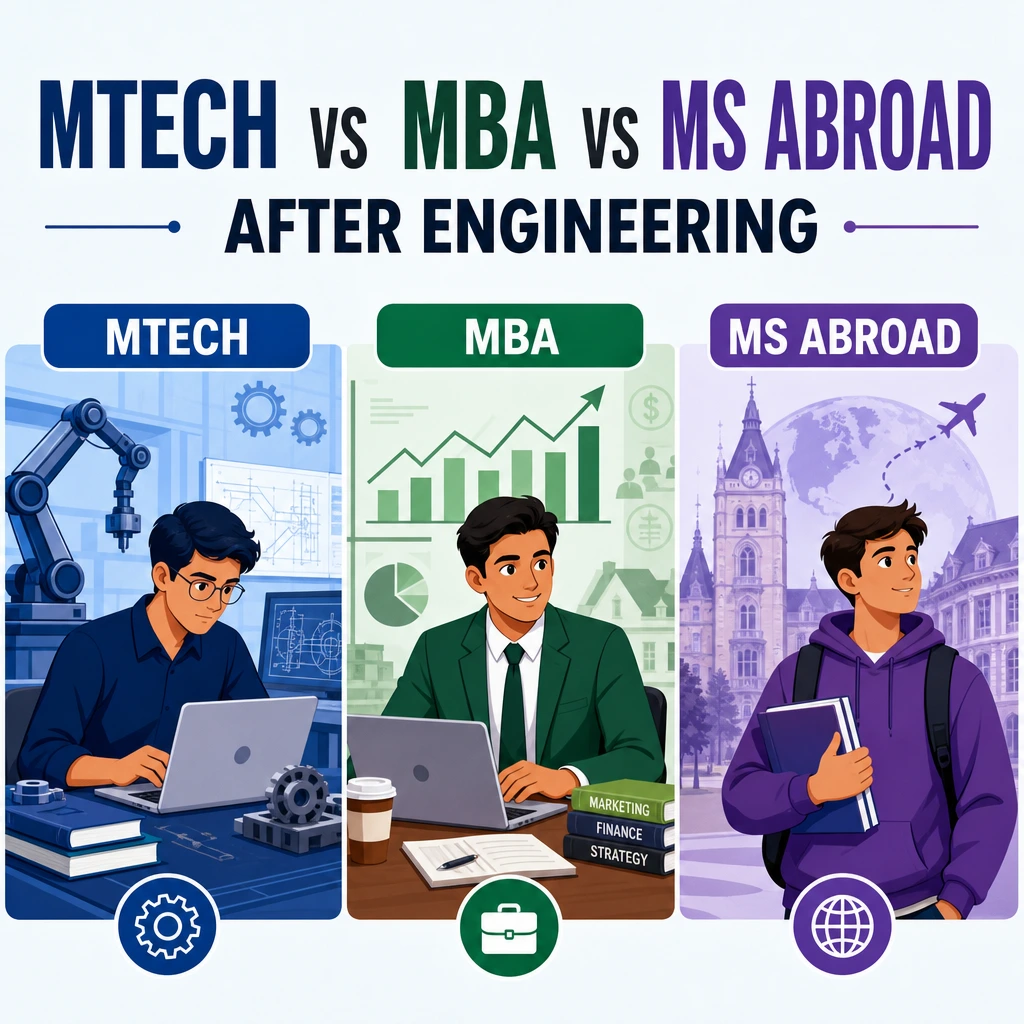
Many BTech graduates feel stuck at the same point - “What next?” One of the most asked questions is after mechanical engineering, which course is best, but students from every branch face the same confusion.
Choosing the right course after engineering affects your salary, job role, work location, and even your work-life balance. In this guide, collegesinfo.org walks you through a clear decision framework. You will see how to shortlist courses after engineering, compare options, and pick a PG path that fits your goals instead of random trends.
Last Updated: September 9, 2026
Why Choosing the Right Course After Engineering Matters
Your PG choice is not just “one more degree.” It changes how your entire career looks over the next 10–20 years.
If you pick a course that matches your strengths, you are more likely to enjoy your work, grow faster, and stay relevant when technology changes. A focused PG program can open higher salary bands, leadership roles, onsite opportunities, or niche technical research paths that a basic BTech may not open up.
On the other hand, a random choice can trap you in a field you do not enjoy. Many engineers realize after a few years that they picked a course only because friends or relatives suggested it, not because it matched their skills. Shifting later becomes harder.
Good PG planning can improve the following:
-
Salary growth - better entry packages and faster hikes.
-
Job opportunities - more companies and roles to apply for.
-
Career flexibility - option to move between tech, management, or product.
-
Industry demand - roles in fields like AI, data, cyber security, and automation.
-
Global options - MS, MEng, or specialized diplomas abroad.
So your PG decision should be planned, not rushed. A simple framework makes it much easier.
Decision Framework to Choose the Best Course After Engineering
Before you look at long lists of courses after engineering, pause and run your decision through four clear steps. This framework works for all branches - mechanical, CSE, civil, ECE, and more.
Follow these 4 steps in order; write your answers on paper, and you will automatically filter out many wrong choices.
Step 1 - Identify Your Career Goal
First, decide what kind of work life you want 5–10 years from now. Broadly, there are four paths:
• Technical specialization - You enjoy core engineering, coding, design, or research. M.Tech, MS, or domain-specific PG diplomas suit you.
• Management roles - You want to lead teams, manage projects, handle clients, or work in strategy. An MBA or PGDM is better here.
• Research and academia - You like solving deep problems, publishing papers, or teaching. An M.Tech followed by a PhD is suitable.
• Entrepreneurship / startups - You want to build products or services. A mix of technical PG and startup exposure or a practical MBA helps.
Circle the path that excites you most.
Step 2 - Evaluate Industry Demand
Next, match your interest with real demand. Some sectors are growing strongly in India and globally:
-
Artificial Intelligence and Machine Learning
-
Data Science and Analytics
-
Cybersecurity
-
Cloud and DevOps
-
Robotics and Automation
-
Electric vehicles, renewable energy, and Industry 4.0
Look at job portals, salary reports, and industry news. (medicaps.ac.in) If a field shows rising jobs, higher starting packages, and demand across cities, that course is safer than a fading specialization with fewer openings.
Step 3 - Check Entrance Exams and Eligibility
Every PG path has its gatekeeper exams and minimum marks:
-
M.Tech / ME - Mostly through GATE or institute-level entrances.
-
MBA / PGDM - CAT, XAT, MAT, CMAT, state CETs, or college-specific tests.
-
Overseas MS - GRE / GMAT plus English tests like IELTS or TOEFL.
-
Specialized PG diplomas - Often direct institute applications.
Also watch state-level changes like CET attempts and seat matrices, which affect competition and availability in some branches.
Check: Are you eligible? Can you realistically prepare and score well within your timeline?
Step 4 - Compare Salary and Career Opportunities
Now compare your shortlisted PG courses on three things:
-
Starting salary and 5-year growth
-
Types of roles and industries
-
Long-term ceiling - leadership vs specialist ceilings
Example: A good MBA from a strong B-school can give 20–30 LPA packages for top profiles, while core engineering M.Tech averages are lower but still strong in good institutes.
However, niche technical fields (AI, data, semiconductor, robotics) can catch up in 5–7 years and sometimes cross business roles.
Pick the option where both your interest and long-term opportunity match.
Top Courses After Engineering for High-Growth Careers
There are many courses after engineering, but a few categories show consistent, long-term demand.
M.Tech / ME
An M.Tech or ME is ideal if you love core engineering and want deeper technical roles. You can specialize in your branch (Mechanical, CSE, Civil, or ECE) or move into newer areas like AI, data, robotics, or renewable energy.
M.Tech. graduates often work in R&D labs, product design, core engineering firms, or as technical leads in tech companies. Many also use M.Tech as a step towards a PhD or teaching.
MBA
An MBA is for engineers who want to move toward management, product, sales, consulting, or leadership roles. Specializations like Operations, Business Analytics, Marketing, Finance, or IT Management fit well with an engineering background.
A strong MBA from a reputed institute can give access to higher salary bands, campus placements with top companies, and faster movement into decision-making roles rather than pure execution.
Data Science and Artificial Intelligence
Data science and AI programs are among the hottest courses after engineering today. These include specialized PG diplomas, MS programs, and online or hybrid master's focused on statistics, machine learning, big data, and ML engineering.
Engineers from any branch can move into data with strong maths and programming. Roles include Data Scientist, ML Engineer, Analytics Consultant, and AI Product Specialist.
Cyber Security
Cyber security PG programs are ideal if you like networks, security, and ethical hacking. You learn how to secure systems, test vulnerabilities, and respond to incidents.
Demand is growing across banks, IT companies, fintech, and government agencies.
Many programs also align with global certifications, which can help you work abroad.
Software Development Programs
For students who enjoyed software engineering courses after 12th and then did a BTech, specialized PG courses in full stack development, cloud, mobile apps, or DevOps can be powerful.
These programs are often shorter, industry-focused, and directly linked to roles like Full Stack Developer, Cloud Engineer, or DevOps Engineer.
Planning an MBA in Mangalore? Explore the Top Colleges, Fees & Admission Process
Check here: MBA Colleges in Mangalore 2026
After Mechanical Engineering Which Course Is Best?
This is the exact question many students type: after mechanical engineering which course is best? There is no single answer, but some options clearly stand out in today’s market.
1. M.Tech in Mechanical Design or Thermal / Manufacturing
-
Best for those who love machines, design, simulation, or energy systems.
-
Roles: Design Engineer, R&D Engineer, Manufacturing Engineer, Simulation Specialist.
2. Robotics and Automation / Mechatronics
-
Combines mechanics, electronics, and control systems.
-
Strong fit for Industry 4.0, smart factories, and robotics companies.
-
Roles: Automation Engineer, Robotics Engineer, Control Engineer.
3. Industrial Engineering / Operations Research
-
Focus on process optimization, productivity, and systems design.
-
Roles: Industrial Engineer, Operations Analyst, Supply Chain Planner.
4. MBA in Operations or Supply Chain
-
For mechanical engineers who want to move into plant management, logistics, or consulting.
-
Roles: Operations Manager, Project Manager, Supply Chain Manager, and consulting roles.
5. Data and Analytics for Manufacturing / Industry 4.0
• Newer path where mechanical engineers learn analytics and data tools to optimize factories and machines.
• Roles: Manufacturing Data Analyst, IoT Specialist, Industry 4.0 Consultant.
The “best” course after mechanical engineering is the one that fits your interests and the kind of work you want: hands-on machines, systems optimization, or business leadership.
Explore Top Engineering Branches with High Salary and Strong Future Demand
Check here:Best Engineering Courses for High-Paying Jobs
Engineering Courses After 12th vs Courses After Engineering
Many students mix up engineering courses after 12th with PG level courses after engineering. These are two very different stages.
Engineering courses after 12th (like B.Tech in CSE, Mechanical, Civil, ECE, or software engineering courses after 12th) are foundation degrees. They build your basic technical and problem-solving skills over 4 years.
Courses after engineering (M.Tech, MBA, data science, and PG diplomas) are specialization courses. They build depth in one direction and shape your final career path.
Quick comparison table
|
Aspect |
Engineering After 12th (B.Tech) |
Courses After Engineering (PG) |
|
Purpose |
Foundation degree |
Specialisation / career upgrade |
|
Typical duration |
4 years |
1–2 years |
|
Entry requirement |
12th with PCM + entrance exams |
B.Tech / BE degree + entrance / merit |
|
Focus |
Broad branch basics |
Narrow, job-focused depth |
|
Outcome |
Engineer (entry level) |
Specialist / manager / researcher |
For school students, choosing the right engineering courses after 12th grade is the first big step. For graduates, this article focuses on the next step - PG choices.
Discover Top Career Paths After 12th for Science, Commerce & Arts Students
Check here: Best Career Options After 12th Guide
Factors to Consider Before Choosing a PG Course
Before you pay any fees or fill out forms, pause and check these factors one by one:
• Personal interest
o Do you like solving equations, writing codes, managing people, or convincing clients?
• Course ROI (Return on Investment)
o Compare fees vs average salary and placements of that course and college.
• Industry demand
o Is the field growing or shrinking? Check hiring trends and new job roles in your target city or country.
• College reputation and ranking
o Look at the NIRF ranking, past recruitment, and alumni networks.
• Faculty and curriculum
o Does the syllabus include current tools, labs, and industry projects?
• Entrance exam difficulty
o Are you ready to spend 1 year preparing for exams like GATE or CAT, or do you want quicker options?
• Location and GEO factors
o Some states have reduced seats in traditional branches but are growing options in computer and data-related fields.
• Internship and placement support
o Check how many students actually get placed and in what packages.
Tick these points for each shortlisted course. A clear picture will emerge.
Career Opportunities After Postgraduate Courses in Engineering
Your PG course opens doors to specific industries and roles.
For technical PGs (M.Tech, MS, data, cyber):
-
Core engineering companies: design, R&D, quality, and manufacturing.
-
IT and product firms - data, AI, software architecture, and DevOps.
-
Research labs and universities - research associates, lecturers.
-
Government and PSUs - roles through GATE or separate exams.
For management PGs (MBA, PGDM):
-
Consulting and strategy roles.
-
Product management and program management.
-
Marketing, sales, and business development.
-
Operations and supply chain management.
Example salary ranges (approximate, for strong institutes in India):
-
Many BTech-only roles start around 5–8 LPA in tech.
-
M.Tech / technical PGs in good institutes often reach 8–15 LPA averages in growing sectors.
-
MBAs from top B-schools can see 20–30 LPA averages or more, with some top packages crossing 1 crore at elite campuses.
These numbers depend a lot on college quality, your own skill building, internships, and interview performance.
Common Mistakes Students Make When Choosing Courses After Engineering
Many students repeat the same mistakes:
• Following friends blindly
o Just because your friend chose MBA or M.Tech does not mean it suits you.
• Chasing only salary figures
o High CTC with work you hate leads to burnout. Balance money with interest.
• Ignoring course content
o Some PG programs have outdated syllabi. Always read the syllabus before applying.
• Not checking placements and alumni outcomes
o A course with poor placements, even in a “hot” field, can leave you disappointed.
• Underestimating entrance exams
o GATE, CAT, and other tests need solid preparation. Last-minute attempts rarely work.
• Skipping research on engineering courses after 12th vs PG
o Some students join random short courses instead of a solid, recognized PG program.
Avoid these mistakes by using the decision framework and verifying every big claim you see in ads or social media.
Conclusion
Choosing the right PG path is one of the most important decisions after engineering. Instead of asking only “which course is best?" shift to a better question - “which course is best for my goals, skills, and situation?”
Use the 4-step framework: define your goal, study industry demand, understand entrance exams, and compare salaries plus roles. Look at strong options like M.Tech, MBA, data science, cyber security, and specialized programs for branches like mechanical or CSE.
When you plan clearly, the answer to after mechanical engineering which course is best? or “which PG is right for me? stops feeling confusing. It becomes a structured choice you can trust.
Still confused about which PG course to choose after engineering?
The team at collegesinfo helps students compare PG programs, exams, colleges, and real placement data instead of only marketing claims.
Need personal guidance?
Visit: collegesinfo
Share your branch, marks, and goals, and get a clear shortlist of PG options that fit you.
FAQs – Courses After Engineering
1. What are the best courses after engineering?
The best courses after engineering depend on your goals. Popular options include M.Tech / ME, MBA, MS abroad, data science and AI programs, cyber security, and specialized PG diplomas in areas like product management or industrial engineering.
2. After mechanical engineering which course is best?
Strong choices are M.Tech in Mechanical Design or Thermal, Robotics and Automation, Industrial Engineering, and MBA in Operations or Supply Chain. Newer options like data and analytics for manufacturing also have positive scope. Pick based on whether you prefer hands-on technical work or management roles.
3. Is an MBA better than an M.Tech after engineering?
An MBA is better if you want business and leadership roles with faster salary growth. M.Tech is better if you love deep technical work, R&D, or teaching. Neither is universally better - your interest, college brand, and long-term plan matter more.
4. What are high salary courses after engineering?
High-salary paths include MBAs from top B-schools, M.Tech or MS in AI, data, or semiconductor fields; and strong product or consulting roles. Good colleges plus strong skills are more important than only the course name.
5. Which course is best after engineering for IT jobs?
For IT jobs, look at data science, AI and ML, full-stack development, cloud computing, and cyber security. If you already did software engineering courses after 12th and a B.Tech. in CSE / IT, these PG paths build strong depth and open global roles.
End Note
If you are reading this, you are already serious about your future. That alone is a strong first step.
You do not have to copy anyone else’s path. Take a little time, use the decision framework, talk to mentors, and then choose a PG course that fits your strengths.
collegesinfo is here to support you with honest information, so your next step after engineering feels clear and practical, not stressful.
Key Takeaways
• Do not look for one “magic” course - look for the course that matches your career goal.
• Use the 4-step framework: goals, demand, exams, salary, and roles.
• For mechanical students, M.Tech, robotics, industrial engineering, and operations or supply chain MBA are strong choices.
• Understand the difference between engineering courses after 12th (foundation) and courses after engineering (specialization).
• Check real data - fees, placements, salary ranges, and alumni outcomes - before you decide.
• Avoid common mistakes like following friends blindly or chasing only CTC.
• Build skills alongside your PG course with projects, internships, and certifications.
• Use platforms like collegesinfo.org to compare options and get neutral guidance.
Frequently Asked Questions
What are the best PG courses after engineering in Karnataka?
Top PG options after engineering include M.Tech (via GATE/PGCET), MBA (via CAT/KMAT), MS abroad, and MCA for non-CS graduates. M.Tech is best for R&D careers while MBA suits management aspirants.
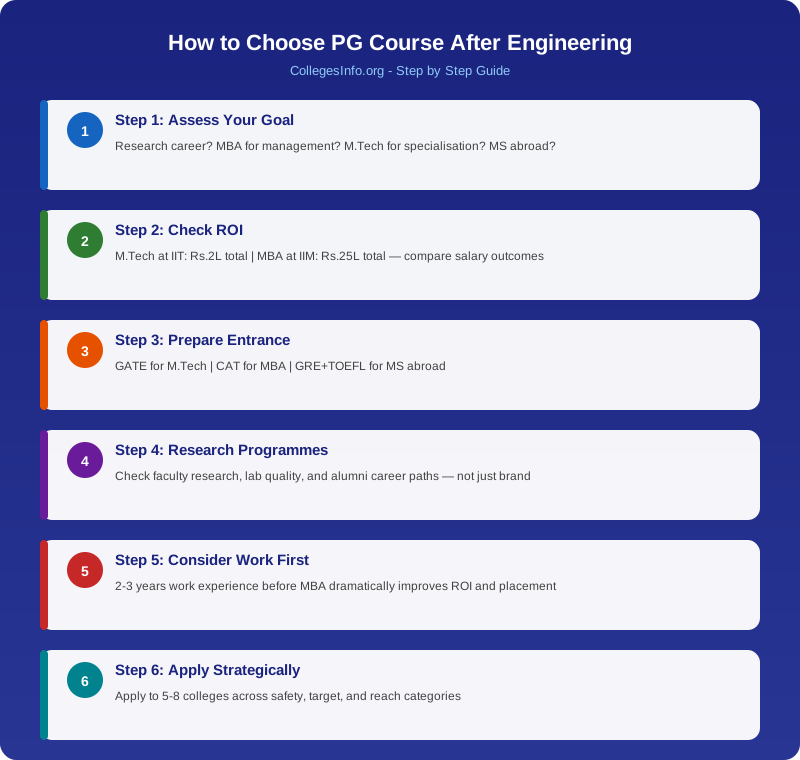
Should I do M.Tech or MBA after B.E in Karnataka?
Choose M.Tech if you want to deepen technical expertise, join R&D or PSUs. Choose MBA if you want management, consulting or entrepreneurial roles. M.Tech fees are lower (Rs 50K-2L/year) while MBA costs more (Rs 2-15L/year) but offers higher average salaries.
Is GATE required for M.Tech admission in Karnataka?
GATE is required for IITs, NITs and NITK Surathkal. For VTU-affiliated colleges, Karnataka PGCET is the primary entrance exam. Some deemed universities accept their own entrance tests.
Need Admission Assistance?
Not sure which college suits your rank, category, or budget? WhatsApp our counsellors at +91 6363 330 233 – we help you get the best admission to your preferred colleges without hassle. We help Karnataka students and families with KCET counselling, NEET seat selection, management quota advice, and college shortlisting.
Chat on WhatsAppNeed help with admission?
CollegesInfo.org helps students secure admission to colleges they are eligible for under that college's actual published criteria. Chat with us on WhatsApp or explore admission assistance.
Looking at the bigger picture? Our guide to the best engineering colleges in Karnataka compares KCET tier-wise cutoffs, COMEDK options, and real fee data across Bengaluru, Mangalore, Mysore, and north Karnataka for 2027.
About This Guide
This article is written and maintained by L K Monu Borkala, founder of CollegesInfo.org and OneCity Technologies Pvt Ltd. L K Monu Borkala has been publishing Karnataka education directories since 2006 and covering college admissions data since 2019 through CollegesInfo.org. If you find anything outdated, WhatsApp us at +91 6363 330 233.