Last Updated: August 26, 2026
| Published: 5 August 2026 | Updated: 6 August 2026Russia enrols more Indian MBBS students than any other country – the Indian Embassy in Russia puts the current figure at roughly 23,000 to 23,500. That scale is exactly why Russia is also where the most misleading agent marketing shows up. This guide covers what our MBBS Abroad hub touches on briefly for Russia, in the depth Russia's size as a destination actually warrants: which specific universities we could independently verify, what founding history and government status each one actually has, what a Russian MBBS year-by-year experience looks like, and the specific claims – "100% visa guarantee," "free counselling" – that should make you walk away from an agent regardless of which university they're pushing.
The One Rule That Matters More Than Any University Name
Before any university comparison: the university you choose abroad must satisfy NMC's Foreign Medical Graduate Licensure Regulations, and you should hold – or be actively obtaining – an NMC Eligibility Certificate before you enrol, not after. NMC does not maintain a simple public "approved list" the way most agent websites imply. What NMC does is set criteria: minimum course duration, curriculum content, and clinical training hours that a specific university's specific MBBS programme must meet. A university being real, government-run, and centuries-old does not by itself guarantee your specific programme satisfies those criteria – that is confirmed per student, per programme.
Cross-check any university against two things before paying anything: the NMC's current guidance at nmc.org.in, and the university's listing in the World Directory of Medical Schools at wdoms.org. If a university appears on WDOMS but you cannot confirm current NMC eligibility, don't enrol on an agent's word alone.
Universities We Could Independently Verify
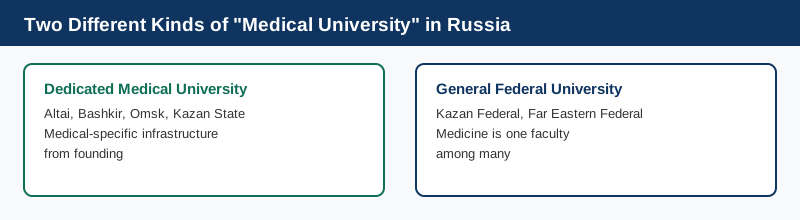
Several agent networks circulate long lists of "NMC-approved government universities" in Russia. Many of the specific universities named are real. Some listings blur a dedicated medical university with a general federal university that happens to have a medical faculty – a real distinction that affects how specialised the medical infrastructure and faculty actually are. Below are the universities we independently verified against multiple non-agent sources, including Wikipedia and each university's own institutional history, rather than repeating agent-network marketing copy.
| University | City | Founded | Type |
|---|---|---|---|
| Kazan State Medical University | Kazan | 1814 (as Medical Faculty), independent institute 1930 | Dedicated medical university |
| North-Western State Medical University (Mechnikov) | St Petersburg | 1907; current structure since 2011 | Dedicated medical university |
| Altai State Medical University | Barnaul | 1954 | Dedicated medical university |
| Omsk State Medical University | Omsk | 1920 | Dedicated medical university |
| Bashkir State Medical University | Ufa | 1932 | Dedicated medical university |
| Saint Petersburg State Pediatric Medical University | St Petersburg | Established mid-20th century, pediatric specialisation | Dedicated medical university |
| Kirov State Medical University | Kirov | 1987 (as a Perm State Medical Institute affiliate) | Dedicated medical university |
| Kazan Federal University | Kazan | 1804 (general university); medicine since 1835 | General federal university, medical faculty |
| Far Eastern Federal University | Vladivostok | 1899 (general university) | General federal university, medical faculty |
| Ulyanovsk State University | Ulyanovsk | 1988 (general university) | General public university, medical faculty |
A genuinely useful distinction sits inside this table: Kazan State Medical University split off from what's now Kazan Federal University back in 1930, becoming its own dedicated medical institute. Both are real institutions and both appear on agent lists – but they are different choices. A dedicated medical university has run medical-specific infrastructure, hospitals, and faculty development for its entire history. A medical faculty inside a large general university shares that university's broader resources but doesn't carry the same singular medical focus. Neither is automatically the wrong choice, but you should know which one you're actually choosing.
The same pattern likely applies to Far Eastern Federal University specifically: a separate, dedicated Far Eastern State Medical University (founded 1930, described as the oldest higher medical institution in Russia's Far East) exists in the same region and is not the institution named on most agent lists circulating for that region's option.
Universities We Could Not Independently Verify Here
Agent-circulated lists commonly also include Yaroslavl State Medical University, Chita State Medical Academy, Privolzhsky Research Medical University, Northern State Medical University, Tver State Medical University, Volgograd State Medical University, Kemerovo State Medical University, Syktyvkar State University, MEPhI National Research Nuclear University, North Caucasus Federal University, Kuban State Medical University, Sevastopol State University, Kabardino-Balkarian State Medical University, Tambov State Medical University, and Saint Petersburg State University of Veterinary Medicine, among others. Several of these are very likely real, established institutions – Russia genuinely has 50-plus medical universities recognised under NMC's framework, more than any other single country. We simply have not yet independently verified each one's specific founding history and current status to the standard shown above, and we won't present a name as verified until we have. Treat any university not in our verified table the same way you should treat any university, verified or not: confirm directly with NMC and WDOMS before enrolling, not based on this page or any agent's list alone.
One name specifically worth flagging: some agent lists also circulate "Synergy University" as a Russian option. Synergy is a private Moscow business university, not a medical institution with a long-established medical faculty the way the universities above are – verify its medical programme's specific NMC status with particular care before treating it as comparable to the dedicated medical universities in this table.
What MBBS in Russia Actually Costs
| Cost Component | Typical Range (INR) | Notes |
|---|---|---|
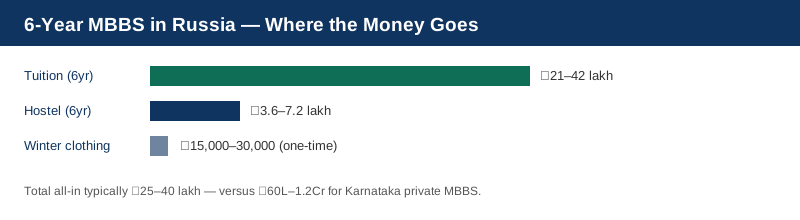
| Tuition (per year) | ₹3.5–7 lakh | Varies by university and city; Moscow/St Petersburg institutions run higher |
| Tuition (6-year total) | ₹21–42 lakh | Before hostel, food, and living costs |
| Hostel/accommodation (per year) | ₹60,000–1.2 lakh | University-run hostels are generally safer and cheaper than private rentals |
| Winter clothing (one-time) | ₹15,000–30,000 | Genuinely necessary – Russian winters reach -20°C to -30°C in cities like Kazan and Novosibirsk |
| Total 6-year programme (all-in) | ₹25–40 lakh | Matches the range already cited on our broader MBBS-abroad guide |
Compare this against ₹60 lakh to ₹1.2 crore for management-quota MBBS at a Karnataka private medical college, covered in detail in our Karnataka MBBS admission guide.
Year-by-Year: What the Programme Actually Looks Like
| Year | Focus | Russian Language Requirement |
|---|---|---|
| Year 1 | Anatomy, Physiology, foundational sciences | Mandatory Russian language coursework begins |
| Year 2 | Biochemistry, Histology | Russian continues alongside medical subjects |
| Year 3 | Pathophysiology, Microbiology, Pharmacology | Russian-language proficiency tests typical |
| Year 4 | Clinical subjects begin, internal medicine rotations start | Patient interactions increasingly in Russian |
| Year 5 | Full clinical rotations in teaching hospitals | Russian-language clinical communication expected |
| Year 6 | Internship year | Return to India for NExT registration begins |
The Russian-language requirement is the single most underestimated part of studying in Russia. By Year 4, you're expected to take patient histories and explain procedures in Russian, not English. Students who arrive with any prior Russian-language exposure have a real, practical advantage over those who don't. English-medium instruction covers lectures; it does not cover ward rounds in a Russian hospital.
Choosing a Specific City
Indian students in Russia concentrate heavily in a handful of cities: Moscow, St Petersburg, Kazan, and Novosibirsk carry the largest, most established Indian student communities, meaning better peer support, more accessible Indian groceries and food, and more mature NExT-coaching infrastructure built around the local Indian student population. Smaller cities may offer lower costs but thinner support networks – weigh this specifically against your own comfort with being one of a small handful of Indian students on a campus, rather than one of hundreds.
The Fraud Patterns Specific to Russia-Bound Students
Our MBBS Abroad hub covers general MBBS-abroad agent fraud. Two patterns show up specifically in Russia-focused agent marketing:
"100% Visa Guarantee." No agent, anywhere, can guarantee a visa. Visas are issued solely by the destination country's government based on your own documentation. An agent making this claim is not describing a real service – they're describing a sales pitch. Russian student visa approval rates are genuinely very high (95%+) for properly documented applicants, which is likely why this claim gets made so casually – but "very high approval for complete applications" and "100% guaranteed" are not the same statement, and only one of them is true.
"Free Counselling" bundled with vague "exclusive partnership" framing. Legitimate education consultants typically charge a modest, disclosed service fee. An agent offering everything free while also claiming an "exclusive partnership" with 20-plus universities simultaneously is a specific combination worth double-checking – verify the agent's registration and ask directly how they're compensated if counselling is genuinely free. Someone is paying for it, and it's worth knowing who.
Frequently Asked Questions
Is Russia still a good choice for MBBS compared to Georgia or the Philippines?
It depends on your priorities. Russia has by far the largest Indian student community and the most established support infrastructure of any MBBS-abroad destination, plus the lowest visa rejection risk. Georgia and the Philippines have historically shown somewhat better NExT/FMGE pass rates and don't carry Russia's mandatory clinical-year Russian-language requirement. The site's college and course comparison tool can help you weigh destinations side by side on fees and outcomes.
How do I check if a specific Russian university is currently valid for NMC purposes?
Check NMC's current guidance directly at nmc.org.in – and if you're still deciding between a Karnataka seat and studying abroad at all, our NEET rank predictor shows what your score already qualifies for domestically – and cross-check the university's listing at wdoms.org (World Directory of Medical Schools). Both checks matter – a WDOMS listing alone doesn't confirm current NMC eligibility for Indian students. Never rely on an agent's verbal assurance or a printed brochure claim alone.
Do I need to know Russian before I go?
Not before you go, but you will need it. Most programmes teach lectures in English but require Russian-language coursework from Year 1, building toward mandatory Russian-language clinical communication by Year 4. Starting basic Russian before departure, even informally, gives you a genuine head start.
What's the real difference between a "State Medical University" and a "Federal University" with a medical programme?
A State Medical University is a dedicated medical institution – its entire infrastructure, faculty development, and history centre on medical education specifically. A Federal University (like Kazan Federal or Far Eastern Federal) is a large general university where medicine is one faculty among many. Both can be legitimate choices, but they're genuinely different environments, and some agent lists present both types interchangeably without explaining the difference.
Is a lower-cost Russian university automatically a worse choice?
Not automatically, but cost alone tells you very little. A university's specific NExT/FMGE pass rate among returning Indian graduates, and the quality of its clinical training, matter more than the fee difference between two NMC-eligible options. Ask any shortlisted university directly for their Indian graduates' recent NExT/FMGE pass rate – a university unwilling or unable to share this is a signal worth taking seriously.