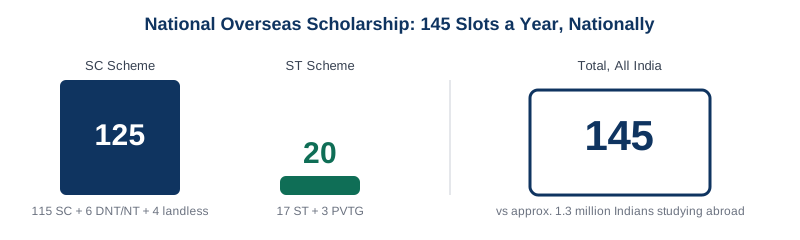
The National Overseas Scholarship funds just 145 Indian students a year nationally – 125 through the SC scheme and 20 through the ST scheme – against roughly 1.3 million Indians who go abroad annually. Most students still pay their own way, with any scholarship covering only part of the real cost. This guide names the actual award amounts, deadlines and eligibility rules, then shows what's left to fund after each one.
Every year around results season, a familiar pattern shows up. A Karnataka student clears their PUC boards with strong marks, starts researching engineering or medicine abroad, and assumes a scholarship will cover most of it. It rarely does. Even the most generous fellowships come with real conditions: years of work experience, a narrow list of eligible fields, or a hard ceiling on what they actually pay out. Knowing which scholarship you can realistically win, and what it still leaves you to arrange, matters far more than chasing every name you've heard mentioned in a WhatsApp group.
This guide walks through the major government, foreign-government and private scholarships Indian students actually receive, with real coverage details and application timing where it could be independently confirmed. Where a figure could not be verified against the awarding body's own site during this research, that is flagged rather than guessed, because a wrong number here costs a real family real money.
1. Government of India Scholarships: Who Actually Qualifies
Two separate ministries run India's flagship overseas scholarship programmes, and students frequently confuse them. The Ministry of Social Justice and Empowerment administers the National Overseas Scholarship (NOS) for Scheduled Caste, Denotified and Nomadic Tribe, landless agricultural labourer, and traditional artisan family candidates, through the official NOS portal. The Ministry of Tribal Affairs runs a parallel scheme for Scheduled Tribe candidates through tribal.nic.in.
The cap that most guides never mention is the one that actually decides your odds. The SC-focused scheme releases just 125 scholarships a year nationally: 115 for Scheduled Castes, 6 for Denotified and Nomadic Tribes, and 4 for landless agricultural labourer and traditional artisan families, with 30 percent of all slots reserved for women. The ST-focused scheme is smaller still, at 20 awards a year – 17 for Scheduled Tribes and 3 for Particularly Vulnerable Tribal Groups. That's 145 scholarships nationally, split across every eligible state, against a family income ceiling of ₹8 lakh a year for the SC scheme and ₹6 lakh for the ST scheme (waived for orphaned candidates). A strong academic record clears the eligibility bar; it does not guarantee a seat once the ranked merit list is drawn up against a quota this small.
What the award actually pays is a genuinely useful number to know before applying: a maintenance allowance of USD 15,400 a year for the USA and most other countries, or GBP 9,900 a year for the UK, plus a separate contingency allowance of USD 1,500 or GBP 1,100 for books, equipment and thesis-related costs. Reimbursed on top of that: tuition fees, medical insurance, visa fees, and return economy airfare. What it does not cover: language course fees and any support for a spouse or dependent. Applications run in two annual windows, roughly February to March and September to October, each open for about 40 days plus a short correction window.
Karnataka layers its own overseas study support on top of these central schemes, for SC, ST, OBC and minority students who are state residents. If that's you, check the state scheme before assuming the central quota is your only option. Our Karnataka Government Study Abroad Scheme guide covers what's currently open at the state level, and our Karnataka scholarships complete guide covers the parallel domestic-study support for comparison.
2. Fulbright-Nehru: the Best-Known Name, the Narrowest Door
The Fulbright-Nehru Master's Fellowship, jointly administered by the United States-India Educational Foundation, is what most students actually mean when they say "Fulbright scholarship." Its eligibility bar surprises a lot of applicants: a bachelor's degree with at least 55 percent marks is table stakes, but the fellowship also requires a minimum of three years of full-time, paid professional work experience in the exact field of the intended Master's degree. This is not an undergraduate award, and fresh graduates without qualifying work experience are simply not eligible, regardless of how strong their academic record is.
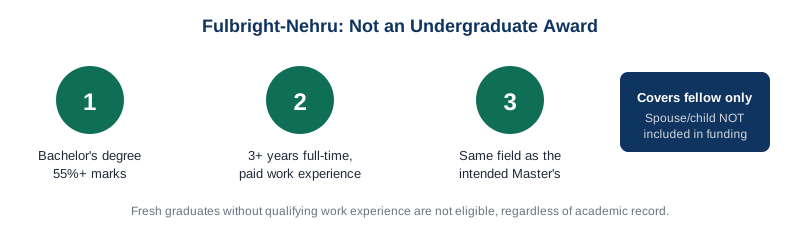
What the fellowship covers is genuinely comprehensive for the fellow themselves: J-1 visa support, round-trip economy airfare from the fellow's home city to the host institution, full tuition, mandatory university fees, a living stipend, and accident and sickness insurance for the duration of the programme. What it explicitly does not cover is any dependent. A spouse or child travelling with the fellow sits entirely outside the funded package, and that gap alone changes the real cost calculation for anyone applying with a family.
The 2026-27 cycle's application deadline was 14 May 2025 at 23:59 IST, submitted through the official IIE portal. The pattern across recent cycles has been a mid-May close for a programme that starts roughly sixteen months later, which suggests the following year's window opens in the preceding autumn. Confirm the exact next-cycle deadline directly on USIEF's site once it is published – the mid-May pattern has held across recent cycles but should not be treated as a fixed annual date.
3. Germany's DAAD: Free Tuition Changes the Entire Calculation
Germany does not charge tuition at most public universities regardless of a student's nationality, and that single fact changes how a DAAD scholarship should be evaluated compared with a US or UK award. A DAAD grant in Germany is topping up a cost of living that's already dramatically lower than a paid-tuition destination, rather than covering a six-figure tuition bill the way a US-bound scholarship often needs to.
DAAD, short for Deutscher Akademischer Austauschdienst, runs multiple separate programme lines through its own scholarship database, covering Master's study, PhD research, and shorter research stays. Each line carries a monthly stipend, health insurance, and a travel allowance, and the exact stipend figure varies by degree level and by the specific programme a student applies through – check the programme-specific rate on DAAD's own site before budgeting around a number, since it is not a single fixed figure across all lines.
For a Karnataka engineering graduate weighing Germany against the United States, the tuition-free structure alone is usually the deciding factor once real numbers are on the table. Our MS in USA guide and Study in Germany guide lay out that tuition gap directly, and it's worth reading both before deciding whether a scholarship is even the deciding variable in the country choice.
4. Commonwealth, Chevening and Erasmus Mundus: Fully Funded but Fiercely Competed
Three names come up constantly in study-abroad forums, and students often blur what each one actually funds. They are worth separating clearly.
4.1 Commonwealth Scholarships (United Kingdom)
Commonwealth Scholarships fund Master's and PhD study at UK universities for students from Commonwealth countries, covering tuition, a living allowance, and return airfare. The programme is aimed specifically at candidates who intend to return to India and contribute to development-linked fields, and that intent genuinely matters at the selection stage, not just as a box to tick on the form.
4.2 Chevening (United Kingdom)
Chevening is a one-year Master's award run by the UK Foreign, Commonwealth and Development Office, built around demonstrated leadership potential rather than a specific academic field. It explicitly wants applicants with at least two years of work experience who plan to build a career with international impact, which makes it closer in spirit to Fulbright-Nehru than to a pure merit scholarship.
4.3 Erasmus Mundus Joint Master's Degrees (European Union)
Erasmus Mundus funds a Master's programme split across two or more European universities, with a tuition waiver plus a monthly living allowance for the duration of study. Competition here is genuinely global rather than India-specific: applicants are ranked against candidates from every partner country in the consortium, not against an India-only quota.
All three run on an annual cycle, with deadlines that typically fall somewhere between September and February depending on the specific award and intake year. Confirm the exact current-cycle deadline for each directly from the awarding body's own site – a single day's slippage between cycles is common, so this guide does not lock in one fixed date across all three.
5. Private and University-Funded Scholarships Indians Actually Win
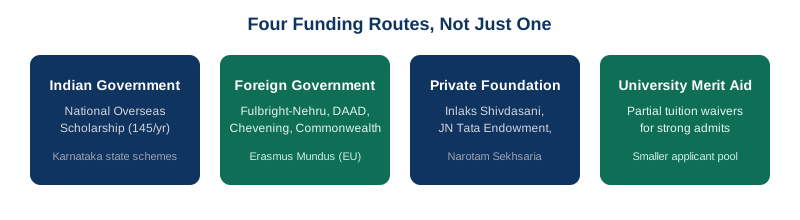
Government and foreign-government awards aren't the only route, and for a great many Karnataka students they're not even the most realistic one. Private trusts fund smaller amounts more often, with meaningfully less bureaucracy attached.
Inlaks Shivdasani Foundation has funded over 1,400 Indians with scholarships, fellowships, art residencies and grants since 1976, for Master's and PhD study at top-ranked universities abroad, selected through a genuinely rigorous interview process rather than a paper application alone. The Foundation does not publish a single fixed award amount on its main site; check its current opportunities page directly for the specific figure attached to this year's cycle.
JN Tata Endowment offers a loan-scholarship of up to ₹20 lakh at a simple interest rate of just 2 percent a year, with repayment spread over years three to seven after the loan is disbursed rather than starting immediately. It's open to Indian citizens under 45 pursuing full-time postgraduate, PhD or postdoctoral study abroad, with at least 60 percent average in prior studies, and applications for the current cycle run from 5 January to 15 March.
Narotam Sekhsaria Foundation Scholarship provides an interest-free loan-scholarship specifically for postgraduate study abroad, with a defined repayment structure that only kicks in once the recipient is employed.
University-specific merit aid is the option most guides skip entirely, and it's often the easiest to actually win. Most destination-country universities covered in our Study in UK, Study in Canada and Study in Australia guides run their own partial-tuition waivers for strong international applicants. The applicant pool for a university's own scholarship is limited to that university's own admits, which is a far smaller field than a national-level award drawing from the entire country.
Scholarship Comparison at a Glance
| Scholarship | Funded By | Study Level | What It Covers | Deadline Window |
|---|---|---|---|---|
| National Overseas Scholarship (SC scheme) | Govt of India | Master's, PhD | Tuition, USD 15,400/yr maintenance, insurance, airfare | Feb–Mar and Sep–Oct |
| National Overseas Scholarship (ST scheme) | Govt of India | Master's, PhD | Tuition reimbursement, visa fees, return airfare | Announced annually |
| Fulbright-Nehru Master's Fellowship | India-US joint (USIEF) | Master's (3+ yrs work exp required) | Tuition, fees, stipend, airfare; no dependents | Mid-May |
| DAAD Scholarships | Government of Germany | Master's, PhD, research stays | Monthly stipend + insurance (tuition already free) | Varies by programme line |
| Commonwealth Scholarship | UK Government | Master's, PhD | Tuition + living allowance + airfare | Varies by cycle |
| Chevening | UK Government | Master's (1 year, 2+ yrs work exp) | Full funding, leadership-focused selection | Varies by cycle |
| Erasmus Mundus | European Union | Joint Master's (2+ EU universities) | Tuition waiver + monthly stipend | Varies by consortium |
| Inlaks Shivdasani | Private foundation | Master's, PhD (under 30) | Interview-based grant, amount set per cycle | Check current cycle |
| JN Tata Endowment | Private foundation | Postgraduate, PhD, postdoc (under 45) | Up to ₹20 lakh loan-scholarship at 2% interest | 5 Jan to 15 Mar |
| Narotam Sekhsaria | Private foundation | Postgraduate | Interest-free loan-scholarship | Varies annually |
| University merit aid | Individual universities | Any level, post-admit | Partial tuition waiver | Set by each university, post-admission |
Deadlines marked "varies" or "check current cycle" should be confirmed against the awarding body's own site before a student plans around them.
6. The Funding Gap Nobody Puts in Writing
Here is the part most scholarship guides leave out entirely. Even a fellowship marketed as fully funded rarely covers everything a Karnataka family actually spends getting a student settled abroad. Fulbright-Nehru pays tuition, fees and a living stipend, but not a spouse or child, and the stipend is calibrated to a modest single-student lifestyle rather than the real cost of setting up a new life in an unfamiliar city. DAAD's tuition-free structure in Germany still leaves visa fees, a health insurance top-up, and a deposit-heavy first month's rent to arrange before the monthly stipend actually starts landing in a bank account.
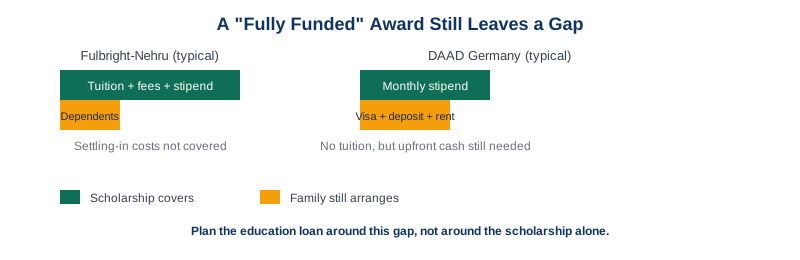
The realistic way to plan is to treat any scholarship as reducing the bill rather than eliminating it, and to have an education loan pre-approved as the actual difference-maker regardless of whether a scholarship comes through. The maths is simple even if nobody spells it out: sanctioned loan amount minus expected scholarship value equals what a family genuinely needs to arrange. Getting that loan pre-approved before scholarship results arrive means a family isn't scrambling for funds in the narrow two or three week window between an admission offer and a visa interview.
Our education loan for study abroad guide walks through exactly this calculation, and it's worth reading alongside this one rather than after a scholarship result comes back disappointing.
7. Application Timeline: When to Actually Start
Scholarship timelines run well ahead of the university application itself, and starting late is the single most common reason strong candidates miss a cycle entirely.
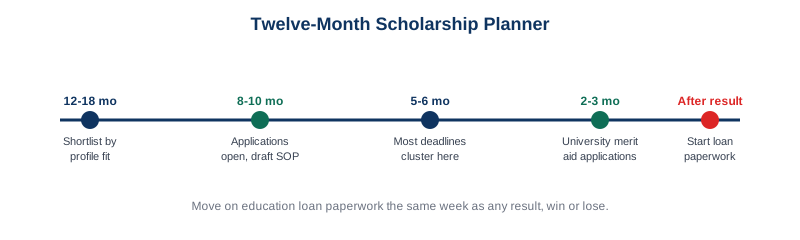
Twelve-Month Planner
| Months Before Intake | What to Do |
|---|---|
| 12 to 18 months | Shortlist scholarships against your specific profile: work experience, field of study, and target country, rather than applying broadly to every name you've heard of. |
| 8 to 10 months | Fulbright-Nehru, Commonwealth and Chevening applications typically open in this window. Start drafting your statement of purpose now, not after the portal opens. |
| 5 to 6 months | Most deadlines cluster in this period. GRE and IELTS scores need to already be in hand by now, not still in progress. |
| 2 to 3 months | University admits should be arriving. This is when to apply for university-specific merit aid, since most of it requires an existing offer letter to even qualify. |
| Immediately after any result | Move on education loan paperwork the same week, win or lose. Loan sanction itself can take four to six weeks, and waiting for every scholarship result before starting that process is how families end up rushed at the visa stage. |
Two exam guides feed directly into this timeline. Our GRE for MS USA guide and IELTS for study abroad guide both cover when to actually sit these tests relative to the scholarship deadlines above, since a score that arrives after the application window closes is worth nothing.
8. Who Should Realistically Skip the Scholarship Hunt
Not every profile benefits from months spent chasing scholarship applications. A student applying straight after their undergraduate degree, with no work experience yet, is already ineligible for most of the largest government and Fulbright-type awards covered above. For that stage, the realistic options narrow down to university merit aid and the handful of private foundation grants aimed specifically at younger applicants. Our Study Abroad After 12th guide covers scholarship options genuinely suited to that undergraduate stage, and they differ meaningfully from the postgraduate-focused awards detailed above.
If the target field is medicine, the calculation changes again. Most MBBS-abroad destinations popular with Karnataka students, including Georgia, Uzbekistan, Kazakhstan and Kyrgyzstan, do not have equivalent large-scale scholarship infrastructure the way US and UK Master's programmes do. For that route, our MBBS Abroad guide and country-specific pages are a more useful starting point than a scholarship-first strategy would be.
9. How to Actually Apply: Documents and Process
Every scholarship listed above asks for a broadly similar document set, even though the exact requirements vary by programme. Getting these ready months in advance, rather than scrambling once a portal opens, is what separates candidates who submit a strong application from those who submit a rushed one.
- Academic transcripts and degree certificates, attested where the awarding body specifies. A translated and notarised copy is often required if the original marksheet isn't in English, and this step alone can take two to three weeks through a college registrar.
- A detailed statement of purpose, written for that specific scholarship rather than recycled from a university application. Selection committees for Fulbright-Nehru and Chevening read these closely for evidence of the applicant's actual stated goals, not generic enthusiasm about "global exposure."
- Letters of recommendation, usually two or three, from people who can speak to specific work or research the applicant has actually done. A letter from a senior figure who barely knows the applicant is weaker than one from a direct supervisor who can cite real examples.
- Proof of work experience, where the scholarship requires it. Fulbright-Nehru and Chevening both need documented, verifiable employment history, not just a resume line.
- English proficiency scores, typically IELTS or TOEFL, submitted within the validity window the scholarship specifies. Score requirements vary widely by programme, so check the specific band a target scholarship expects well before the test date.
- Financial documents, even for fully funded awards, since most scholarship applications still ask for proof that the applicant can cover any gap the award doesn't fund.
Once documents are ready, the application itself usually follows a shortlist stage, an interview or written test for the stronger awards, and a final selection announcement that can take anywhere from six weeks to several months depending on the scholarship. Chevening and Commonwealth both include a structured interview stage for shortlisted candidates; Fulbright-Nehru does as well, typically conducted by a panel that includes both Indian and American academics.
10. Why Strong Applications Still Get Rejected
A surprising number of rejections have nothing to do with academic merit. The most common, recurring reasons include a statement of purpose that reads as generic rather than specific to that scholarship's stated mission, a mismatch between the applicant's stated career goals and the field they're applying to study, missing the work-experience threshold on a technicality (counting an internship as full-time employment, for instance), and submitting English test scores that have expired by the time the application is reviewed.
The fix for most of these is starting early enough to get a second pair of eyes on the statement of purpose, and reading the scholarship's own stated selection criteria literally rather than assuming general strength will carry the application. A Fulbright-Nehru reviewer is explicitly looking for leadership and community engagement alongside academic ability; an application that only makes the academic case is competing with one hand behind its back.
Frequently Asked Questions
Does the Indian government actually give scholarships for studying abroad, or is it mostly foreign governments?
Both. The National Overseas Scholarship, run through nosmsje.gov.in for SC candidates and tribal.nic.in for ST candidates, is genuinely Indian-government-funded. Fulbright-Nehru is technically a joint India-US programme administered by USIEF, not a purely Indian scheme, even though it's often described loosely as one.
Can a scholarship be combined with an education loan?
Yes, and for most students this is the realistic path. A scholarship reduces the amount that needs to be borrowed rather than replacing a loan entirely, and lenders typically want to see the scholarship award letter before finalising the loan disbursement amount.
Is Fulbright-Nehru open to fresh graduates?
No. It requires a minimum of three years of full-time, paid professional experience in the intended field of study, which rules out most students applying immediately after finishing their bachelor's degree.
Are there scholarships specifically for Karnataka students?
Yes, alongside the central schemes. Karnataka runs its own overseas study support for SC, ST, OBC and minority categories among state residents; see the Karnataka Government Study Abroad Scheme guide linked above for what is currently open.
Which scholarships genuinely cover full tuition and living costs?
Fulbright-Nehru and the National Overseas Scholarship both aim for near-full coverage of tuition and a living stipend, but neither covers dependents, and real out-of-pocket costs during the settling-in period are rarely zero even under a fully funded award.
How early should scholarship applications actually start?
For Fulbright-Nehru, Commonwealth or Chevening, begin building the application ten to twelve months before the intended intake. These have a single annual deadline each, and missing that window means waiting a full year for the next cycle.
About the Author
OneCity Technologies Pvt. Ltd. began in 2006 publishing an annual print education directory for Karnataka students and parents. As demand grew, OneCity launched an education portal in 2019 to bring that same directory information online, and in 2025 relaunched as CollegesInfo.org – a comprehensive Karnataka college directory covering 1,500+ institutions across engineering, medical, management, arts, commerce, and more. Founder L K Monu Borkala brings 20+ years of business experience and 19 years of work across various education-sector services. CollegesInfo.org's content is built from publicly available KEA, NMC, AICTE, and university data, cross-checked against official sources wherever possible. CollegesInfo.org's admission assistance service helps students secure admission to colleges they are eligible for under that college's actual published criteria. We help you get the best admission to your preferred colleges without hassle.
Have questions about which study abroad route fits your profile?
We help you get the best admission to your preferred colleges without hassle.