About Dayananda Sagar College of Architecture
Written by L K Monu Borkala, Founder & Chief Strategist
Last Updated: August 4, 2026 · Verified with COA, AICTE and VTU data for 2025–26
Dayananda Sagar College of Architecture (DSCA), Bangalore began in 1991 as a department under Dayananda Sagar College of Engineering and became an independent institution in 2017. Approved by the Council of Architecture and AICTE, affiliated to VTU, it offers B.Arch, M.Arch, B.Voc and PhD programs, with 2025 rankings placing it 36th nationally and 5th in Karnataka per India Today.
| Established | 1991 (independent status since 2017) |
| Approvals | Council of Architecture (COA), AICTE |
| Affiliation | VTU, Belagavi |
| Managed By | MGVP Trust (Dayananda Sagar Institutions) |
| Ranking (2024) | 36th nationally, 5th in Karnataka (India Today) |
| Programs | B.Arch, M.Arch, B.Voc, PhD |
| Admission | NATA (min score 80/200) |
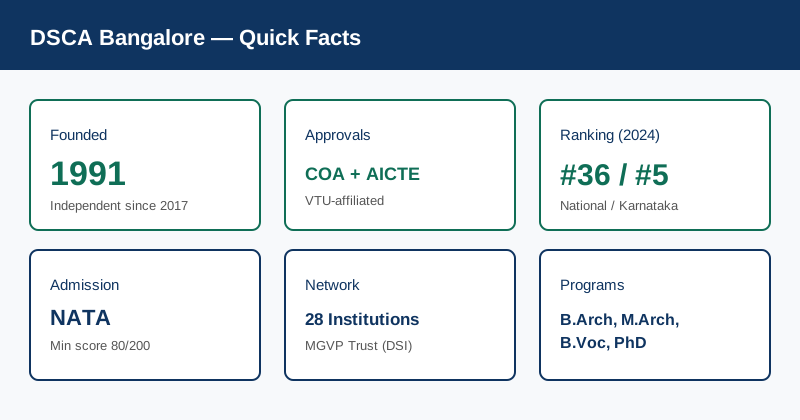
Independent since 2017, but its roots trace back 26 years earlier as a department within the parent engineering college.
From Department to Independent Institution
DSCA started life in 1991 as an architecture department inside Dayananda Sagar College of Engineering, part of the wider Dayananda Sagar Institutions network. The trust behind it, MGVP, was established in 1960 by Late Sri R. Dayananda Sagar and now runs 28 educational institutions across Bangalore, alongside Sagar Hospitals, a multi-specialty hospital chain under the same trust umbrella. DSCA operated as a department for 26 years before being granted independent institution status in 2017, a common path in India for architecture programs that begin inside a larger engineering college before proving demand for standalone accreditation.
That history explains why DSCA's approvals sit differently from most other schools on this site's directory: rather than a fresh college seeking recognition from scratch, DSCA inherited an established academic reputation from its 26 years as DSCE's architecture department, which is part of why it already carries a 2024 India Today ranking despite its comparatively recent independent status.
Programs and Admission
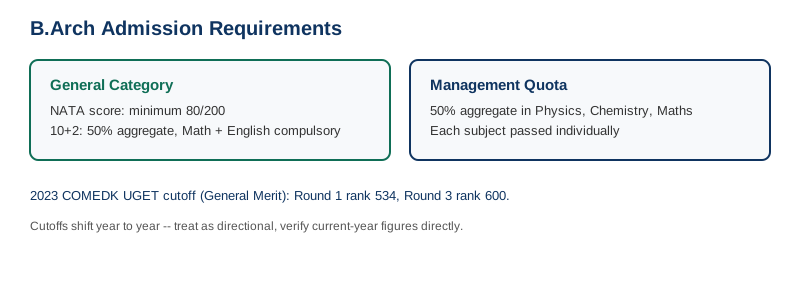
The college runs B.Arch (5 years), M.Arch (2 years), B.Voc, and PhD programs, with a specific Interior Design specialisation track. Admission to B.Arch requires the National Aptitude Test in Architecture (NATA), with a minimum qualifying score of 80 out of 200, alongside 10+2 with at least 50% aggregate marks and compulsory Mathematics and English. Management quota seats require a minimum 50% aggregate specifically in Physics, Chemistry and Mathematics, each passed individually rather than averaged. This differs from KCET-based engineering admission elsewhere in Karnataka, where a single combined rank typically governs seat allocation.
Fees and Rankings
First-year B.Arch fees ran approximately Rs 2.81 lakh in the 2024 admission cycle, per COMEDK UGET-linked disclosures; applicants should confirm the current figure directly given year-to-year revisions. The college holds a 2024 India Today ranking of 36th nationally out of 45 ranked architecture institutions, and 5th within Karnataka specifically, alongside a 22nd-of-30 Outlook ranking the same year and a 19th-of-25 national, 6th-in-Karnataka placement from The Week in 2022. Multiple independent rankings placing DSCA consistently in Karnataka's top 6 architecture schools is a more reliable signal than any single ranking taken alone.
Admission Cutoffs
2023 COMEDK UGET cutoff data for DSCA's General Merit category closed at rank 534 in round 1, extending to 600 by round 3, giving applicants a realistic sense of the competitive rank range needed. Cutoffs shift year to year based on applicant volume and available seats, so this figure should be treated as directional for planning purposes rather than a guaranteed current threshold. For comparing DSCA against other professional programs in Karnataka on fees and outcomes together, the site's comparison tool covers both in one view.
What "Part of a 28-Institution Network" Means Practically
DSI's scale gives DSCA access to resources a standalone architecture college of similar size typically cannot draw on: shared campus infrastructure, cross-disciplinary faculty exchange with DSCE's engineering programs, and an alumni network spanning three decades across the wider Dayananda Sagar system. The connection to Sagar Hospitals, part of the same trust, also opens specific research and design-studio collaboration opportunities in healthcare architecture that a purely design-focused institution without a hospital-system connection would not have.
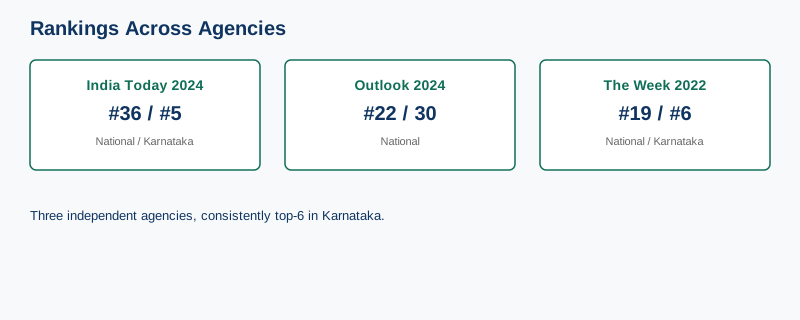
Three independent ranking agencies place DSCA consistently in Karnataka's top 6 -- a stronger signal than any single ranking alone.
Studio-based design projects at DSCA span luxury interiors, adaptive reuse of existing structures, and sustainable low-energy building design, reflecting broader shifts in Indian architectural education toward environmental responsibility over the past decade. The Council of Architecture's curriculum standards, which DSCA follows as a COA-approved institution, mandate this kind of applied studio work alongside theoretical coursework, distinguishing professional architecture education from a general design or fine arts degree.
Who This Fits
DSCA suits NATA-qualified applicants specifically seeking an established, COA-and-AICTE-approved architecture program with a multi-decade academic history, rather than a brand-new standalone architecture college without DSCA's inherited institutional depth. Students specifically interested in Interior Design within the broader architecture curriculum have a dedicated specialisation track here that not every architecture school on this site offers. For admission guidance specific to NATA-based programs, confirming current-year cutoffs and fee figures directly with the college is essential given how much both shift year to year.
The gap between DSCA's 1991 founding and its 2017 independent status is worth understanding for a specific practical reason: alumni and industry recognition built up during those 26 years as a DSCE department transferred to the standalone institution rather than starting from zero, which is part of why a college independent for less than a decade already carries multi-agency national rankings that a brand-new architecture school would take years to earn on its own.
Frequently Asked Questions
Is DSCA the same as Dayananda Sagar College of Engineering?
No, though they share history. DSCA began in 1991 as an architecture department inside DSCE and became an independent institution in 2017, both part of the wider Dayananda Sagar Institutions network under MGVP Trust.
What is the admission process?
B.Arch admission requires NATA with a minimum score of 80 out of 200, plus 10+2 with at least 50% aggregate and compulsory Mathematics and English. Management quota seats require 50% aggregate in Physics, Chemistry and Mathematics, each passed individually.
What are DSCA's current rankings?
36th nationally and 5th in Karnataka per India Today's 2024 architecture rankings, alongside a 22nd-of-30 Outlook ranking the same year and a 19th-of-25 national, 6th-in-Karnataka placement from The Week in 2022.
What programs does DSCA offer?
B.Arch (5 years), M.Arch (2 years), B.Voc, and PhD, with a specific Interior Design specialisation track within the broader architecture curriculum.
Does KCET matter for admission here?
No. B.Arch admission runs through NATA specifically, not KCET, which governs engineering seat allocation through a different rank system entirely.
About the Author
L K Monu Borkala, Founder & Chief Strategist of OneCity Technologies, brings 20+ years of business experience and 19 years of work across various education-sector services. CollegesInfo.org's content is built from publicly available KEA, NMC, AICTE, and university data, cross-checked against official sources wherever possible.