About MS Ramaiah School of Architecture
Written by L K Monu Borkala, Founder & Chief Strategist
Last Updated: August 4, 2026 · Verified with COA, AICTE and VTU data for 2025–26
The School of Architecture at Ramaiah Institute of Technology (MSRIT), Bangalore was established in 1992, recognised by the Council of Architecture and AICTE, and affiliated to VTU, Belagavi. It sits within MSRIT, an autonomous engineering institute founded in 1962 that holds NAAC A+ accreditation (3.28 CGPA), offering B.Arch and M.Arch with specialisations in Landscape and Advanced Architecture.
| Established | 1992 (parent MSRIT: 1962) |
| Approvals | Council of Architecture (COA), AICTE |
| Affiliation | VTU, Belagavi |
| Parent Institute NAAC | A+ Grade (CGPA 3.28) |
| Autonomous Status | UGC and VTU, through 2029 |
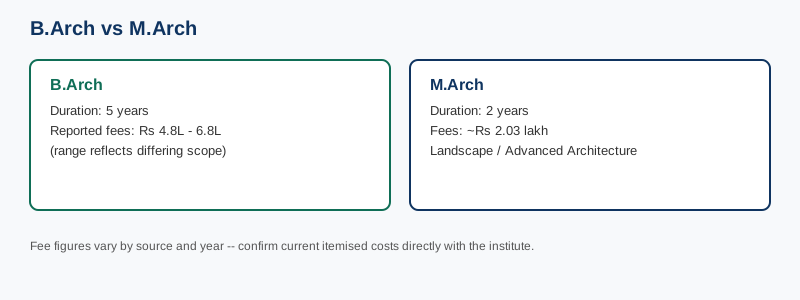
| Programs | B.Arch (5 yrs), M.Arch (2 yrs) |
| M.Arch Specialisations | Landscape Architecture, Advanced Architecture |
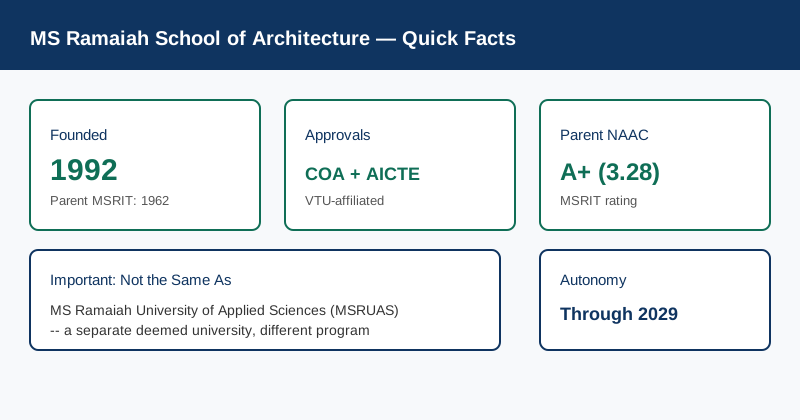
Part of MSRIT specifically -- a separate M S Ramaiah trust institution (MSRUAS) runs its own distinct architecture program elsewhere.
Which "MS Ramaiah" This Actually Is
The M S Ramaiah name covers multiple separate institutions across Bangalore, run by different arms of the wider Gokula Education Foundation trust: Ramaiah Institute of Technology (MSRIT), an autonomous engineering college established in 1962, and M S Ramaiah University of Applied Sciences (MSRUAS), a separate deemed university with its own architecture program. This page covers the School of Architecture specifically within MSRIT, VTU-affiliated, distinct from any MSRUAS-affiliated program that shares the family name. Applicants should confirm which specific "M S Ramaiah" institution a listing refers to before applying, since fees, affiliation, and accreditation differ between them, a distinction some third-party listing sites blur together carelessly.
MSRIT itself has run continuously since 1962 and now holds NAAC A+ accreditation with a 3.28 CGPA, per the NAAC database, alongside NBA accreditation for its academic departments under the newer assessment process. The UGC and VTU jointly conferred autonomous status on MSRIT for both undergraduate and postgraduate programs through 2029, giving the institute latitude to design its own curriculum within VTU's broader affiliation framework rather than following a syllabus set entirely by the university.
Programs and Admission
The School of Architecture runs a five-year B.Arch and a two-year M.Arch, the latter offering specific specialisations in Landscape Architecture and Advanced Architecture. B.Arch admission requires 10+2 with Mathematics as a subject and a minimum 50% aggregate for general category applicants, dropping to 45% for SC/ST, Category-1 and OBC applicants, alongside a NATA score, with SC/ST/Category-1/OBC candidates needing a minimum 40% NATA score specifically. This runs independently of KCET-based admission, which does not cover architecture seats.
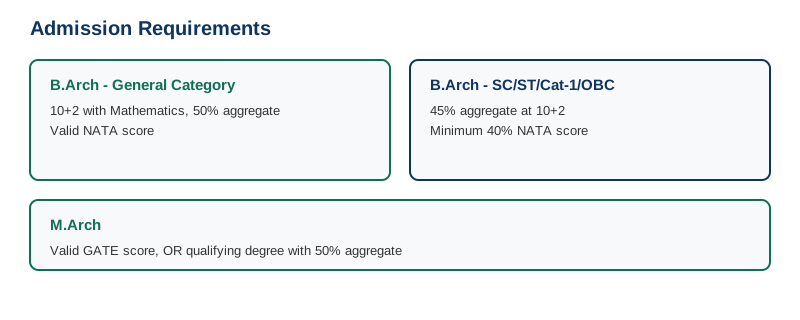
M.Arch admission accepts either a valid GATE score or a qualifying degree examination result with a minimum 50% aggregate across all subjects and semesters. Reported B.Arch fee figures vary by source and year, ranging from approximately Rs 4.8 lakh to Rs 6.8 lakh across the full five-year program; applicants should confirm the current figure directly with the institute given this spread. M.Arch fees run approximately Rs 2.03 lakh across the two-year program per the most recent disclosure available.
Curriculum Focus
The program's stated educational objectives emphasise applying architectural knowledge to real-world problems, integrated socio-technical design, cross-functional team leadership, and continuing professional education, a framework consistent with Council of Architecture curriculum standards nationally. Coursework spans design, structural analysis, and integrated systems covering people, materials, information and technology, reflecting the broader shift in Indian architectural education toward multidisciplinary, systems-level thinking rather than pure design aesthetics alone.
What Autonomous Status Through 2029 Actually Means
MSRIT's autonomous status, jointly granted by UGC and VTU with a defined term through 2029, is not a permanent designation; it requires periodic renewal based on continued performance against quality benchmarks. For an architecture applicant, this matters practically: the institute can currently design and revise its own curriculum within VTU's broader framework rather than following a fixed university-wide syllabus, giving the School of Architecture more flexibility to update coursework in response to industry shifts than a purely affiliated college without autonomous status would have.
The institute's TEQIP participation, a Government of India initiative aimed at improving technical education quality nationally, also feeds into the School of Architecture's resources and faculty development opportunities, even though the program itself sits within a broader engineering-focused institute rather than a standalone architecture school. Students weighing MSRIT's architecture track against dedicated architecture-only institutions elsewhere in Karnataka should factor in this engineering-institute context, which brings genuine cross-disciplinary exposure but a different campus culture than a design-focused standalone school.
Who This Fits
This program suits NATA-qualified applicants who specifically want MSRIT's VTU-affiliated architecture track, backed by the parent institute's NAAC A+ accreditation and multi-decade engineering-education reputation, rather than applicants seeking MSRUAS's separate deemed-university architecture program. For admission guidance distinguishing between M S Ramaiah's multiple institutions, or comparing this program against other professional programs in Karnataka, confirming the exact institution name and affiliation before applying avoids a common mix-up among applicants searching by trust name alone.
Confusion between MSRIT's architecture program and any similarly-named program elsewhere in the wider M S Ramaiah trust happens often enough that applicants should treat the institution's full official name, "Ramaiah Institute of Technology," and its VTU affiliation as the two most reliable identifiers when verifying which specific program they are applying to. Neither the founder's name alone nor the general "M S Ramaiah" brand reliably distinguishes between the trust's several separate institutions.
Fee variation between sources for this program is worth flagging explicitly: one aggregator lists total B.Arch fees near Rs 4.8 lakh, while another cites Rs 6.8 lakh for the same five-year program. This gap likely reflects differing scope, whether hostel, exam, and miscellaneous charges are included alongside tuition, rather than different tuition rates. Requesting an itemised fee breakdown directly from the institute, rather than relying on any single aggregator's headline figure, is the only reliable way to budget accurately.
Frequently Asked Questions
Is this the same as MS Ramaiah University of Applied Sciences' architecture program?
No. This page covers the School of Architecture within Ramaiah Institute of Technology (MSRIT), VTU-affiliated. MS Ramaiah University of Applied Sciences (MSRUAS) is a separate deemed university under the same wider trust, with its own distinct architecture program.
What is the NAAC grade?
The parent institute, MSRIT, holds NAAC A+ accreditation with a 3.28 CGPA, alongside NBA accreditation for its academic departments.
Does KCET matter for admission here?
No. B.Arch admission requires NATA specifically, not KCET, which does not cover architecture seat allocation. M.Arch admission accepts GATE scores or a qualifying degree result.
What are the admission eligibility requirements?
General category: 50% aggregate at 10+2 with Mathematics, plus a NATA score. SC/ST, Category-1 and OBC applicants: 45% aggregate, with a minimum 40% NATA score.
What specialisations does the M.Arch offer?
Landscape Architecture and Advanced Architecture, over a two-year program requiring a valid GATE score or a qualifying degree result with 50% aggregate marks.
About the Author
L K Monu Borkala, Founder & Chief Strategist of OneCity Technologies, brings 20+ years of business experience and 19 years of work across various education-sector services. CollegesInfo.org's content is built from publicly available KEA, NMC, AICTE, and university data, cross-checked against official sources wherever possible.