About St Philomena College Puttur
Written by L K Monu Borkala, Founder & Chief Strategist
Last Updated: August 4, 2026 · Verified with UGC, NAAC and Mangalore University data for 2025–26
St Philomena College, Puttur was founded in 1958 by Msgr. Antony Patrao and is now an autonomous institution affiliated to Mangalore University. It holds NAAC A grade accreditation, UGC and AICTE approval, and ISO 9001:2015 certification. The college offers BA, BSc, BCom, BBA, BCA and BSW at undergraduate level, with median UG placement salary of Rs 2.52 lakh per year per NIRF 2025 data.
| Established | 1958 |
| Status | Autonomous college |
| Accreditation | NAAC A Grade |
| Approvals | UGC, AICTE, ISO 9001:2015 |
| Managed By | Catholic Board of Education, Diocese of Mangalore |
| Campus | 23.5 acres, Darbe, Puttur |
| Placement | Median Rs 2.52 lakh/yr (NIRF 2025) |
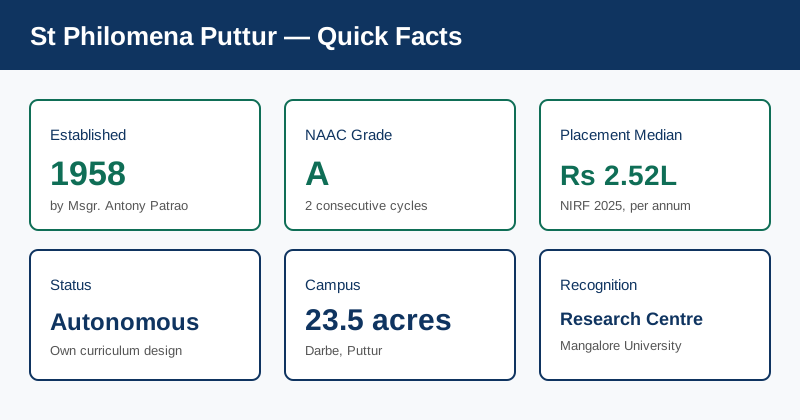
St Philomena is one of the older Catholic-managed colleges in Dakshina Kannada, predating St Aloysius's deemed-university conversion by 66 years.
A Rural College That Almost Closed, Now Autonomous
Msgr. Antony Patrao, then parish priest of the Mai De Deus Church in Puttur, founded the college in 1958 to save local families the trip to Mangalore for higher education. The UGC recognised it under Section 2(f) and 12(B), and the Catholic Board of Education of the Diocese of Mangalore has managed it since founding. The college now holds full autonomous status, distinct from ordinary affiliation, which means it designs and revises its own curriculum within Mangalore University's broader framework rather than following a syllabus set entirely elsewhere.
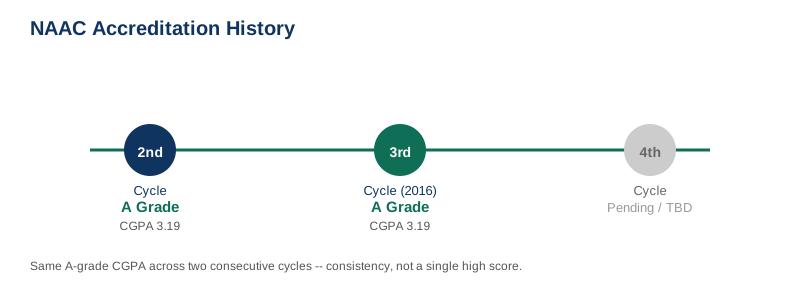
NAAC's re-accreditation history tells a specific, verifiable story of improvement: the second accreditation cycle awarded an A grade with a 3.19 CGPA, and the college volunteered for a third cycle in 2016, again earning A grade at the same 3.19 CGPA. Consistency across cycles, rather than a single high score, is what NAAC's multi-cycle system is actually designed to measure, and few of the other Mangalore-area colleges on this site have a two-cycle track record this documented.
Programs and Placement Reality
Undergraduate options span BA (English, Economics, History), BSc, BCom, BBA (BBM), BCA and BSW. Postgraduate programs include MSW, MCom, and MSc in Physics, Mathematics and Computer Science. Admission is merit-based on 10+2 marks for undergraduate entry, not through KCET counselling, which governs professional and engineering seats rather than general-degree colleges like this one.
NIRF's 2025 disclosure records 53 undergraduate students placed in 2024, with a median salary of Rs 2.52 lakh per annum. That figure sits meaningfully below what deemed universities and larger private institutions report, a realistic expectation for a general-degree autonomous college rather than a management or engineering-focused institution. Applicants weighing this against other options should factor placement scale into the comparison alongside fees.
Recognition Beyond NAAC
The college holds a 3-Star rating from the Ministry of Human Resource Development, Government of India, and is recognised as a Research Centre by Mangalore University, meaning it can supervise PhD candidates directly rather than sending doctoral students elsewhere. It also serves as a NAIN-project innovation and incubation site under Karnataka's Department of IT & BT. None of these are marketing claims; each is a specific institutional designation verifiable against the awarding body's own records.
Managed by the Same Diocese as St Aloysius, But Independently
The Catholic Board of Education, Diocese of Mangalore, oversees several institutions across Dakshina Kannada, including St Philomena. This is worth distinguishing clearly from the Society of Jesus, which runs St Aloysius Mangalore: both are Catholic-managed, but through separate organisational structures with separate governance, separate accreditation histories, and no shared administration. Applicants sometimes conflate Catholic-run institutions in this region as a single network; they are not, and each carries its own NAAC cycle, its own fee structure, and its own admission calendar.
Puttur itself sits inland from Mangalore, in a taluk that historically had fewer higher-education options than the coastal city. St Philomena's founding in 1958 addressed exactly that gap, and the college's own history records a genuine financial crisis in 1989 severe enough that the Catholic Board of Education considered closing it, before the principal and correspondent at the time raised funds parish-by-parish to keep it running. That the institution now holds Research Centre status and a 3-Star government rating is a specific turnaround story, not a given for a rural college of this vintage.
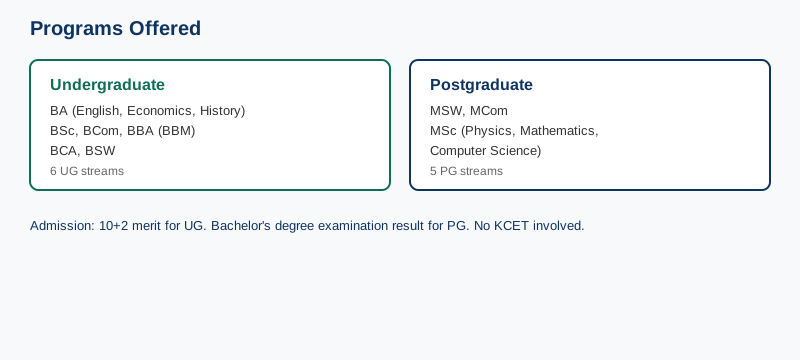
11 degree programs across UG and PG levels, spanning arts, science, commerce and social work.
The college is also approved by AICTE for its technical programs, and its ISO 9001:2015 certification covers institutional quality-management processes rather than a single department. For students specifically weighing management-focused options against a Puttur-based general-degree college, travel time to the coastal city for internships and interviews is a practical factor worth planning around in advance.
Who This Fits
St Philomena suits students who want a local, Catholic-managed general-degree college with a documented, multi-cycle accreditation history, rather than a newly-converted deemed university or a large multi-campus institution. Its Research Centre status is a specific advantage for students considering postgraduate research in Mangalore University's system without relocating to a bigger city. For admission guidance specific to this college's application window, contact the institution directly rather than assuming dates that apply elsewhere in Karnataka.
Msgr. Antony Patrao, the founder, was born in 1901 in Mangalore and served the Puttur parish for years before establishing the college. The Mai De Deus Church he led still stands in Puttur today, and the college's own historical records treat the 1958 founding and the parish's earlier work as continuous, rather than treating the college as a separate later addition. That continuity matters for understanding why the Catholic Board of Education has kept the institution under its umbrella for nearly seven decades rather than spinning it off independently.
Frequently Asked Questions
Is St Philomena College autonomous or affiliated?
Autonomous. The college designs and revises its own curriculum within Mangalore University's broader framework, a status distinct from ordinary affiliated colleges that follow a syllabus set entirely by the university.
What is the NAAC grade and accreditation history?
NAAC A grade, awarded in both the second cycle (CGPA 3.19) and the third cycle in 2016 (also CGPA 3.19). See the NAAC database to verify current status. This shows consistency rather than a single high score.
Does KCET matter for admission here?
No. Undergraduate admission is merit-based on 10+2 marks. KCET governs engineering and professional-course seats, not general-degree programs like BA, BSc, BCom or BBA at this college.
What is the placement record?
NIRF 2025 data shows 53 undergraduate students placed in 2024, with a median salary of Rs 2.52 lakh per annum, typical for a general-degree autonomous college rather than a management-focused institution.
Can students pursue a PhD through St Philomena?
Yes. The college is recognised as a Research Centre by Mangalore University, allowing it to supervise doctoral candidates directly rather than referring them elsewhere.
About the Author
L K Monu Borkala, Founder & Chief Strategist of OneCity Technologies, brings 20+ years of business experience and 19 years of work across various education-sector services. CollegesInfo.org's content is built from publicly available KEA, NMC, AICTE, and university data, cross-checked against official sources wherever possible.