About BGS School of Architecture and Planning
Written by L K Monu Borkala, Founder & Chief Strategist
Last Updated: August 4, 2026 · Verified with COA and VTU data for 2025–26
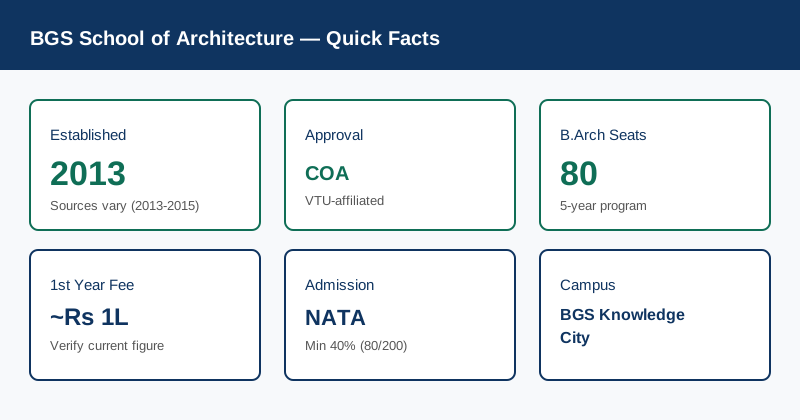
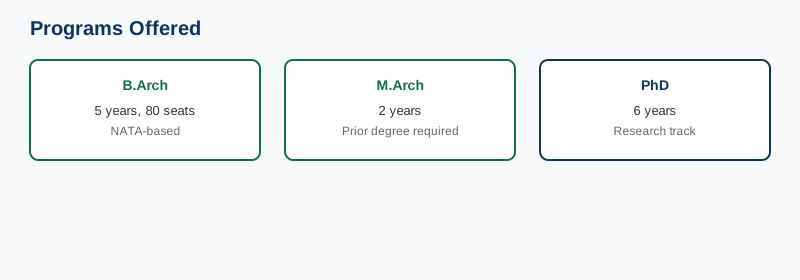
BGS School of Architecture and Planning (BGSSAP), Bangalore was established in 2013, affiliated to VTU Belagavi and approved by the Council of Architecture. It offers a 5-year B.Arch with 80 seats, a 2-year M.Arch, and a 6-year PhD program, with admission through NATA and 10+2 qualifying marks.
| Established | 2013 |
| Approval | Council of Architecture (COA) |
| Affiliation | VTU, Belagavi |
| Campus | BGS Knowledge City, Nityanandha Nagar |
| Programs | B.Arch (5 yrs, 80 seats), M.Arch (2 yrs), PhD (6 yrs) |
| B.Arch 1st Year Fee | Approximately Rs 1 lakh |
| Admission | NATA (min 40%, 80/200) |
Part of BGS Knowledge City, a shared campus with several other BGS group institutions in South Bangalore.
Part of the BGS Group's Wider Education Network
BGSSAP sits within BGS Knowledge City in South Bangalore, sharing infrastructure and a transport network with SJBIT, a sister engineering institute under the same wider BGS group of institutions. Applicants researching this college under the "BGS" name should confirm they are looking at the architecture-specific school rather than a different BGS-affiliated institution, since the group runs multiple separate colleges across engineering, medicine, and other disciplines under related but distinct branding, similar to how other large education trusts in Karnataka structure their institutions.
The Council of Architecture approved BGSSAP's B.Arch program, and the college is affiliated to VTU, Belagavi, meaning degrees are awarded under VTU's broader academic framework rather than as an independent university qualification. This affiliation structure is standard for most architecture schools on this site outside the handful that operate as autonomous or deemed institutions.
Programs and Admission
BGSSAP offers a five-year B.Arch program with 80 seats, admission based on NATA score combined with 10+2 qualifying examination marks. Eligibility requires 10+2 with Mathematics as a compulsory subject and a minimum 50% aggregate, or a 10+3 Diploma with the same 50% threshold, with a minimum qualifying NATA score of 40%, equivalent to 80 out of 200. This runs independently of KCET-based admission, which governs engineering seats through a separate rank system.
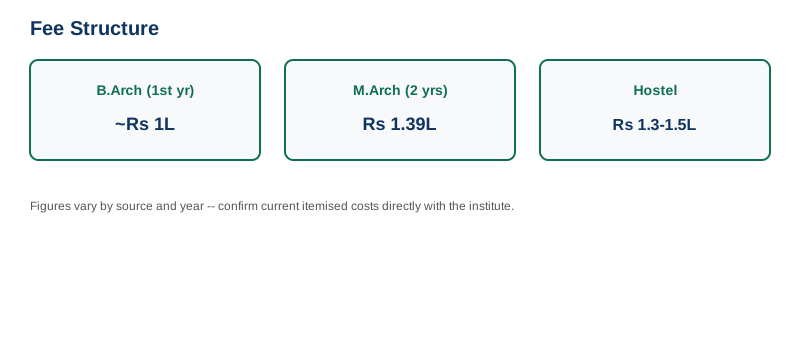
A two-year M.Arch and a six-year PhD program are also available, both requiring the relevant prior degree as a base qualification. First-year B.Arch fees run approximately Rs 1 lakh per third-party fee aggregators, though applicants should confirm the current, complete fee schedule directly with the college given how frequently such figures shift year to year and vary depending on which cost components a given source includes.
Campus and Facilities
Faculty at BGSSAP includes practicing architects holding professor and associate professor titles, a common and important structural feature at COA-approved schools generally, since architecture education relies heavily on instructors who bring live project experience into the studio alongside academic credentials. This blend of practice and pedagogy is a standard COA expectation across accredited programs, not unique to BGSSAP specifically, but worth confirming for any architecture school under consideration.
The school emphasises hands-on learning through workshops, seminars, site visits, and faculty-led architectural study tours both within India and internationally, aiming to give students exposure beyond classroom instruction alone. Hostel accommodation runs approximately Rs 1.3 to 1.5 lakh depending on room sharing arrangement, available separately for male and female students. For students comparing professional program options across Karnataka on cost and outcomes together, the site's comparison tool covers multiple institutions side by side.
The Founding-Year Discrepancy Worth Knowing
Different aggregators cite BGSSAP's founding year inconsistently, some listing 2013, others 2015. This kind of discrepancy is common across smaller architecture schools that launched shortly after India's architecture education sector expanded rapidly in the early 2010s, when multiple new COA-approved programs opened within a short window and record-keeping across third-party listing sites did not always stay perfectly synchronised. The AICTE's own institutional database, alongside the college's official registration documents, remain the most reliable sources for confirming the exact founding date if it matters for a specific application requirement.
This kind of minor data inconsistency across aggregators is a useful reminder for any applicant researching smaller, newer architecture schools generally: cross-checking at least two independent sources, and ideally the college's own official communications, catches discrepancies that a single source alone would miss.
Who This Fits
BGSSAP suits NATA-qualified applicants seeking a COA-approved, VTU-affiliated architecture program with international study-tour exposure as part of its stated pedagogy, at a comparatively accessible first-year fee point relative to several other architecture schools on this site. Students specifically prioritising international collaboration or the widest possible program breadth might weigh this against larger multi-campus institutions elsewhere. For admission guidance specific to NATA-based programs, confirming current-year cutoffs and fee figures directly with the college remains essential.
Architecture study tours, both domestic and international, are increasingly common among newer Karnataka architecture schools as a differentiator against older, more traditionally classroom-focused programs. For applicants weighing BGSSAP specifically for this reason, confirming which tours are actually included in standard tuition versus offered as an optional paid add-on avoids a common source of budget surprise partway through the program. The NAAC database is worth checking directly for institutions this size, since accreditation status for smaller professional schools can change between cycles more visibly than at larger multi-program universities.
The gap between BGSSAP's roughly Rs 1 lakh first-year fee and the significantly higher figures charged by some other Bangalore architecture schools reflects real differences in campus scale, faculty seniority, and brand recognition rather than a simple quality gap. A lower first-year fee at a COA-approved, VTU-affiliated program is a legitimate option worth serious consideration, particularly for applicants for whom cost is a primary constraint, provided the specific accreditation and placement outcomes meet individual expectations after direct verification.
Frequently Asked Questions
Is BGSSAP the same as SJBIT or other BGS-affiliated colleges?
No. BGSSAP shares campus infrastructure at BGS Knowledge City with sister institutions like SJBIT, but operates as a separate, architecture-specific school with its own COA approval and admission process.
What is the admission process?
Admission is based on NATA score combined with 10+2 qualifying marks. Eligibility requires 10+2 with Mathematics and 50% aggregate, or an equivalent Diploma, plus a minimum NATA score of 40% (80 out of 200).
Does KCET matter for admission here?
No. B.Arch admission runs through NATA specifically, not KCET, which governs engineering seat allocation through a separate rank system.
What programs does BGSSAP offer?
A five-year B.Arch with 80 seats, a two-year M.Arch, and a six-year PhD program, all affiliated to VTU, Belagavi.
What does the program cost?
First-year B.Arch fees run approximately Rs 1 lakh per third-party aggregators, with hostel accommodation adding roughly Rs 1.3 to 1.5 lakh depending on room type. Applicants should confirm the current complete fee schedule directly with the college.
About the Author
L K Monu Borkala, Founder & Chief Strategist of OneCity Technologies, brings 20+ years of business experience and 19 years of work across various education-sector services. CollegesInfo.org's content is built from publicly available KEA, NMC, AICTE, and university data, cross-checked against official sources wherever possible.