Pharm.D Colleges in Bangalore 2026 — PCI Approved, KCET Cutoff and Fees
Pharm.D colleges in Bangalore 2026. PCI approved, 6-year course. Government fees Rs 15-30K, private Rs 80K-2 lakh/yr. KCET cutoff and career scope.
Pharm.D – Doctor of Pharmacy – is a 6-year clinical pharmacy degree (5 years academic + 1 year residency/internship) regulated by the Pharmacy Council of India (PCI) under the Pharm.D Regulations, 2008. It is the highest pharmacy degree in India and positions graduates as clinical pharmacists capable of direct patient care roles in hospitals. Bangalore has several PCI-recognised Pharm.D institutions – including Government College of Pharmacy (GCP) Bangalore, which offers Pharm.D alongside B.Pharm and M.Pharm under government fees. Admission is through KCET 2026 via KEA counselling at cetonline.karnataka.gov.in. This guide covers every verified Pharm.D college in Bangalore with profiles, KCET 2025 closing ranks, fee structures, the post-B.Pharm Pharm.D pathway, clinical pharmacy career tracks, and exact admission process – sourced from PCI regulations, KEA allotment data, and institutional disclosures. Nothing is fabricated.
Last Updated: August 26, 2026
- Program duration: 6 years (5 years academics + 1 year residency/internship)
- Also available: Pharm.D (Post-Baccalaureate) – 3 years after B.Pharm
- Regulator: Pharmacy Council of India (PCI) under Pharm.D Regulations, 2008
- Affiliating university: Rajiv Gandhi University of Health Sciences (RGUHS)
- Admission: KCET 2026 → KEA counselling
- NEET not required – KCET only
- Eligibility: 12th PCB/PCM, minimum 45% (40% SC/ST)
- Government Pharm.D college in Bangalore: GCP Bangalore
- Practice rights: Clinical pharmacist – hospital pharmacy, patient care, pharmacovigilance
- Registration: Pharmacy Council of India + Karnataka State Pharmacy Council
- Counselling: cetonline.karnataka.gov.in
What is Pharm.D? Understanding India's Clinical Pharmacy Degree
Pharm.D was introduced in India in 2008 by the Pharmacy Council of India specifically to create clinical pharmacy specialists who work alongside doctors and nurses in hospital settings – not just in dispensing or manufacturing roles. It is modelled on the Doctor of Pharmacy (Pharm.D) degree practiced in the United States, where clinical pharmacists are integral members of hospital medical teams.
The Indian Pharm.D is 6 years long – 5 years of academic and clinical training plus 1 year of compulsory residency in hospital clinical pharmacy. It is distinct from B.Pharm in both duration and scope: Pharm.D graduates are trained for patient-centred pharmaceutical care, not just dispensing or drug manufacturing.
PCI Pharm.D Regulations 2008 specify the curriculum, clinical posting requirements, and hospital infrastructure colleges must maintain:
- Years 1–3: Pharmaceutical sciences foundation – Anatomy and Physiology, Pharmaceutics, Pharmaceutical Chemistry, Pharmacognosy, Biochemistry, Pathophysiology, Pharmacology, Pharmaceutical Analysis
- Years 3–5 (Clinical phase): Clinical Pharmacy, Clinical Pharmacokinetics, Hospital and Community Pharmacy, Pharmacotherapeutics (8 units covering all major disease categories), Pharmacovigilance, Clinical Toxicology, Clinical Research
- Year 6 – Residency: 1 full year of hospital clinical pharmacy residency across all major departments – Medicine, Surgery, Paediatrics, ICU, OBG, Oncology, Nephrology. This is the defining differentiator of Pharm.D from B.Pharm
After completing Pharm.D and residency, graduates register with the Karnataka State Pharmacy Council and PCI. Pharm.D graduates are legally entitled to practice as clinical pharmacists in India – reviewing drug regimens, counselling patients on medications, monitoring drug interactions, and reporting adverse drug reactions through the PvPI (Pharmacovigilance Programme of India) network.
Pharm.D vs B.Pharm vs M.Pharm: Which to Choose
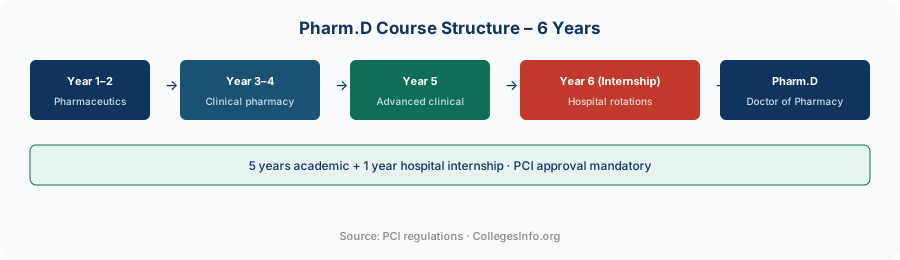
Pharm.D course timeline: 5 years academic + 1 year hospital internship
| Factor | Pharm.D | B.Pharm | M.Pharm |
|---|---|---|---|
| Duration | 6 years (incl. residency) | 4 years | 2 years (after B.Pharm) |
| Focus | Clinical patient care | General pharmacy science | Specialised pharmacy science |
| Hospital clinical role | Primary qualification | Secondary (with experience) | Research/academic focus |
| Drug manufacturing/R&D | Limited (not primary focus) | Full access | Full access (specialist) |
| Clinical research (CRA) | Strong pathway | Good pathway | Strong (research focus) |
| Retail pharmacy | Qualified but not primary | Qualified | Qualified |
| GPAT / M.Pharm eligibility | Not applicable (parallel track) | Yes (via GPAT) | N/A (already PG) |
| Government pharmacy officer | Eligible | Eligible | Eligible (senior posts) |
| KCET rank needed (Govt college) | Very competitive (GCP) | Competitive (GCP) | N/A (PG separate) |
| Post-B.Pharm entry | Yes – 3-yr Pharm.D (PB) | N/A | Yes (via GPAT) |
| Best for | Hospital clinical pharmacy career | Pharma industry, research, clinical | Specialisation after B.Pharm |
Pharm.D (Post-Baccalaureate): The B.Pharm Pathway
Pharm.D is also available as a post-B.Pharm qualification – Pharm.D (Post-Baccalaureate) or Pharm.D (PB). This is a 3-year program (2 years academic + 1 year residency) open to B.Pharm graduates. It allows B.Pharm graduates to upgrade to clinical pharmacy specialist qualification without completing the full 6-year program from 12th standard.
- Eligibility: B.Pharm from a PCI-recognised institution
- Duration: 3 years (2 years academic + 1 year residency)
- Admission: Through PCI-approved institutions – some use PGCET (Karnataka) or own entrance, others use merit-based direct admission
- Available at: GCP Bangalore, Ramaiah College of Pharmacy, JSS College of Pharmacy, and other PCI-approved Pharm.D colleges in Bangalore
- Outcome: Pharm.D (Post-Baccalaureate) qualification – equivalent practice rights to 6-year Pharm.D for clinical pharmacy roles
Government Pharm.D College in Bangalore
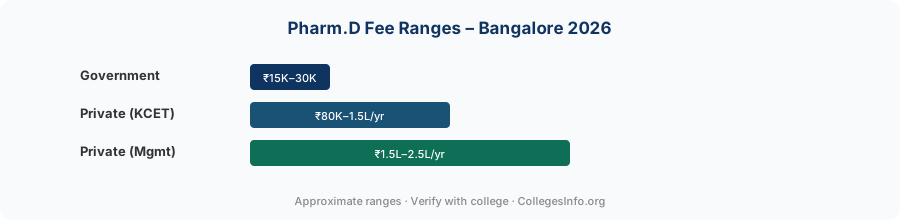
Pharm.D annual fee ranges by college type in Bangalore
Government College of Pharmacy (GCP), Bangalore
GCP Bangalore is Karnataka's only government-funded pharmacy institution offering all three pharmacy programs – B.Pharm, Pharm.D, and M.Pharm. Its Pharm.D program is PCI-approved and RGUHS-affiliated. GCP's Pharm.D has the additional advantage of the government-attached pharmacy hospital and Bangalore's public hospital network for clinical postings – Victoria Hospital, Bowring Hospital, and Vani Vilas Hospital are within the GCP clinical attachment network, providing significantly higher patient volumes than private college hospital attachments.
GCP Pharm.D government fees are the lowest in Bangalore for this 6-year clinical pharmacy degree. The KCET closing rank for Pharm.D at GCP is very competitive – reflecting the demand for the only government Pharm.D seat in Karnataka's capital.
- Pharm.D intake: 30 seats (confirm at GCP for 2026-27)
- Affiliation: RGUHS | PCI recognition: Yes
- Annual fees: ₹15,000–40,000 (government tariff)
- KCET 2025 GM closing rank (Pharm.D): Approximately 10,000–30,000
- Clinical attachments: Victoria Hospital (1,800+ beds), Bowring & Lady Curzon Hospital, Vani Vilas Hospital
- Address: 1/1, Bhaskaran Road, Subramanyanagar, Bangalore – 560021
Private Pharm.D Colleges in Bangalore
1. Ramaiah College of Pharmacy, Bangalore
Part of the MS Ramaiah Group with direct attachment to Ramaiah Medical College and Ramaiah Hospital, Bangalore. The Ramaiah Pharm.D program benefits from one of Bangalore's most active private teaching hospital environments – Ramaiah Hospital has 600+ beds, ICU, oncology, nephrology, and cardiac units. Clinical postings during Pharm.D years 3–6 at an active 600-bed hospital makes a measurable difference in the quality of residency training. Pharm.D graduates from Ramaiah have strong placement in clinical pharmacy roles at Bangalore's corporate hospitals.
- Pharm.D intake: 30 seats | Affiliation: RGUHS
- Annual fees (govt quota): ₹60,000–1,00,000/year
- KCET 2025 GM closing rank: Approximately 20,000–60,000
- Key advantage: Ramaiah Hospital 600-bed clinical attachment for residency
2. JSS College of Pharmacy, Mysuru (and Ooty – relevant for Karnataka students)
JSS College of Pharmacy is one of India's premier pharmacy institutions – its Ooty campus is among India's top-ranked pharmacy colleges. The Mysuru campus offers Pharm.D affiliated with JSS Academy of Higher Education and Research (Deemed University). JSS Pharm.D graduates are well-placed nationally in clinical pharmacy and pharmaceutical industry roles. While technically not in Bangalore, JSS Mysuru is the top choice for Karnataka students who miss GCP's rank cutoff and want an alternative top-quality Pharm.D program.
- Pharm.D intake: 30 seats | Affiliation: JSS AHER (Deemed)
- Annual fees: ₹1,00,000–1,50,000/year
- KCET 2025 GM closing rank: Approximately 30,000–80,000
- Key advantage: National institutional reputation, JSS Hospital clinical attachment
3. Dayananda Sagar College of Pharmacy, Bangalore
Part of the Dayananda Sagar Institutions group with the Dayananda Sagar Hospitals network providing clinical attachment for Pharm.D residency. Located in Kumaraswamy Layout, South Bangalore. RGUHS-affiliated and PCI-recognised for Pharm.D.
- Pharm.D intake: 30 seats | Affiliation: RGUHS
- Annual fees (govt quota): ₹55,000–85,000/year
- KCET 2025 GM closing rank: Approximately 40,000–1,00,000
Pharm.D Colleges Quick Comparison
| College | Type | Annual Fee | KCET 2025 GM Rank | Hospital Attachment |
|---|---|---|---|---|
| GCP Bangalore | Government | ₹15K–40K | 10K–30K | Victoria, Bowring (1,800+ beds) |
| Ramaiah Pharmacy | Private | ₹60K–1L | 20K–60K | Ramaiah Hospital (600 beds) |
| JSS Mysuru | Deemed Univ. | ₹1L–1.5L | 30K–80K | JSS Hospital Mysuru |
| Dayananda Sagar Pharmacy | Private | ₹55K–85K | 40K–1L | DS Hospitals network |
⚠️ KCET cutoff ranks are indicative from KEA 2025 Round 3 data. Pharm.D seats are fewer (30 per college vs 60 for B.Pharm) – competition is higher. Verify at cetonline.karnataka.gov.in. Deemed university colleges (JSS) have independent admissions.
KCET Cutoff Trends for Pharm.D – Bangalore (2023–2025)
| College | 2023 GM Closing | 2024 GM Closing | 2025 GM Closing | Trend |
|---|---|---|---|---|
| GCP Bangalore – Pharm.D | 8,000–25,000 | 9,000–27,000 | 10,000–30,000 | ↑ Growing demand |
| Ramaiah Pharm.D | 18,000–55,000 | 19,000–57,000 | 20,000–60,000 | ↑ Steady |
| Dayananda Sagar Pharm.D | 35,000–90,000 | 37,000–95,000 | 40,000–1,00,000 | → Stable |
Pharm.D Admission Process: Step-by-Step (2026)
- Appear for KCET 2026 – Physics, Chemistry, Biology or Mathematics. Your pharmacy KCET rank applies to both B.Pharm and Pharm.D option entry. NEET is not required.
- Download KCET rank card – from cetonline.karnataka.gov.in.
- Register for KEA counselling – Karnataka domicile required for state merit seats.
- Document verification – Class 10, 12 marks cards, KCET rank card, Aadhaar, category certificate, domicile certificate.
- Option entry: Pharm.D options are listed separately from B.Pharm in KEA's choice filling. Enter both B.Pharm and Pharm.D options if you're open to either. GCP Pharm.D first. Add private RGUHS Pharm.D options after.
- Seat allotment (2–3 rounds) – accept, pay, report with originals.
- Pharm.D (Post-Baccalaureate) admission: If you already have B.Pharm, contact colleges directly – GCP, Ramaiah, and Dayananda Sagar accept Pharm.D (PB) applications separately from KCET. Process varies by college – typically merit-based using B.Pharm aggregate marks.
Career Paths After Pharm.D from Bangalore
Pharm.D career tracks are distinctly clinical – they differ materially from B.Pharm careers. The residency year in hospital clinical pharmacy is the defining experience:
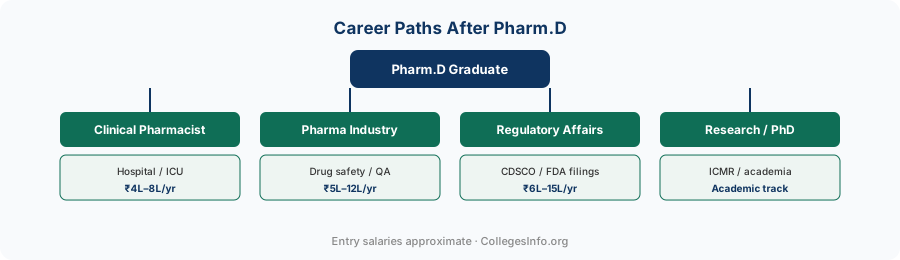
- Clinical pharmacist – corporate hospitals: Bangalore's Apollo, Narayana Health, Manipal Hospitals, Fortis, Sakra World, and Aster actively recruit Pharm.D graduates for clinical pharmacy departments. Roles include drug therapy monitoring, adverse drug reaction reporting, patient counselling, ICU clinical pharmacy, and ward pharmacy services. Starting: ₹35,000–60,000/month. Senior clinical pharmacist: ₹60,000–1,20,000/month. Head of Pharmacy or Chief Pharmacist at large hospitals: ₹1,20,000–2,50,000/month.
- Pharmacovigilance (PV) associate: India's PvPI (Pharmacovigilance Programme of India) under CDSCO and global pharma companies' PV functions actively recruit Pharm.D graduates. Pharm.D's clinical training makes graduates more qualified for PV roles than B.Pharm. Starting at CROs (IQVIA, Syneos, ICON, Parexel, PPD – all with Bangalore offices): ₹4–7 lakh CTC. Senior PV: ₹10–20 lakh CTC.
- Clinical research – CRA / CRC roles: Clinical Research Associates at CROs are primarily recruited from Pharm.D and B.Pharm. Pharm.D's clinical pharmacology training gives an advantage in therapeutic area understanding. Entry CRA at Bangalore CROs: ₹4–6 lakh CTC. Senior CRA: ₹8–18 lakh CTC.
- Regulatory affairs: Pharm.D graduates with clinical knowledge command premium in drug regulatory submissions, CDSCO filings, and international regulatory dossier preparation. Senior regulatory affairs at pharma companies: ₹12–30 lakh CTC.
- Hospital pharmacy management: Pharm.D is the preferred qualification for Pharmacy Director and Chief Pharmacist roles at large hospitals. Career progression: clinical pharmacist → pharmacy supervisor → pharmacy manager → pharmacy director. Director of Pharmacy at a 500-bed Bangalore hospital: ₹1.5–3 lakh/month.
- Teaching and academics: M.Pharm is the standard teaching qualification, but Pharm.D holders are increasingly preferred for clinical pharmacy teaching posts at Pharm.D colleges. Teaching posts at RGUHS-affiliated colleges: ₹40,000–80,000/month for Lecturer/Assistant Professor.
- International clinical pharmacy: Pharm.D is the standard clinical pharmacy qualification in the US, UK, Canada, and Australia. Indian Pharm.D graduates seeking to practice abroad need to clear licensing exams in the destination country (FPGEE in the US, GPhC in the UK). Pharm.D from a PCI-recognised institution is the standard starting credential for this pathway.
Pharm.D Residency Year: What the Hospital Posting Involves
The 6th year residency is Pharm.D's defining component. PCI Regulations 2008 specify mandatory rotations:
- General Medicine – drug therapy review, round participation, medication reconciliation
- Surgery – preoperative and postoperative pharmaceutical care
- Paediatrics – paediatric dose calculation, weight-based dosing, adverse event monitoring
- ICU – critical care pharmaceutical care, TPN preparation, sedation management
- Obstetrics and Gynaecology – pregnancy pharmacology, lactation-safe medications
- Pharmacovigilance unit – ADR reporting, causality assessment
- Drug Information Centre (if available) – responding to drug information queries
The quality of residency training directly depends on the hospital attachment. GCP Bangalore's Victoria Hospital (1,800+ beds) provides ICU, oncology, and speciality postings that many private college hospitals cannot replicate. For Pharm.D students, the hospital quality matters more than the college brand.
Clinical Pharmacy in Bangalore's Hospital Ecosystem
Bangalore's hospital infrastructure is one of the strongest in India for clinical pharmacy careers. The city has 50+ hospitals with 200+ beds, including several with 500–2,000 beds. This matters specifically for Pharm.D graduates because clinical pharmacy roles are concentrated in hospitals with active ICU, oncology, nephrology, and cardiology departments.
Key Bangalore hospitals actively employing Pharm.D graduates as of 2026:
- Narayana Health City, Bommasandra: 2,000+ beds, one of India's largest multi-speciality hospitals. Active pharmacy department with clinical pharmacist positions. Strong oncology and cardiac pharmacy demand.
- Manipal Hospitals, Old Airport Road: 600+ beds. Has a dedicated clinical pharmacy department with Pharm.D-qualified pharmacists. One of Bangalore's stronger clinical pharmacy employers.
- Apollo Hospitals, Bannerghatta Road and Jayanagar: Both campuses employ clinical pharmacists. Apollo has a structured clinical pharmacy program with defined Pharm.D career tracks.
- Sakra World Hospital, Marathahalli: 350 beds with strong pharmacy team. International patient base creates demand for clinical pharmacists with documentation skills.
- Victoria Government Hospital: India's second-largest hospital by bed count. GCP Bangalore's primary clinical attachment. Pharm.D students at GCP rotate through Victoria's ICU, medicine, surgery, and speciality wards during residency year.
The practical career advantage: Pharm.D graduates with GCP's Victoria Hospital residency training have clinical exposure that most private college hospitals cannot replicate. When applying for clinical pharmacist positions at Narayana, Manipal, or Apollo, the breadth of Victoria Hospital's patient case mix is a credible differentiator on a resume.
Pharm.D Scholarships and Fee Support
Pharm.D is a 6-year program – fee support is more material here than for shorter programs:
- Post-Matric Scholarship (SC/ST): Central government scholarship covering tuition and maintenance allowance for SC/ST students in professional programs including Pharm.D. Apply at scholarships.gov.in.
- EBC Scholarship (Karnataka): For economically weaker General category students. Apply through Karnataka Social Welfare Department.
- Minority Scholarships: Central government minority community scholarships cover Pharm.D tuition at PCI-recognised institutions.
- AICTE PG Scholarship: For Pharm.D (PB) – AICTE provides scholarships for students enrolled in approved PG-equivalent programs at AICTE-recognised institutions. Check AICTE portal for current eligibility.
Hyderabad-Karnataka Reservation for Pharm.D
Students domiciled in Bidar, Kalaburagi, Yadgir, Raichur, Koppal, and Ballari districts are entitled to Article 371(J) reservation in Karnataka educational institutions including GCP Bangalore's Pharm.D seats. This constitutionally-mandated reservation provides H-K district students access to Pharm.D seats at KCET ranks above the General Merit closing rank. Submit your H-K district domicile certificate during KEA document verification – this is a significant access advantage for students from North-East Karnataka seeking GCP Pharm.D.
After Pharm.D: Career Year-by-Year
| Stage | Timeline | Income Range | Role |
|---|---|---|---|
| Pharm.D + Residency | 6 years | – | Student/resident |
| KSPC Registration | After residency | – | Licensed pharmacist |
| Junior clinical pharmacist | Year 1–3 | ₹35,000–60,000/month | Hospital clinical pharmacy |
| PV / CRA entry | Year 1–2 | ₹4–7 lakh CTC | CRO, pharma company |
| Senior clinical pharmacist | Year 3–6 | ₹60,000–1,20,000/month | ICU, oncology, speciality |
| Pharmacy Manager | Year 6–10 | ₹1–2 lakh/month | Hospital pharmacy head |
| Chief Pharmacist / Director | Year 10+ | ₹1.5–3 lakh/month | Large hospital leadership |
| International (US/UK) | Year 2–5 | USD 50,000–120,000/yr | After FPGEE/GPhC licensing |
PCI Verification Before Joining Any Pharm.D College
PCI specifically audits Pharm.D colleges against its 2008 Regulations. Colleges have had their Pharm.D recognition withdrawn or reduced for non-compliance. Before joining:
- Verify Pharm.D-specific PCI approval (separate from B.Pharm approval) at pci.nic.in
- Confirm the attached hospital has the required specialities (ICU, surgery, paediatrics, OBG minimum)
- Ask specifically: how many patients does the hospital's OPD and IPD see daily? Less than 100 OPD patients/day is inadequate for Pharm.D clinical exposure
- Check RGUHS affiliation for 2026-27
Documents Required for Pharm.D Admission 2026
- ✅ KCET 2026 rank card
- ✅ Class 10 and 12 marks cards
- ✅ Transfer Certificate
- ✅ Aadhaar Card
- ✅ Category Certificate (SC/ST/OBC/EWS if applicable)
- ✅ Karnataka Domicile / Study Certificate
- ✅ Passport-size photographs (minimum 8)
- ✅ Migration Certificate (if from outside Karnataka)
- For Pharm.D (PB): ✅ B.Pharm degree certificate and all marksheets + KSPC registration
Frequently Asked Questions
Is Pharm.D better than B.Pharm?
They serve different career goals. Pharm.D is better if your target is clinical pharmacy in hospitals, pharmacovigilance, or clinical research. B.Pharm is better if your target is pharmaceutical manufacturing, R&D, quality control, regulatory affairs, or retail pharmacy. Pharm.D takes 2 extra years (6 vs 4) but positions you for patient-care roles that B.Pharm alone does not qualify you for. If you have a strong KCET rank, Pharm.D at GCP Bangalore is one of Karnataka's most valuable pharmacy education options.
What KCET rank is needed for Pharm.D at GCP Bangalore?
GCP Pharm.D is the most competitive Pharm.D seat in Karnataka. In 2025, General Merit closing rank was approximately 10,000–30,000. With only 30 seats (vs 60 for B.Pharm), the Pharm.D cutoff is tighter than GCP's B.Pharm cutoff. SC/ST/OBC candidates qualify at higher ranks through reservation. Verify using KEA's official 2025 allotment at cetonline.karnataka.gov.in.
Can I do Pharm.D after B.Pharm?
Yes – Pharm.D (Post-Baccalaureate) is a 3-year program for B.Pharm graduates (2 years academic + 1 year residency). GCP Bangalore, Ramaiah, and Dayananda Sagar College of Pharmacy offer Pharm.D (PB). Admission is merit-based using B.Pharm marks – not through KCET. Contact each college directly for their 2026-27 Pharm.D (PB) admission process and seat availability.
Is Pharm.D recognized in the US or UK?
Indian Pharm.D from a PCI-recognised institution is the starting credential for international pharmacy licensing – but additional country-specific exams are required. In the US: FPGEE (Foreign Pharmacy Graduate Equivalency Examination) plus TOEFL plus state licensing exams. In the UK: GPhC (General Pharmaceutical Council) overseas pharmacist assessment. The 6-year Indian Pharm.D is academically comparable but licensing equivalency is country-specific.
What salary does a Pharm.D graduate earn in Bangalore?
Starting clinical pharmacist at Bangalore corporate hospitals: ₹35,000–60,000/month. Pharmacovigilance associate at CROs: ₹4–7 lakh CTC/year. Clinical Research Associate: ₹4–6 lakh CTC/year. Senior clinical pharmacist (5 years): ₹60,000–1,20,000/month. Chief Pharmacist at large hospital: ₹1.2–2.5 lakh/month. Pharm.D salaries are significantly higher than D.Pharm and comparable to or exceeding B.Pharm in clinical settings.
How many Pharm.D colleges are in Bangalore?
Approximately 8–12 PCI-approved Pharm.D colleges operate in Bangalore and immediate vicinity. GCP is the only government institution. Verify the current approved list specifically for Pharm.D (not just B.Pharm) at pci.nic.in – PCI maintains separate approval records for Pharm.D programs.