Law Colleges in Bangalore 2026 — 24 BCI-Approved, CLAT Cutoff and Fees
24 BCI-approved law colleges in Bangalore 2026. NLSIU CLAT cutoff AIR 50-80, Christ Rs 1.5-2.5L per year, CMR Rs 1-2L. BA LLB, BBA LLB and 3-year LLB options.
Last Updated: August 26, 2026
Bangalore has 24 BCI-approved law colleges – more than any other city in Karnataka, and among the highest concentrations of legal education institutions in South India. The range is wide: from NLSIU, ranked #1 among law schools in India by NIRF 2025, to government colleges charging under ₹50,000 for a full 5-year integrated LLB. If you're choosing a law college in Bangalore for 2026-27, the decision comes down to three things: the admission route you qualify for, the total cost you can manage, and what you want to do with the degree when you graduate.
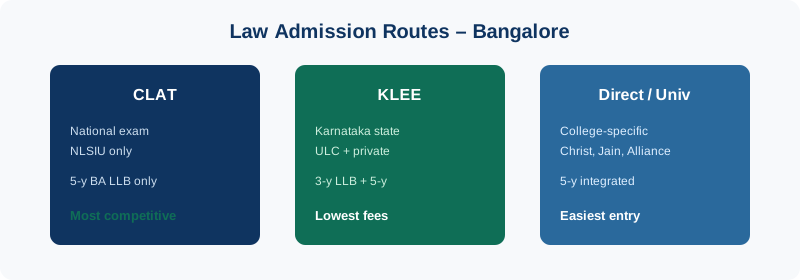
This guide covers all 24 BCI-approved law colleges in Bangalore – fees, admission process, affiliation, and who each college realistically suits.
Law Colleges in Bangalore – Quick Comparison
| College | Type | Affiliation | Courses | Admission | Approx Fees (5-yr LLB) |
|---|---|---|---|---|---|
| NLSIU Bangalore | Govt (Autonomous) | Autonomous (NLU) | BA LLB, LLM, PhD | CLAT | ₹22.88 lakh |
| University Law College Bangalore | Government | Bangalore University | LLB (3-yr), BA LLB (5-yr) | BU CET / Merit | ₹30,000–₹50,000 |
| Government Law College Bangalore | Government | KSLU, Hubli | LLB (3-yr), BA LLB (5-yr) | KSLU CET / Merit | ₹25,000–₹40,000 |
| Christ University School of Law | Deemed University | Christ University | BA LLB, BBA LLB, LLM | CLAT / CUET / Direct | ₹4–6 lakh/year |
| MS Ramaiah College of Law | Private (Aided) | KSLU, Hubli | BA LLB, BBA LLB, LLM | KSLU CET / Direct | ₹80,000–₹1.2 lakh/year |
| Alliance School of Law | Deemed University | Alliance University | BA LLB, BBA LLB, LLM | CLAT / LSAT / Direct | ₹2.5–3.5 lakh/year |
| Presidency University School of Law | Private University | Presidency University | BA LLB, BBA LLB, LLM | CLAT / Direct | ₹90,000–₹1.5 lakh/year |
| Dayananda Sagar College of Law | Private | KSLU, Hubli | BA LLB, LLB (3-yr) | KSLU CET / Direct | ₹60,000–₹1 lakh/year |
| PES University School of Law | Deemed University | PES University | BA LLB, BBA LLB | CLAT / CUET / Direct | ₹2–3 lakh/year |
| BMS College of Law | Private | KSLU, Hubli | BA LLB, LLB (3-yr) | KSLU CET / Direct | ₹70,000–₹1 lakh/year |
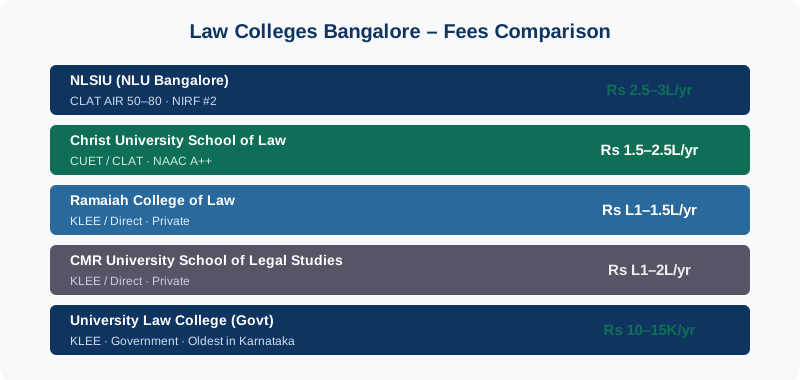
NLSIU Bangalore – India's #1 Law School
The National Law School of India University (NLSIU) in Bangalore requires a separate mention because it operates in a completely different category from every other law college in this list. NLSIU has been ranked #1 in India in the NIRF Law Rankings consistently, including NIRF 2025. It was the first National Law University established in India – set up by the Bar Council of India in 1987 – and its alumni include Supreme Court judges, senior advocates, and legal scholars who shape Indian jurisprudence.
Admission to NLSIU's 5-year integrated BA LLB programme is exclusively through CLAT (Common Law Admission Test), conducted by the Consortium of NLUs. CLAT is one of the most competitive entrance exams in India – roughly 60,000 students compete for approximately 120 General Merit seats at NLSIU. The CLAT cutoff for NLSIU General Merit is typically under 100 rank nationally. For Karnataka students, a state quota applies – check the NLSIU official website for current state quota seat details.
NLSIU also offers a separate 3-year LLB programme through NLSAT (National Law School Admission Test) – a NLSIU-specific exam for graduates with a bachelor's degree. If you're a graduate targeting NLSIU without going through the 5-year integrated route, NLSAT is the pathway.
The total fees for NLSIU's 5-year programme are approximately ₹22.88 lakh – significantly higher than other law colleges in Bangalore. However, NLSIU provides substantial need-based scholarships and its placement record (with firms like AZB & Partners, Cyril Amarchand Mangaldas, and J. Sagar Associates regularly recruiting) makes the investment defensible for students who get in.
Government Law Colleges in Bangalore – Affordable Options
If NLSIU is out of reach by rank or budget, Bangalore has two quality government law colleges that offer legal education at a fraction of private college costs:
University Law College Bangalore
Affiliated to Bangalore University, University Law College is one of the oldest and most respected government law colleges in Karnataka. It offers a 3-year LLB (for graduates) and a 5-year integrated BA LLB programme. Fees are significantly subsidised – typically ₹30,000–₹50,000 for the full course. Admission is through Bangalore University's common entrance process or merit-based selection. SC/ST students qualify for full fee waivers. The college has produced Karnataka High Court judges and senior advocates. For law students who don't have the CLAT rank for NLSIU but want quality government legal education in Bangalore, University Law College is the primary option.
Government Law College Bangalore
Affiliated to KSLU (Karnataka State Law University), Hubli, Government Law College Bangalore offers BCI-approved LLB programmes at minimal fees. Admission is through KSLU's counselling process. The KSLU affiliation means the degree qualifies for Bar Council of Karnataka enrolment and is recognised for all Karnataka state legal positions. For students targeting government legal service examinations or public sector legal roles, this is the most cost-effective route in Bangalore.
Private and Deemed University Law Colleges – Key Options
Christ University School of Law
Christ University's law school is one of the stronger private options in Bangalore, with BCI approval and recognition for moot court competitions and placement in law firms and corporate legal teams. The university accepts CLAT, CUET, and has its own entrance test. Annual fees run ₹4–6 lakh – significantly higher than government options. The deemed university status means degrees aren't under KSLU and candidates need to verify Bar Council enrolment eligibility. Christ Law's advantage is its strong campus placement cell and corporate law focus.
MS Ramaiah College of Law
One of the more established private law colleges in Bangalore, affiliated to KSLU. The KSLU affiliation means KSLU CET is the admission pathway for state quota seats, with a management quota for direct admissions. MS Ramaiah College of Law has produced practicing advocates across Karnataka courts. Fees are in the ₹80,000–₹1.2 lakh per year range – significantly more affordable than deemed university options while maintaining KSLU recognition for court practice.
Alliance School of Law
Alliance University's law school accepts CLAT and LSAT scores. It has a corporate law focus with ties to Bangalore's legal and business community. The deemed university status and private fee structure (₹2.5–3.5 lakh/year) makes it accessible primarily to students targeting corporate legal careers rather than traditional court practice. BCI approval is maintained.
Other Notable Private Law Colleges in Bangalore
- Acharya Institute of Law: KSLU affiliated, BCI approved. Mid-range fees, court-practice focused curriculum.
- BMS College of Law: Part of the BMS group, KSLU affiliated. Strong alumni network in Bangalore legal fraternity.
- CMR University School of Legal Studies: Part of CMR University. Accepts CUET and direct admission. Corporate law focus.
- Dayananda Sagar College of Law: KSLU affiliated, part of the large DS group. Reasonable fees with good infrastructure.
- Jain University School of Law: Deemed university, accepts CUET. Integrated with Jain University's campus ecosystem.
- KLE Society's Law College Bangalore: KLE Society operates multiple professional colleges across Karnataka. KSLU affiliated.
- Kristu Jayanti College of Law: Bangalore North University affiliated. Growing law programme with campus in north Bangalore.
- PES University School of Law: Deemed university, CLAT and CUET accepted. Part of PES's strong Bangalore campus.
- Presidency University School of Law: Affordable private university option. Fees from ₹90,000 for LLM. CLAT accepted.
- Reva University School of Law: Reva University's law programme. CUET and direct admissions. North Bangalore location.
- Seshadripuram Law College: KSLU affiliated. One of the older law colleges in Bangalore. Known for producing trial court advocates.
- SJR College of Law: KSLU affiliated. Focused on traditional court practice preparation.
Admission Routes for Law Colleges in Bangalore 2026
There are four distinct admission pathways for law colleges in Bangalore, and which one applies depends entirely on which college and programme you're targeting:
1. CLAT – Common Law Admission Test
CLAT is conducted by the Consortium of NLUs for admission to all 24 National Law Universities across India, including NLSIU Bangalore. CLAT 2026 was conducted in December 2025 for 2026-27 admission. The exam tests English, Current Affairs & GK, Legal Reasoning, Logical Reasoning, and Quantitative Techniques. For Karnataka state quota seats at NLSIU, CLAT is mandatory – there is no other route into NLSIU's undergraduate programme. Many private deemed university law schools in Bangalore (Christ, Alliance, PES, Presidency) also accept CLAT scores for their own programmes. Check the Consortium of NLUs official website for counselling schedules.
2. KSLU CET – Karnataka State Law University Common Entrance Test
KSLU conducts a state-level law entrance test for admission to 5-year LLB programmes in KSLU-affiliated colleges across Karnataka – including most private law colleges in Bangalore like MS Ramaiah, BMS, Dayananda Sagar, Seshadripuram, SJR, KLE, and Acharya Institute of Law. The KSLU CET 2026 is the primary route for the majority of Bangalore law college seats. Government quota seats at KSLU-affiliated colleges go through this process. Check the KSLU official website for KSLU CET 2026 schedule and application process.
3. CUET – Common University Entrance Test
NTA's CUET is accepted by several Bangalore law colleges including CMR University, Jain University, Reva University, Christ University, and PES University. CUET Law tests domain subjects relevant to legal studies. Students who've appeared for CUET 2026 can apply to these colleges using CUET scores alongside or instead of CLAT.
4. Direct/Management Quota Admission
Most private law colleges in Bangalore have a management quota – typically 15–30% of total seats – filled through direct admission based on 10+2 marks without an entrance exam. Management quota fees are higher than merit quota. Always verify the direct admission process and fee structure directly with the college and cross-check with the Bar Council of India's approved fee structure for the institution.
Eligibility Criteria for Law Courses in Bangalore
| Programme | Duration | Eligibility | Minimum Marks |
|---|---|---|---|
| BA LLB / BBA LLB (Integrated) | 5 years | 10+2 (any stream) | 45% GM; 40% SC/ST/OBC |
| LLB (3-year) | 3 years | Any Bachelor's degree | 45% GM; 40% SC/ST/OBC |
| LLM | 1–2 years | LLB or equivalent law degree | 55% GM; 50% SC/ST |
The Bar Council of India mandates these minimum eligibility requirements for BCI-approved law programmes. Colleges cannot admit students below these percentages for programmes meant for court enrolment. For students targeting Karnataka-specific legal careers – Karnataka High Court, Karnataka State Judicial Service, state government legal departments – KSLU-affiliated degrees are preferable to deemed university degrees for eligibility verification purposes.
KSLU vs Deemed University Affiliation – What It Means for Your Career
This is the most important distinction that Bangalore law college guides consistently underemphasise. If your goal is to practise in Karnataka courts – as an advocate enrolled with the Bar Council of Karnataka – your degree must be from a BCI-approved institution. Both KSLU-affiliated and deemed university law colleges in Bangalore meet this requirement IF the specific programme is BCI-approved.
However, for certain Karnataka government legal positions and state judicial service exams, candidates with degrees from Karnataka-recognised universities (KSLU, Bangalore University, Bengaluru City University) may have more clear eligibility than those from deemed universities or central universities. Always verify specific exam eligibility with the examining body before making your college choice purely on brand recognition.
For corporate legal careers – joining a law firm, an in-house legal team, or pursuing international legal practice – deemed university and private university law degrees from well-regarded institutions like Christ, Alliance, and PES carry equivalent weight to KSLU-affiliated degrees in employer perception.
Fee Comparison by College Type
| College Type | 5-Year LLB Total Fees (Approx) | Examples |
|---|---|---|
| Government (State-aided) | ₹25,000–₹2.5 lakh | University Law College, Govt Law College |
| KSLU-affiliated Private | ₹4–8 lakh | MS Ramaiah, BMS, Dayananda Sagar, Seshadripuram |
| Deemed/Private University (Mid) | ₹8–15 lakh | PES University, Presidency University |
| Deemed University (Premium) | ₹15–30 lakh | Christ University, Alliance University |
| NLU (NLSIU) | ₹22.88 lakh | NLSIU Bangalore only |
Placements and Career Outcomes
Law careers in Bangalore broadly fall into three tracks, and different colleges are better positioned for each:
Court Practice and Advocacy
Karnataka High Court is located in Bangalore – one of the busiest High Courts in India. Advocates practising here come from all tiers of law colleges, but the ones with the strongest Karnataka High Court alumni networks are NLSIU, University Law College, and the older KSLU-affiliated colleges like MS Ramaiah and BMS College of Law. If traditional court practice is your goal, proximity to High Court advocates for internships and the KSLU degree's smooth Bar Council enrolment pathway matter more than brand prestige.
Corporate Law and Law Firms
Bangalore's technology and startup ecosystem has created significant demand for corporate lawyers specialising in M&A, intellectual property, employment law, and regulatory compliance. NLSIU dominates placement with national law firms. Christ University, Alliance, PES, and Jain University place students with mid-sized Bangalore law firms and corporate legal departments. If you're targeting this track, the college's law firm connections, moot court programme quality, and alumni who recruit matter more than government affiliation.
Judicial Services
Karnataka Judicial Service Exam (for Civil Judge / Junior Division) requires an LLB from a BCI-recognised university and Karnataka domicile. All law colleges in this list are BCI-recognised. Government college alumni historically dominate judicial service lists – partly because the affordable fees allow students to focus on exam preparation rather than part-time work to service loans, and partly because the faculty culture in government law colleges is more court-oriented.
Who Should Choose Which College
| Your Profile | Best Fit |
|---|---|
| CLAT rank under 100 nationally | NLSIU Bangalore |
| CLAT rank 100–500, targeting NLU environment | NLSIU or consider other NLUs |
| Strong academic record, limited budget, court practice goal | University Law College or Govt Law College Bangalore |
| KSLU CET qualifier, mid-budget, court practice or judicial service | MS Ramaiah, BMS, Dayananda Sagar, Seshadripuram |
| Corporate law focus, higher budget, campus placement preferred | Christ University, Alliance, PES University |
| Flexible budget, Bangalore-based preferred, any stream | Presidency University, Reva University, CMR University |
All Law Colleges in Bangalore 2026 – Complete List
- NLSIU (National Law School of India University) – Autonomous NLU, CLAT
- University Law College Bangalore – Government, Bangalore University
- Government Law College Bangalore – Government, KSLU
- Christ University School of Law – Deemed, CLAT/CUET
- MS Ramaiah College of Law – Private, KSLU
- Alliance School of Law – Deemed, CLAT/LSAT
- PES University School of Law – Deemed, CLAT/CUET
- Presidency University School of Law – Private, CLAT/Direct
- Dayananda Sagar College of Law – Private, KSLU
- BMS College of Law – Private, KSLU
- Acharya Institute of Law – Private, KSLU
- CMR University School of Legal Studies – University, CUET
- Jain University School of Law – Deemed, CUET
- KLE Society's Law College Bangalore – Private, KSLU
- Kristu Jayanti College of Law – BNU affiliated
- Reva University School of Law – University, CUET
- Seshadripuram Law College – Private, KSLU
- SJR College of Law – Private, KSLU
For a complete list of all law colleges across Karnataka including Mysuru, Mangaluru, Hubli, Belagavi and other districts, see the Law Colleges in Karnataka stream page. For admission guidance specific to your 12th marks, CLAT score, or KSLU CET rank, see the Karnataka admissions section.
Frequently Asked Questions
Which is the best law college in Bangalore?
NLSIU (National Law School of India University) is ranked #1 among law schools in India by NIRF 2025 and is the unambiguous top choice – for students who qualify through CLAT. For students who don't make NLSIU's cutoff, the next tier depends on your goals: University Law College for affordable government legal education, Christ University for corporate law placement, and MS Ramaiah College of Law for KSLU-affiliated court practice preparation at reasonable cost.
What is the admission process for law colleges in Bangalore?
It depends on the college. NLSIU admits only through CLAT. KSLU-affiliated private colleges (MS Ramaiah, BMS, Dayananda Sagar, Seshadripuram, KLE, Acharya, SJR) admit through KSLU CET for merit quota and directly for management quota. Government colleges admit through Bangalore University or KSLU merit processes. Deemed universities (Christ, Alliance, PES, Jain, Reva) accept CLAT, CUET, and institution-specific tests. There is no single entrance exam for all law colleges in Bangalore.
What is the minimum percentage required for law colleges in Bangalore?
The Bar Council of India mandates a minimum of 45% in 10+2 for General category students and 40% for SC/ST/OBC for integrated 5-year LLB programmes. For the 3-year LLB, the same percentages apply to bachelor's degree marks. Individual colleges may set higher minimums – NLSIU's effective cutoff is far above BCI minimums given CLAT competition.
Are all law colleges in Bangalore BCI-approved?
All 24 colleges listed here are BCI-approved. BCI (Bar Council of India) approval is mandatory for any law degree that qualifies the holder for advocate enrolment with a State Bar Council. Always verify current BCI approval status before admission – BCI periodically de-recognises colleges for non-compliance. Check the current approved list at barcouncilofindia.org.
What is the difference between KSLU-affiliated and deemed university law degrees?
KSLU-affiliated degrees (from colleges like MS Ramaiah, BMS, Government Law College) are state university degrees issued by Karnataka State Law University, Hubli. Deemed university degrees (Christ, Alliance, PES) are issued by the respective deemed university. Both are BCI-recognised and qualify for Bar Council enrolment. The practical difference: for Karnataka government legal positions and judicial service exams, KSLU-affiliated degrees may have more clear eligibility. For corporate legal careers, both carry equivalent weight.
Does NLSIU Bangalore have a state quota for Karnataka students?
Yes. NLSIU has a Karnataka state domicile quota – a percentage of seats reserved for Karnataka residents as part of the NLU admission structure. Karnataka domicile students with lower CLAT ranks than the national General Merit cutoff can still secure admission through the state quota. The exact state quota seats and cutoffs for CLAT 2026 counselling will be published on the Consortium of NLUs website at consortiumofnlus.ac.in and on the NLSIU website at nls.ac.in.