BFA at Chamarajendra Academy of Visual Arts, Mysuru 2026 — A Royal Legacy Since 1906
BFA at CAVA Mysuru: a royal legacy since 1906, foundation stone by King George V, 5-year integrated structure.
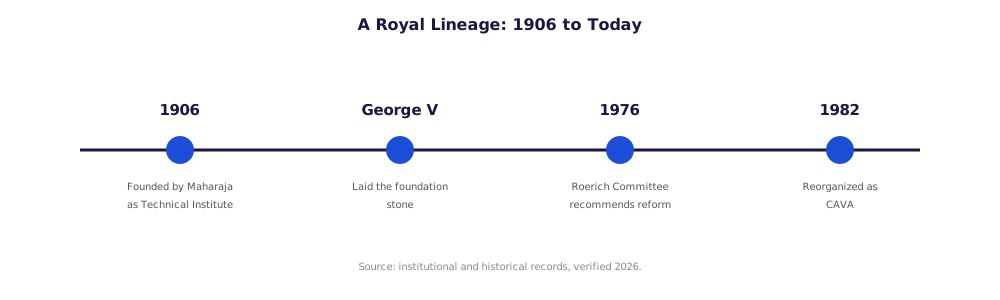
BFA at Mysuru's Chamarajendra Academy of Visual Arts (CAVA) traces its origins to 1906, founded by the Maharaja of Mysore, with its foundation stone laid by King George V of the United Kingdom. Reorganized in 1982 based on a committee headed by renowned painter Svetoslav Roerich, CAVA runs a genuinely different 5-year integrated structure from Bengaluru's standard BFA route.
| Detail | CAVA — Bachelor of Fine Arts |
|---|---|
| Original Founding | 1906, as Chamarajendra Technical Institute, by Maharaja Krishnaraja Wodeyar IV |
| Reorganized As CAVA | 1982, based on the Roerich Committee's recommendations |
| Course Structure | 5-year integrated (2-year Foundation + 3-year Specialisation) |
| Specialisations | Painting, Graphics, Sculpture, Applied Art, Photography & Photo-Journalism, Art History |
| Eligibility | SSLC (Class 10) pass — no PUC/12th required for Foundation |
| Minimum Age | 22 years for Foundation, 24 years for Specialisation |
| Admission | Written test, practical test, and interview |
🎯 Use the Free KCET Rank Predictor — Enter your rank and category to instantly see which arts and design colleges you can get in 2026. No login required. Try KCET Predictor →
Is This Genuinely Different From Bengaluru's BFA Programmes?
Our main BFA Fine Arts guide covers Bengaluru's cluster, including Karnataka Chitrakala Parishath. CAVA, academically affiliated to University of Mysore, is genuinely, structurally different — it runs a 5-year integrated programme (2-year Foundation followed by 3-year Specialisation) rather than a standard 3-4 year BFA. It's also historically distinct in a way few Indian art institutions can claim: CAVA traces its lineage to the Chamarajendra Technical Institute, founded in 1906 by the Maharaja of Mysore, Krishnaraja Wodeyar IV, with its foundation stone reportedly laid by King George V of the United Kingdom. The institute was modelled on Mumbai's well-known J.J. School of Arts.
What Does the Roerich Committee Connection Actually Mean?
This is genuinely worth knowing, since it explains why CAVA exists in its current form. In 1976, the Government of Karnataka constituted an expert committee to reorient art education in the state for the post-independence era, headed by Svetoslav Roerich — a genuinely renowned Russian-born painter who settled in India and held deep, documented ties to Karnataka specifically. Based on this committee's recommendations, CAVA was formally established in 1982 as the successor institute to the original Chamarajendra Technical Institute, explicitly intended to carry forward its tradition of craftsmanship, including a distinctive wood-inlay art tradition that had been fading by the early 20th century.
Why Does the Age Requirement and Entry Level Genuinely Differ Here?
This is a real, distinctive structural detail: CAVA's Foundation course accepts SSLC (Class 10) pass as sufficient entry — no PUC or Class 12 required — which differs from most Bengaluru BFA programmes requiring 10+2 completion. However, CAVA also imposes a genuine minimum age requirement: 22 years for the Foundation course and 24 years for direct Specialisation entry. This combination suggests a programme genuinely structured for students who've taken a somewhat different educational path, not necessarily fresh school-leavers — worth understanding clearly before assuming this is simply "easier to enter."
What Does the Actual Admission Process Involve?
Unlike many Bengaluru BFA programmes admitting primarily on academic marks, CAVA's admission runs through a written test, a practical test, and an interview — a genuinely more involved, skills-assessed process reflecting the institution's specific focus on demonstrated artistic aptitude over purely academic performance.

What Are the Six Specialisations Actually Available?
CAVA's curriculum spans six specific specialisations: Painting, Graphics, Sculpture, Applied Art, Photography and Photo-Journalism, and Art History. This is a genuinely broader specialisation spread than some Bengaluru programmes, particularly the explicit inclusion of Photography and Photo-Journalism as a dedicated specialisation track alongside more traditional fine-arts disciplines.
Who Should Consider CAVA Specifically?
- Students drawn to a genuinely historic institution with real royal and cultural heritage, not just an ordinary art college
- Those specifically interested in the wood-inlay craft tradition or the broader specialisation spread, including Photography and Photo-Journalism specifically
- Students who fit CAVA's specific age and entry requirements — genuinely worth verifying directly given the unusual SSLC-entry-plus-age-minimum combination
- Anyone comfortable with a skills-based admission process (written test, practical test, interview) rather than pure academic marit selection
Frequently Asked Questions
Is CAVA genuinely older than most Karnataka art institutions?
Yes — it traces its lineage to 1906, as the Chamarajendra Technical Institute, founded by the Maharaja of Mysore, making it one of Karnataka's oldest art education institutions by direct lineage.
Does CAVA require a Class 12 (PUC) qualification for admission?
No — the Foundation course accepts SSLC (Class 10) pass, though a minimum age requirement of 22 years applies for Foundation entry specifically.
How is CAVA's course structure different from a standard BFA?
CAVA runs a 5-year integrated structure (2-year Foundation plus 3-year Specialisation), differing from the standard 3-4 year BFA structure at many other institutions.
What specialisations does CAVA actually offer?
Painting, Graphics, Sculpture, Applied Art, Photography and Photo-Journalism, and Art History.
Need help figuring out whether CAVA or a Bengaluru BFA programme fits you better? WhatsApp +91 6363 330 233 and we'll help you think it through. We help you get the best admission to your preferred colleges without hassle.
Information on this page is compiled from publicly available institutional and historical sources, cross-checked across multiple sources. Always confirm current fees, age requirements, and admission details directly with CAVA and the University of Mysore. Published by L K Monu Borkala, founder of OneCity Technologies — publishing Karnataka education directories since 2006.